

You can lose clients, credibility, and money by selecting the wrong SEO reseller. The questions to ask an SEO reseller before entering into any contract are essential for making the right decision. An SEO reseller is another company or individual that supplies SEO solutions to clients, but under your agency name. They are utilized by agencies for growing their businesses, cutting down on costs, and providing SEO services without the need to hire big teams. It may be efficient on paper, and for many people it is.
In 2026, however, SEO isn’t solely about rankings and backlinks. Chosen poorly, a bad reseller can ruin your client’s trust and loyalty in an instant thanks to AI search, new algorithms, and tougher spam controls. In this guide, you’ll learn how to ask the right questions before you join a reseller and check if they meet modern SEO standards, ethics, and AI-driven search trends. If you want sustainable growth, transparency, and results that actually last, start here.
Why Asking the Right Questions Before Hiring an SEO Reseller Matters?
Relying unknowingly on an SEO reseller is not something that should be done. The right questions ensure that you’re not hurting your clients, your agency’s brand, or your ability to scale in the AI-driven SEO world.
1. The Cost of Hiring the Wrong Reseller
A poor SEO reseller can employ any of the following: black-hat, low-quality backlinks, and automated spam content. The result? Google penalties, drop in rankings, client frustration, refunds, and loss of the agency’s reputability over time.
2. SEO Today Is More Complex Than Ever
Today’s SEO includes AI-powered search results, entity search, modeling user intent, and frequent updates to the algorithm. Those resellers who remain in traditional methods will not be able to keep up with this change, and neither will your clients.
3. Questions Help You Filter Before It’s Too Late
It’s not too early to ask the right questions to expose weak processes, lack of transparency, and false promises. It can help you find resellers that are dedicated to sustainable growth and not quick fads that will die out within a few months.
List of 12 Key Questions to Ask an SEO Reseller

1. How Do You Optimize for AI-generated Search Results and Zero-click SERPs?
Optimizing for AI-driven and zero-click SERPs goes beyond the conventional approaches to ranking. A good SEO reseller prioritizes entity optimization, schema markup, topical relevance, and semantic relevance, ensuring that brands are mentioned in AI-generated responses.
They fine-tune their material to mirror the intent of the user and boost chances of being featured in snippets, knowledge panels, and AI summaries. Measurement also has evolved and begins to look at impressions, brand mentions, and assisted conversions rather than clicks. A good reseller will know that this is visibility within AI answers.
It also establishes authority and trust even if people don’t go to the website right now. This will provide ongoing brand visibility in the ongoing evolution of search interfaces from blue-link experiences.
2. How Do You Avoid Over-Optimization and Algorithmic Risk at Scale?
To avoid over-optimization, discipline, data monitoring, and control of execution are required. Advanced SEO resellers take care of anchor text variety, control link velocity, and schedule content releases to follow organic growth cycles. They constantly check backlinks, on-page signals, and internal links for algorithm red flags.
Once at scale, risk becomes many times greater, and the mature reseller sets thresholds for aggressive actions and adjusts strategies based on niche competitiveness. They also watch for early warning indicators like ranking fluctuations or crawl anomalies.
They’re not into the “wild and crazy” approach but rather making sure that they are not taking any chances with penalties or losing client trust by overdoing their SEO techniques.
3. What is The Easiest Way to Establish and Gauge Topical Authority Over Time?
Strategic content depth, not volume, is what is used to build topical authority. An advanced reseller builds out his content by organizing it into clusters of related topics and using semantically similar sub-clusters, connecting them with strong internal links.
They are able to model entities, questions, and search intent phases to provide thorough topic coverage. Beyond rankings, tracking keyword breadth, semantic visibility, internal link equity flow, and engagement metrics.
Over time, this will help to show the search engines if that website is an authority in its niche. A strong reseller treats topical authority as a long-term asset, gradually expanding coverage while reinforcing existing content instead of constantly chasing new keywords.
4. What Safeguards Do You Have Against Google Penalties and Manual Actions?
Any reseller who is reliable carries prevention first systems. They conduct regular backlink audits, content quality reviews, and technical health checks to ensure compliance with search engine guidelines. Rogue linkages are identified early, poisonous sources are disavowed, and harmful strategies are not used at all.
Any content undergoes editorial and intent-alignment checks before being published. They have strategies and action logs for rollback in case of volatility to rapidly pinpoint causes. Manual action readiness covers documentation, cleanup procedures, and a reconsideration process. These features prevent traffic drops and allow for continued SEO growth for digital marketers and seo experts, even during significant updates or enforcement changes.
5. What is The Balance Between Automation And Human SEO Execution?
Automation makes things efficient but doesn’t offer strategic judgment. Automation helps advanced resellers save time on repetitive tasks, track performance, conduct audits, and gather data for them, leaving time free for strategy, content quality, and decision-making.
With human oversight, AI-generated insights are properly contextualized, further matching brand tone, compliance, and intent. The critical areas (link acquisition, content creation, and technical prioritization) are still in the hands of experts.
This balance helps to avoid common automation pitfalls like duplicate content or unnatural patterns. This means scalable SEO that can be adaptive and creative and withstand scrutiny by algorithms.
6. What About Client Industries with Underlying YMYL or High-Trust Content?
The level of accuracy, credibility, and compliance is even higher for YMYL industries. A good reseller will have robust content validation checks, use authoritative authorship signals, and build trust through references, schema, and transparency.
They emphasize the E-E-A-T concept by enhancing author credibility, brand signals, and content trustworthiness. Link building is conservative – it’s targeting authoritative and niche-specific sources. Realistic performance expectations are established based on gradual improvements rather than risky approaches.
This approach of trust first and fines later shields sensitive industries’ clients from penalties while at the same time gaining search visibility in accordance with the criteria of higher ranking.
7. What Link Building Practices Do You Use?
An important part of SEO is earning backlinks. The top result in Google has around 3.8 times more backlinks than the remaining first-page results.
So, enquire about their backlink-acquiring methods. Do they follow ethical (white hat) link-building practices?
If they use black hat methods (spamming blog comments, purchasing low-quality backlinks, or cloaking), Google might penalize your client’s website.
Seek sample link-building reports from previous clients.
8. How Do You Integrate SEO Insights With CRO and User Behavior Data?
Current search engine optimization has visibility related to results. Advanced resellers combine SEO intelligence with CRO data, examining factors like dwell time, interaction depth, and conversion paths.
They spot content gaps that don’t convert traffic and improve UX, internal navigation, and aligning with intent. No assumptions are made; all SEO recommendations are based on actual user behavior. This integration gives organic traffic a purpose other than rankings; it also gives it a purpose for the business.
When SEO is integrated with the other parts of a website that contribute to conversions, agencies can prove their value and make SEO more of a revenue-generating tool than a traffic one.
9. How Do You Manage Data Privacy And Compliance in Different Regions?
Agencies that serve global clients need to pay attention to data privacy. SEO resellers who are mature will adhere to strict data-handling procedures, secure access to the data, and regional compliance standards. Reporting dashboards are access-controlled, client information is segmented, and sensitive information is encrypted.
They keep up with tracking methods and stay away from practices that could lead to misuse of data in line with privacy regulations. Clarity of data collection and use helps to instill trust in the agencies and end clients. Compliance in 2026 isn’t just a requirement; it’s a competitive edge that safeguards brands against legal, reputational, and operational risk.
10. What Happens When Our Agency Outgrows Your Means of Operation?
A scalable SEO reseller is someone who plans on growth before it occurs. They have documented processes, modular work flows, and trained backup teams to meet quality standards as they expand delivery.
As capacity grows, so do the onboarding timelines and SLA changes, as well as dedicated account structures. Strong resellers specify how resources grow with the client’s expansion rather than giving promises. This guarantees a consistent performance, predictable delivery, and continuous service.
This readiness enables agencies to build up their businesses aggressively without being hampered by the reseller but rather having them as a strong enabler of growth.
11. How Do You Handle Content Freshness, Updates, and Decay Over Time?
SEO success depends heavily on maintaining content relevance. Advanced SEO resellers actively monitor content performance to identify decay in rankings, traffic, or engagement. Instead of continuously publishing new pages, they refresh existing content by updating data, expanding coverage, aligning with evolving user intent, and improving internal linking.
They also optimize for new SERP features and AI summaries as they emerge. Content updates are scheduled strategically, not reactively, ensuring sustained topical authority. This approach improves efficiency, preserves link equity, and keeps content competitive without unnecessary bloat, making SEO efforts more sustainable and cost-effective for agencies.
12. How Do You Align SEO Strategy With a Client’s Overall Brand Positioning?
Strong SEO resellers ensure search visibility reinforces brand identity, not just traffic growth. They align keyword targeting, content tone, and entity signals with the client’s messaging, expertise, and market positioning.
This includes avoiding misleading keywords, maintaining a consistent brand voice, and strengthening branded search presence. By coordinating SEO with brand authority and trust signals, resellers help clients attract the right audience, not just more visitors.
This alignment is critical, as search engines increasingly reward recognizable, credible brands over generic, volume-driven content strategies.
Red Flags to Watch Out For When Choosing an SEO Reseller
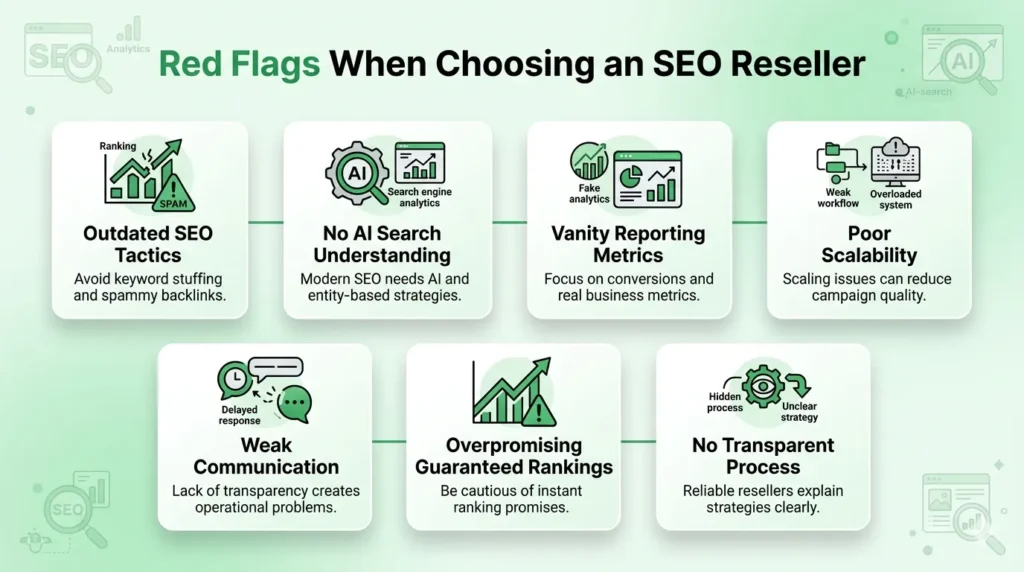
Do not overlook red flags when you’re considering a price or promises. The red flags typically show up early… if you know what to look for and what questions to ask.
1. Outdated SEO Tactics Still Being Used
Avoid the old school of “keyword stuffing, mass directory links, spun content, and exact-match anchor abuse” SEO resellers. In 2026, relevance, intent, and authority are what search engines will reward. The strategies that will be outdated will get you moving in the rankings for a while, but then the rankings will go down, penalties will be given, or you will lose your organic visibility.
2. No Clear Understanding of AI Search Behavior
To navigate today’s SEO landscape, a modern reseller needs to grasp the concepts of generative results, zero-click searches, and AI-driven SERPs. Rankings and no mention of entities, topical authority, or search intent modeling means that they are not ready for how users will find conten.
3. Poor or Vanity-Focused Reporting Metrics
Some resellers are only showing you rankings or a general amount of traffic and are masking poor performance. Successful SEO reporting should also cover conversions, engagement quality, topical coverage, visibility in all modern SERP features, and more, to show that the agency is providing true business value rather than surface-level metrics.
4. Limited Scalability for Growing Agencies
A good SEO reseller can excel in a handful of cases, but not on a large scale. As your agency expands and client needs grow, inconsistent results, delays, and quality issues can arise due to lack of automation balance, process documentation, or dedicated account management.
5. Weak Communication and Slow Response Times
SEO is not a one-off project; it’s a dynamic process that requires constant collaboration. Slow-responding resellers, non-accountability, and non-explanation of changes in algorithm updates are risk factors. Good partners proactively and clearly communicate issues early and support agencies with clarity, speed, and strategic insight.
What Defines a Good SEO Reseller in 2026?
A good SEO reseller is more of a partner rather than just a fulfillment vendor. Quality resellers fuse data, AI comprehension, and ethical action.
1. AI-Ready, Future-Proof SEO Strategies
Smart resellers know how users act when searching with AI, zero-click results, topical authority, and user intent. They optimize strategies instead of following old ranking strategies or link building that is based on volume.
2. Full Transparency and White-Label Reporting
Great SEO resellers provide transparent reporting, customizable dashboards, and straightforward performance analysis. You must be able to clearly communicate with clients, avoiding the use of jargon and hyperbole.
3. Focus on Long-Term Client Retention
A steady reseller places importance on sustainable growth—clean backlinks, quality content, technical optimization, and conversion optimization. They share the same objective: to make their client happy, to rank their website safely, and to boost their revenues over time.
Conclusion
The selection of an SEO reseller is a strategic decision and not a quick way to save money. The wrong partner can destroy your clients, rankings, and agency reputation faster than ever before. By asking the right questions, you can steer clear of black-hat techniques, old marketing strategies, and false promises.
Questions to ask an seo reseller. An SEO reseller worth their salt should be familiar with AI-powered search, play by the rules of SEO, be transparent, and be a part of your team, not a hidden risk. Apply this checklist to thoroughly evaluate, plan for the future, and safely scale partnerships. Today, in the world of SEO, caution is not standing pat; it is prudent growth.