

Getting traffic from search engines like Google is no longer just about adding a few keywords to your website. Today, search engines focus on user experience, content quality, authority, and relevance before deciding which pages deserve top rankings. With the rise of Google AI Mode and AI Overviews, the SEO landscape has changed even more. Many websites have seen fluctuations in clicks and rankings because users are now getting direct AI-generated answers on the search results page itself. This has increased the importance of creating trustworthy, well-structured, and experience-based content that stands out beyond basic information.
The good news is that improving rankings still does not always require complicated strategies or a massive budget. Small but smart SEO improvements can significantly improve visibility, organic traffic, and conversions. Whether you run a blog, business website, or online store, understanding modern SEO practices is now more important than ever. In this blog, we’ll cover practical SEO tips for higher rankings and explain how to adapt your content strategy in the era of AI-driven search results.
What Is Blog SEO?
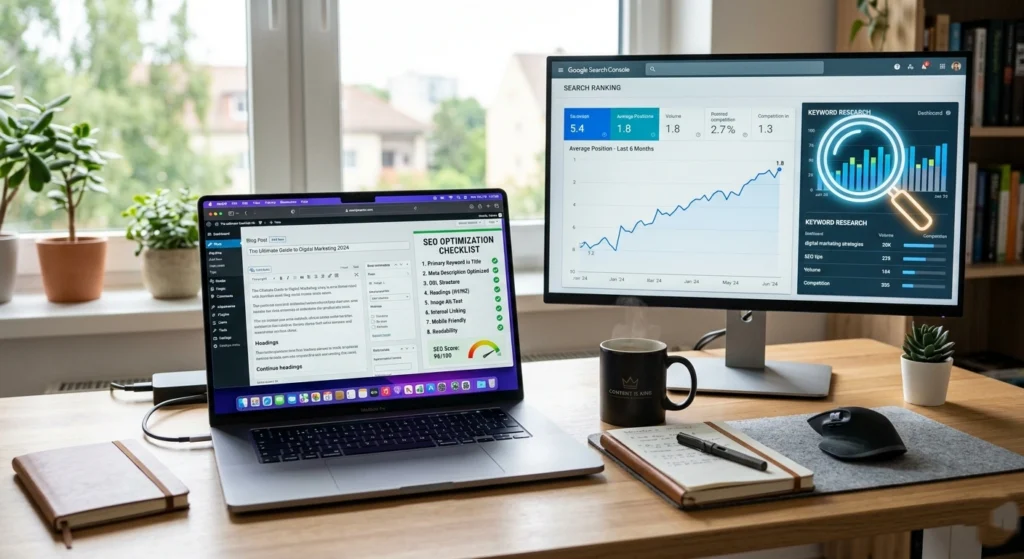
Blog SEO is the process of optimizing blog content so it can rank higher on search engines like Google and attract more organic traffic. It involves improving different elements of a blog, such as keywords, content quality, headings, internal links, images, page speed, and user experience, to make the content more relevant and valuable for both users and search engines.
The goal of blog SEO is not just to rank on the first page but also to help the right audience find useful information easily. A well-optimized blog can increase website visibility, generate leads, build authority, and drive long-term traffic without relying heavily on paid ads.
Why Blog SEO Matters More Than Ever In 2026?
By 2026, blog SEO will decide if your content is discovered, summarized by AI, or completely ignored in search results.
- AI Search Has Changed the Game: AI-driven summaries, interactive responses, and contextual follow-ups are the main features of search results. People tend to read a lot of information on the results page without clicking through multiple links. Blogs must now be optimized for visibility across AI summaries, snippets, and interactive search elements to survive.
- Organic Traffic Builds Lasting Trust: If you have an organic ranking blog, it indicates trustworthiness and authority. For learning and decision-making, informative content is more trusted than paid promotions by users. In the long run, organic visibility allows brands to develop trust, loyalty, and re-readership.
- Higher ROI Than Paid Advertising: SEO is an investment that can last for a long time. While ads are only active while the money is being spent, a blog post that has been optimized over time can keep bringing in traffic for months or even years afterward—for minimal cost.
- Visibility Beyond the Top 10 Links: Ranking #1 is no longer the end goal for success. To be noticed in today’s search landscape, blogs need to surface in AI Overviews, feature snippets, and “People Also Ask” boxes.
How Will Google Rank Blogs
Google’s ranking algorithm values helpfulness, experience, and alignment with intent over timeworn SEO tactics.
- Helpful, High-Quality Content Comes First: The biggest ranking factor these days is usefulness. Blog posts need to meet user intent and provide accurate, original, and actionable information. Thin or generic content is less likely to stand out in AI-driven search.
- User Experience Signals Matter: Page speed under 3 seconds, bounce rate, time on page, and mobile usability play a significant role in rankings. The more users enjoy reading your blog, the more it becomes a positive quality signal for search engines.
- Backlink Quality Over Quantity: Contextual and authoritative links are still important. But the quality of links outweighs the quantity, as spammy or irrelevant links can hurt the trust signals.
- Search intent match is critical: Blogs, which match precisely with informational, navigational, and transactional intent, perform better than vague blog content. When users and AI systems understand each other’s intent, this contributes to a clear understanding of your page’s purpose.
Top 15 Blog SEO Tips for Higher Rankings In Google
1. Do Proper Keyword Research (Target Search Intent)
keyword research isn’t just about volume, and it’s about intent. Utilize keyword research tools such as Ahrefs, SEMrush, and Google Keyword Planner to find long-tail keywords that align with actual user needs. Identify intent as informational, commercial, transactional, or navigational. Search for your target keyword and review your pages on the rankings before writing. Pay attention to their structure, guides, listicles, or definitions, and design your content in a way that Google prefers.
2. Create an SEO-Optimized Title (Power Words)
Your title has the power to either click through or scroll through. A title that is optimized for search engines should be based on your main keyword, mention a benefit, and use power words that provoke curiosity or urgency. When appropriate, include numbers, brackets, or emotive words. Avoid titles over 60 characters, as this will result in titles being cut off in search results. Titles in need to resonate with both people and AI algorithms, impacting search rankings, CTRs, AI Overviews, and featured search positions.
3. Optimize Your Meta Description for Clicks
Meta descriptions are used to determine if your blog will be worth a click. Create benefit-driven, compelling descriptions that succinctly capture content in 155–160 characters. Use the main keyword where appropriate, but don’t try to force it in, and address the reader’s problem. Meta descriptions don’t directly influence page ranking, but they do have an impact on click-through rates. AI-powered search results can generate high-quality descriptions, enhancing the relevance scores and driving engagement, thereby indirectly boosting SEO results.
4. Use Header Tags (H1, H2, H3). Strategically
Header tags structure your content and make it easier to understand and read. Include one clear H1 for the main topic and then H2s and H3s for logical sections. A properly structured heading can enhance scannability, accessibility, and the understanding of the content by AI. Search engines use headers to see the hierarchy of topics. Well-structured content is more likely to get featured in AI Overviews, “People Also Ask,” and featured snippets.
5. Create Quality Backlinks (Off-Page SEO)
Quality content is the recipe for successful blog SEO. Google prefers educational, unique, and detailed content that fully answers the questions and problems of the reader. Your quality content should be researched and well-written, providing practical advice, examples, and pertinent information to support your argument.
Including the right sort of images, like infographics, charts, or photographs, will increase user engagement and readability of your content. Trim filler or superfluous content, each paragraph should offer something. Ongoing monitoring, editing, and reusing of prior blog posts make your content fresh and pertinent in the long term.
Additionally, shoot for optimal length; although longer content items (1,500+) will have a higher chance of being top searches, it will have to be quality across the board to optimize SEO best. Extensively researched, high-quality content not only meets search intent but also makes acquiring backlinks more likely, which creates credibility and visibility for your blog on search engine results pages.
6. Create Long-Form Quality Content (2000+ words)
Long-form content works because it covers topics well. When it comes to competitive niches, blogs with over 2,000 words can be more successful provided they are written with quality and alignment of intent. Be deep, original, and useful, not filler. Divide content into parts, address questions that follow, and include examples or steps to take. To write high-quality long-form articles faster, you can also use content writing tools. Long-form content is valuable for boosting dwell time, establishing authority, and enhancing AI-generated summaries and rich search elements.
7. Use Schema Markup to Enhance Search Visibility
Schema markup assists search engines in comprehending your content and showing it with rich results. Structured data for FAQs, articles, breadcrumbs, and authors boosts the likelihood of getting rich snippets and AI summaries. Schema is increasingly influencing Google’s understanding and presentation of content in AI overviews and enhanced search. With the correct schema, you will boost click-through rates, visibility, and content clarity without altering the appearance of your page to your user.
8. Create a Table of Contents (Gets Featured Snippets)
Having a table of contents creates a better navigation and user experience, particularly for lengthy blogs. It enables readers to quickly navigate to the parts they want and helps them spend more time on the page. It also helps search engines to identify the structure of content, and using blog outline generator tools can make creating a proper structure much easier.blogs that are well-structured and easily navigable will be more likely to get featured snippets and AI summaries. A clickable table of contents is an easy, yet effective, on-page optimization feature.
9. Create a robust internal linking structure
Internal linking assists search engines in crawling your site and comprehending content connections. Use meaningful anchor text for linking related blog posts together. This can help spread link equity, boost topical relevance, and encourage longer visit durations. A powerful internal linking architecture makes it simpler to be indexed, keeps visitors on your website longer, and helps them navigate the path of your content. well-structured internal linking not only boosts SEO but also enhances AI-powered content discovery. For better off-page SEO results, you should also follow proven link building strategies to increase authority and rankings.
10. Ensure Mobile-First Design
Google takes a “mobile-first” approach to assess sites, so mobile optimization is crucial. Your blog should be fast to load, look good, and be easy to navigate on smartphones. Adopt responsive design, readable fonts, and touch-friendly buttons. When mobile users don’t have a pleasant experience, they will bounce, and rankings suffer. Mobile usability plays a crucial role in the visibility, engagement, and overall success of a search campaign in the context of an AI-driven search environment.
11. Improve Page Speed (Core Web Vitals)
Page speed is one of the most important ranking factors for user experience. Optimize load times (less than 3 seconds) by optimizing images, enabling cache, and reducing scripts. Core Web Vitals are metrics for loading performance, interactivity, and visual stability, and you can measure them using SEO tools like Google PageSpeed Insights and GTmetrix. Slower pages will cause users to become frustrated, and crawlers will not crawl as efficiently. With the year approaching, it seems that fast-loading blogs have a greater chance at ranking higher, keeping visitors engaged, and even making it to AI-driven search results.
12. Improve for E-E-A-T (Experience, Expertise, Authority, Trust)
EEAT has become a key factor in SEO for particularly for informational content. Use authentic experiences to illustrate, use accurate explanations to demonstrate, use credible references to build authority, and be transparent to build trust. Author bios, references, up-to-date information, and secure website practices. Google’s E-E-A-T signals help it evaluate content quality and boost its rankings in competitive and AI-driven search results.
13. Target Google AI Overviews & Featured Snippets
Content submitted for AI Overviews needs to be clear, organized, and succinct. Use short paragraphs, bullet points, and definitions to answer questions directly. Don’t add the fluff and just be accurate. AI systems will be attracted by content that is easily summarized and from which information is easily extracted. AI Overviews boost visibility above the fold and establish your blog as a valuable source of information.
14. Build Topical Authority with Content Clusters
Topical authority is created by the in-depth discussion of a topic. Develop a pillar page explaining a general topic and back it up with supporting subtopics that link to it. A cluster approach allows search engines to understand you and your relevance. The depth of topical content is superior to random content publishing in. Content clusters boost rankings, build strong internal links, and build long-term SEO authority.
15. Promote Content Across Multiple Channels
SEO is not complete after you publish. Share your blog on social media, email newsletters, professional networking sites, and content-sharing websites. The more early traffic, engagement, and links you get, the more promoted you are. The more visible the content, the quicker search engines can identify its value. Multi-channel promotion is a must for boosting your rankings, complementing AI discovery, and extending the lifespan of your content.
Blog SEO Mistakes to Avoid
Most blogs that fail don’t fail because they aren’t producing enough blog posts; they fail because of preventable SEO blunders.
1. Writing for Keywords, Not Readers
If the content is stuffed with keywords and has nothing of value, it does not meet the needs of users. Readers lose focus easily, and bounce rates rise; AI-powered search systems devalue pages that do not deliver clear, helpful, and human-centric answers.
2. Ignoring Content Structure
When content is not organized, headings are weak, and paragraphs are long, it makes browsing and indexing difficult. If a blog lacks scannable formatting, it is less likely to be eligible for AI summaries, featured snippets, and better ranking in modern search results.
3. Skipping Content Updates
Content that’s published once and never changed or updated is less credible. Outdated statistics, broken references, and old advice indicate less relevance, while constantly updated content creates trust, accuracy, and relevance to changing search intent.
4. Neglecting Technical SEO Basics
If a page takes too long to load, it results in a poor user experience, as do broken links, and not optimizing the site to work on mobile devices. These technical issues have a negative impact on rankings, negatively affect crawlability, and decrease the chance of being served by AI-driven search features.
How to Track Your Blog SEO Performance?

SEO monitoring helps you maintain an efficient blogging strategy, improve the visibility, and ensure it’s relevant to the search trends of today.
- Monitor Organic Traffic Trends: Monitor growth, decay, and trends in organic traffic to gauge the impact of SEO tactics on visibility, discoverability, and content performance in changing search experiences and Google’s new search algorithm.
- Analyze Engagement Metrics: Analyze time-on-page, scroll depth, and bounce rate to gauge if the reader is getting value from your content; is it engaging and easy to consume? This has a significant impact on current search rankings.
- Track Keyword & Feature Visibility: Track keyword rankings as well as the presence in featured snippets, People Also Ask, and AI Overviews to gauge the impact of search presence beyond rankings.
- Audit Content Regularly: Perform periodic SEO audits to identify low-performing pages, technical issues, outdated content, and content opportunities that can enhance relevance and ranking.
Conclusion
Blog SEO in 2026 isn’t about algorithms or quick hacks; it’s about developing useful, organized content that truly meets user needs. With AI-driven search, Google now rewards clarity, experience, and intent alignment more than ever before.
Fast loading, engaging, and informative blogs with accurate and up-to-date information gain visibility in AI overviews, rich snippets, and organic results.
By avoiding common SEO mistakes, tracking performance consistently, and focusing on long-term value, bloggers can build sustainable traffic and authority. If SEO is executed correctly, it is an excellent way to grow without relying on costly ad buys.