
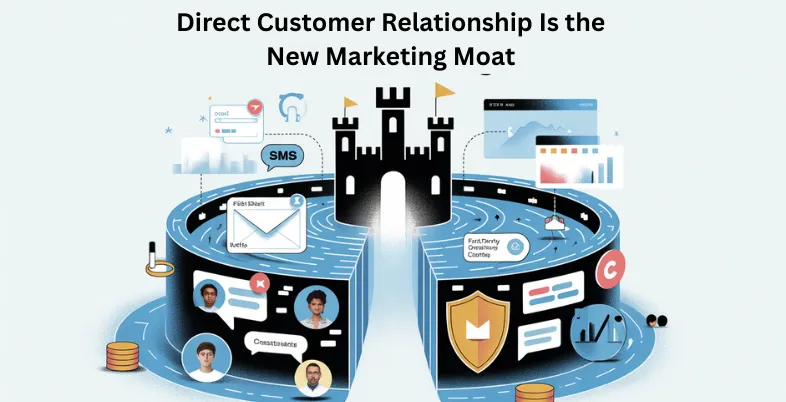
Why Messaging Infrastructure, Not Traffic, Defines Growth in 2026
For years, digital marketing has been optimized around one primary objective: traffic acquisition.
More impressions.
Better targeting.
Lower CAC.
But as ad costs rise and algorithmic reach becomes less predictable, a subtle shift is happening. Meta’s CPM costs rose 19.2% year-over-year in Q1 2025, with March hitting $11.86—the highest on record. Meanwhile, Facebook’s organic reach has collapsed to just 1.37% in 2024, with engagement rates at a median of 0.2%.
The real differentiator is no longer who can generate attention—it’s who can manage the conversation that follows.
In high-trust industries, especially beauty, healthcare, coaching, and local services, customers rarely purchase without asking questions. These questions are not friction; they are part of the decision process. The problem is that most businesses treat messaging as a support function rather than a structured sales environment.
That distinction matters.
Messaging Is Where Intent Becomes Revenue
When someone sends a WhatsApp message or Instagram DM, they have moved beyond passive interest. They are no longer browsing; they are evaluating.
This is the most economically valuable moment in the funnel.
Yet many teams handle it inconsistently:
- Replies are delayed
- Objections are answered but not guided
- Conversations end without a defined next step
- Follow-ups depend on memory rather than system
As inquiry volume grows, these inconsistencies compound. Marketing might be working, but revenue becomes unstable because conversation quality varies.
The bottleneck is not demand.
It is conversational bandwidth.
Case Study: How Structure Changed Conversion
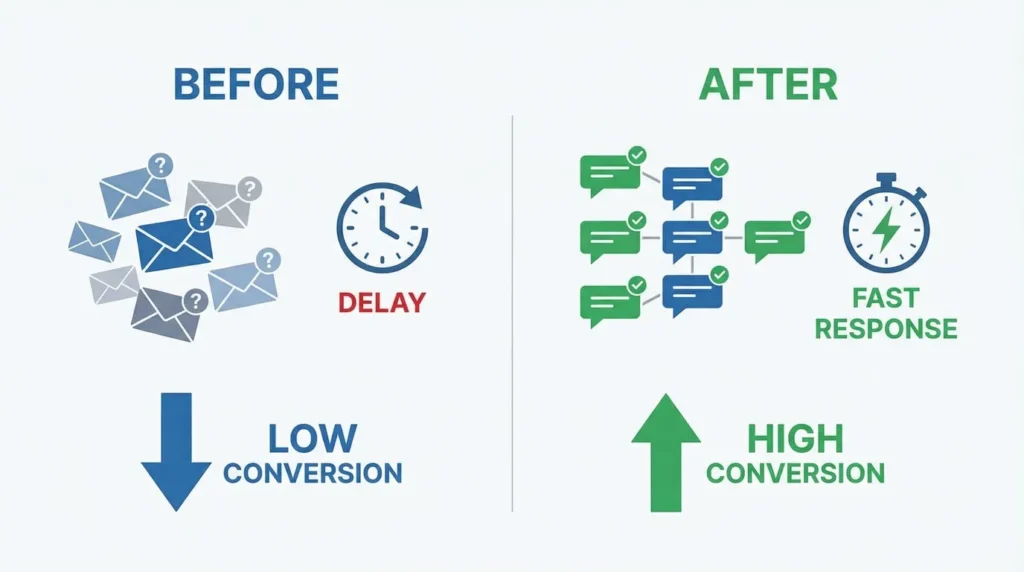
Consider a mid-sized aesthetic clinic in Singapore handling 150+ monthly inquiries across WhatsApp and Instagram. Before implementing conversational structure:
- Average response time: 4.2 hours
- Inquiry-to-booking rate: 18%
- Follow-up completion: 31%
After introducing a structured conversation framework with defined stages (intent clarification → constraint identification → objection handling → booking prompt):
- Average response time: 12 minutes
- Inquiry-to-booking rate: 41%
- Follow-up completion: 78%
The change wasn’t hiring more staff. It was designing conversations intentionally.
This pattern aligns with broader industry data: 79% of businesses report increased customer loyalty, sales, and revenues through conversational systems, while messaging-based interactions show 30% better ROI than traditional retargeting ads.
From Reactive Replies to Conversational Structure
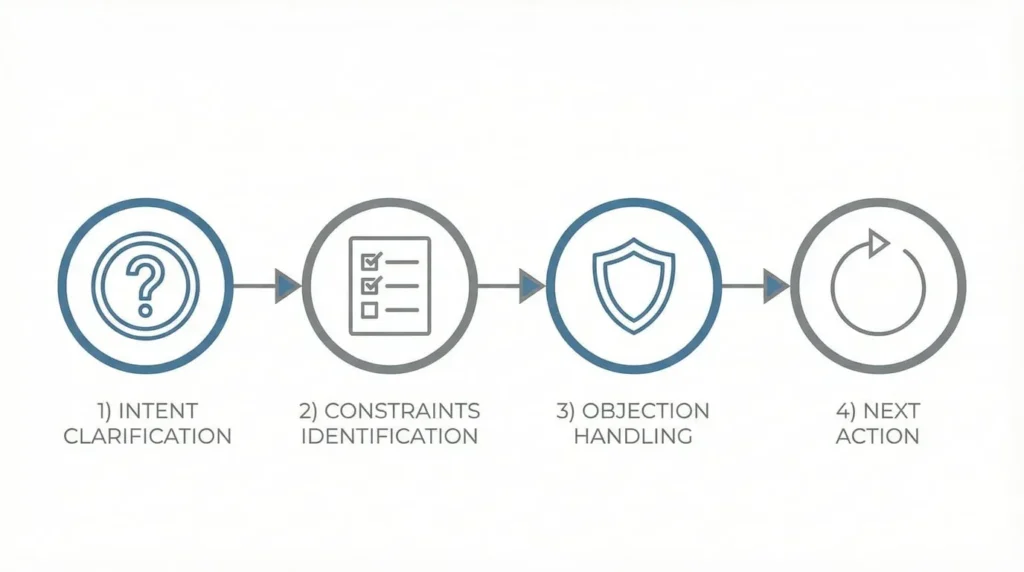
High-performing messaging teams do not simply “respond quickly.” They design conversations intentionally.
A structured conversation typically includes:
Clarifying intent — What problem is the customer trying to solve?
Identifying constraints — Budget, timeline, suitability
Addressing hesitation — Price, risk, uncertainty
Defining a concrete next action — Booking, payment, scheduled follow-up
Without these elements, conversations remain informational. With them, conversations become directional.
This is what transforms messaging from customer service into revenue infrastructure.
The Scaling Challenge
Manual chat management works—until it doesn’t.
Once daily inquiries reach a certain threshold, teams encounter predictable issues:
- Response time increases
- Tone becomes inconsistent
- High-value leads are mixed with low-intent inquiries
- Follow-ups are irregular
Ironically, growth introduces instability.
This is why many businesses experience a paradox: traffic increases, but conversion rates fluctuate. The missing piece is not marketing optimization; it is conversation systemization.
The Rise of Conversational Infrastructure
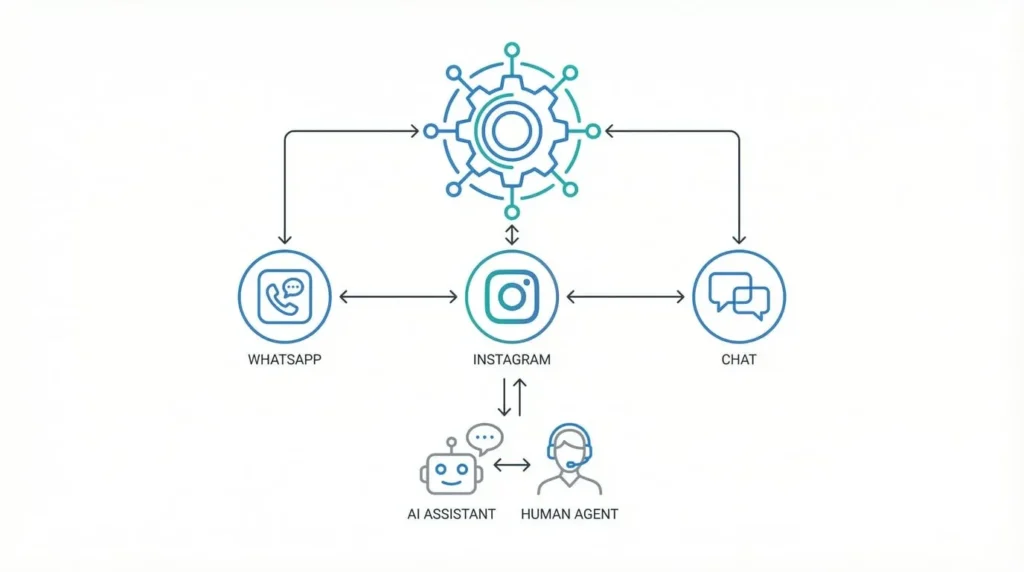
To stabilize messaging as a conversion layer, businesses increasingly rely on structured systems:
- Defined conversation stages
- Objection-handling frameworks
- Automated follow-up logic
- Escalation rules for complex cases
In this context, conversational AI tools are not replacements for human interaction but extensions of it. Their value lies in continuity—ensuring that every inquiry enters a structured decision pathway rather than depending entirely on individual availability.
The market validates this shift: the global conversational commerce market reached $8.8 billion in 2025 and is projected to grow at 14.8% CAGR to $32.6 billion by 2035. Global spend via conversational commerce is projected at $290 billion in 2025, up from $41 billion in 2021.
Several platforms are emerging in this space. Tools like Intercom and Drift pioneered chatbot-based qualification, while newer solutions such as Dealism focus specifically on maintaining sales-oriented dialogue across WhatsApp, Instagram, and live chat, with intelligent human handoff when nuance is required.
The underlying philosophy is simple: conversation should be predictable, even when demand fluctuates.
Why This Matters Now
As digital channels fragment, owning traffic becomes increasingly expensive and unstable. Messaging channels, however, represent direct customer relationship environments. They are opt-in, intent-driven, and less dependent on algorithmic visibility.
WhatsApp alone reached 2.93 billion users in Q2 2025, with over 150 billion messages exchanged daily. More importantly, 67% of consumers value messaging a brand through mobile apps, and 60-78% prefer text over email or phone for customer support.
In 2026, the competitive advantage is not merely generating interest. It is managing the moment of evaluation with structure and consistency.
Important caveat: This framework applies primarily to high-consideration purchases where consultation is part of the buying process. For low-ticket impulse purchases (fast fashion, consumables under $20, viral products), traditional traffic optimization and frictionless checkout remain the priority. The conversational layer adds value when customers need guidance, not when they need speed.
Businesses that treat messaging as infrastructure—rather than as a reactive inbox—are building a durable conversion advantage.
Because marketing does not end at the click.
It evolves into a conversation.
And conversation, when structured correctly, becomes the moat.
FAQs
1. Is Messaging Really More Important Than Traffic?
Traffic creates opportunity. Conversation converts it. In high-consideration purchases, the ability to manage decision dialogue often influences revenue more than incremental increases in impressions. However, for impulse-buy products with clear value propositions, optimizing for frictionless checkout may still outperform conversational engagement.
2. When Should A Business Consider Conversational AI?
Typically when inquiry volume exceeds the team’s ability to respond consistently and follow up systematically. A practical threshold: if you’re receiving 50+ inquiries per week and response time exceeds 2 hours, or follow-up completion falls below 60%, structured automation becomes valuable. AI becomes useful not to automate everything, but to stabilize early-stage qualification and ensure continuity.
3. Does Automation Reduce Personalization?
Poor automation does. Structured conversational systems, however, can maintain consistent tone and escalate nuanced cases to humans, preserving personalization while improving reliability. According to research, 72% of people who have interacted with chatbots describe them as useful and informative. The key is designing for handoff, not replacement.
4. Which Industries Benefit Most From Structured Messaging?
Industries involving consultation, risk evaluation, appointment booking, or personalized recommendations—including healthcare, beauty, education, financial services, and local services—tend to benefit the most. B2B sales with longer decision cycles also see significant improvement. The conversational commerce market is particularly strong in the retail and banking sectors.
5. What Metric Best Reflects Messaging Performance?
Beyond open rates, businesses should monitor:
- Inquiry-to-decision conversion rate (most critical)
- Response time (first reply and subsequent replies)
- Follow-up completion rate (percentage of promised follow-ups actually sent)
- Conversation-to-booking/purchase rate
- Revenue per chat session
These indicators often correlate more directly with revenue stability than traffic volume alone. WhatsApp Business messages achieve a 98% open rate, significantly higher than email.