
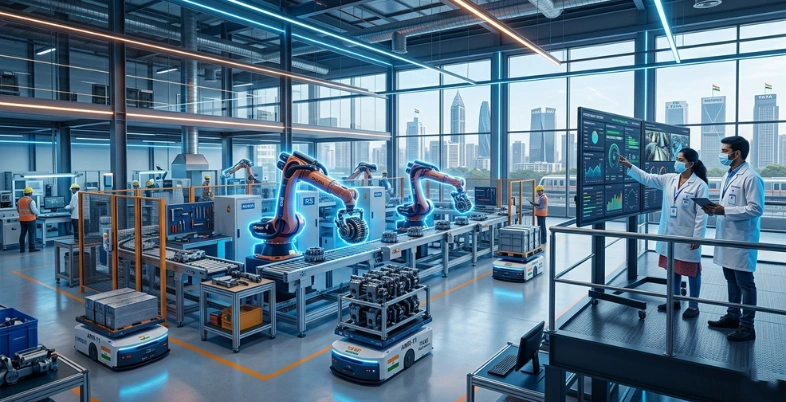
India is rapidly moving towards a robotics revolution, driven by rising automation demand and the growth of Industry 4.0. Businesses across sectors are increasingly adopting advanced technologies, making robotics companies in India more important than ever. However, the biggest challenge is— which company should you choose? With so many Robot Manufacturers in India available, finding the right one can be confusing. In this guide, we will cover top robot manufacturers, market insights, comparisons, and buying tips to help you make the best decision for your needs
The Current State of Robotics in India
In 2026, robotics in India is evolving from a niche, academic pursuit to an integrated, industry‑oriented ecosystem, due to the reduced cost of parts, government support and an explosion of startups. The use of industrial robots in manufacturing is growing, with a robotics‑in‑manufacturing market expected to grow at about 13% per year, foreshadowing further automation in automotive, electronics, textiles and other industries.
- Academic and grassroots growth: Education in robotics has become more democratised, with basic robotics now part of STEM programs in many cities and inexpensive kits that allow students and tinkerers to build their own robots for a few hundred rupees. This has led to an ecosystem of youthful makers, online resources and local vendors, making it much easier to get into robotics than in the early 2010s.
- Industry and government initiatives: The government has identified “self‑reliant” robotics as a priority with technology missionson roadmaps, indigenisation goals and mission‑linked funding for startups and MSMEs for collaborative robots, physical-AI systems for healthcare and unmanned platforms for defence and security. Meanwhile, Indian IT and engineering companies are demonstrating AI-driven autonomous robots in warehouses and logistics, emphasising the integration of India’s software capabilities with tangible robotics.
- Challenges and outlook: While growth is rapid, India remains behind the curve in terms of robot density per worker, with many applications still confined to large manufacturing and high-value services, rather than small businesses. Looking ahead, emphasis will be on “augmentation rather than replacement” of human jobs, safer robots, and export‑ready “Make in India, Make for the World” robots, which will in turn attract more investment and innovation in 2030.
Why Is India Becoming a Global Robotics Hub?
India is poised to become a robotics powerhouse thanks to targeted government programs, a thriving manufacturing industry and a large engineering talent pool.
- Government Initiatives: The “Make in India“ program and Production-Linked Incentive (PLI) programs have promoted local manufacturing of robotics components, such as arms, sensors, controllers, among others. The National Robotics Mission by India AI focuses on sectors like manufacturing, agriculture, health care and defense to promote innovation with a Robotics Innovation Unit. This will establish India as a robotics R&D and manufacturing leader.
- Growing Installations and Market: In 2024, India’s industrial robot installations hit a new height at 9,120, a 7% annual growth, ranking sixth globally, with 4,070 robots in use in the automotive industry. In 2023, 8,510 robots were installed, taking the total number of robots in operation to over 44,000. Investment in robotics startups spiked to $117M in 2024 with over 40 deals, exceeding earlier years.
- Talent and Innovation Ecosystem: Global Capability Centers (GCCs) of firms like bosch, Siemens and Intel are driving R&D activities, generating robotics talent and aiding startups like GreyOrange. NVIDIA backed companies, such as over 25 in its Inception program, use platforms such as Isaac to automate warehouses and medical facilities India’s low cost - 10x lower prototyping costs and 2x faster roll-outs – adds to the attraction.
- Infrastructure and Global Ties: Refurbished electronics and precise engineering services support export-oriented robotics. EU partnerships via facilities such as IRAS-HUB offer robotics and autonomous systems training for Industry 4.0. This positions India at the forefront as the cost of hardware reduces and EVs investments increase.
Types of Robots Manufactured In India
India manufactures various types of robots for industrial, agricultural and service sector applications, with a growing trend in domestic production by companies such as Delta Stark, Svaya Robotics, etc. These robots enhance automation in sectors like automobile manufacturing, warehousing and defense.
1. Industrial Robots
Industrial robots are used for welding, assembly and material handling in manufacturing. Precision Delta Stark, ABB India, KUKA Robotics, and Yaskawa India articulated and SCARA robots are used in the automobile and manufactureing industries.
2. Collaborative Robots (Cobots)
Collaborative robots work safely with humans and are ideal for small and medium-scale enterprises and production.
3. Autonomous Mobile Robots (AMRs)
AMRs autonomously map and navigate workplaces using LiDAR and AI for material handling and inventory management. Market is exploding, projected to grow from USD 153M in 2025 to USD 542M in 2034, as suppliers such as Chennai’s providing to e-commerce and automotive industries.
4. Humanoid & Service Robots
Humanoids look like people for service robots such as security and help. The first was deployed on Inadian Railways at Visakhapatnam station for crowd management and announcements; Machani Robots are under development for domestic use.
5. Agricultural Robots
These are used in farming for seeding, weeding and harvesting using AI vision. While imported, domestic companies adapt drones and rovers for precision farming in rice and cotton farms due to labour shortages.
6. Defense & Surveillance Robots
These are border security, explosive handling, surveillance UGVs and drones. Defense Research & Development Organisation (DRDO) and startups offer rugged variants with thermal sensors for defense, improving security in harsh environments.
such as automotive and electronics, as well as investments by multinational corporations.
How to Choose the Right Robot Manufacturer in India?
When choosing a robot manufacturer in India, consider factors like experience, technology, and industry-specific support. Here are some points with explanations.
- Experience and Track Record: Look for manufacturers with a proven track record in the industry, and projects in your specific industry (automotive, warehouse, etc.). Interesting case studies, customer reviews , and success stories will give you a better idea of the reliability and practicability.
- Technology and Innovation: Look for companies with advanced technology, such as artificial intelligence and machine learning, natural language navigation controls and safety features, wihout needing infrastructural upgrades. Choose companies engaged in R&D, and offering future-proof features such as less than centimeter accuracy or modularity.
- Customization Capabilities: Select vendors providing custom solutions to match your business, weight (200kg–2,000kg) and integration with enterprise systems (ERP solutions, WMS). Do not choose “one size fits all” robots!
- Industry Relevance:Choose vendors who work in your industry (FMCG, pharmaceuticals, electronics, etc.) with expertise in regulatory, safety and hygiene requirements. This will provide a better return-on-investment and easy roll out.
- Integration and After-Sales Support:Check that an integrator plans to integrate robots and offer after-sales service, training and scalability. Effective communication, and certifications (e.g. ISO) are helpful.
- Scalability and ROI: Assess modular scalability to grow, measurement (throughput enhancement or labor savings) and total cost of ownership Show and tell, ask for ROI and quotes to fit your budget and scalability
List Of Top 15 Robot Manufacturers in India
1. Addverb Technologies

- Founded: 2016
- Headquarters: Noida, Uttar Pradesh, India (Bot-Valley, Bot-Verse in Greater Noida)
- Co-Founders: Sangeet Kumar, Bir Singh, Prateek Jain, Satish Shukla (ex-Asian Paints);
- website: https://addverb.com/
Addverb Technologies is a provider of industrial and warehouse robots, specialising in logistics automation products such as autonomous mobile robots (AMRs), automated storage/retrieval systems (AS/RS), sortation systems, and pallet shuttles. It was established by former Asian Paints leaders, initially focusing on pallet shuttles, and now operates globally with facilities such as Bot-Valley for research and manufacturing.
With investors like Reliance Retail and initial investor Jalaj Dani (Asian Paints co-promoter), it has more than 800 employees and global customers. It focuses on local production of components (70-80%) and AI-trained robots for intricate tasks. It operates the world’s largest mobile robot factory, Bot-Verse, in Greater Noida.
Key Products
- Autonomous Mobile Robots (AMRs/AGVs)
- Automated Storage & Retrieval Systems (AS/RS)
- Sortation & Pallet Shuttle Systems
- Four-legged Robots (e.g., Trakr, Digital Mule)
- Humanoid Robots (e.g, Elixis) & Cobots
- Warehouse Management Software
Clients
- Reliance, Flipkart, Amazon, Hindustan Unilever, Coca-Cola, PepsiCo, Future Supply Chain and Marico are key clients.
2. GreyOrange

- Founded: 2011
- Headquarters: Gurugram (Gurugram), India.
- Co-founders: CEO Akash Gupta and Samay Kohli.
- Website: https://www.greyorange.com/
GreyOrange is an AI-focused Indian robotics firm and one of the leading robot manufacturers in India, specializing in warehouse automation with inventory management solutions and supply chain automation. Founded by engineering students Akash Gupta and Samay Kohli—who built India’s first humanoid robot “AcYut” while in college—the company started with a small ₹5 lakh seed funding in 2011.
Today, it deploys over 15,000 robotic agents globally, serving major e-commerce and retail players amid rising demand for efficient post-pandemic supply chain management solutions. Based in Gurugram, India, with offices across Asia and the U.S., GreyOrange has grown rapidly, reaching nearly $100 million in revenue and continuing to innovate with advanced technologies like multi-pallet autonomous forklifts.
Key Products
- Goods-to-person picking Autonomous Mobile Robots (AMRs).
- GreyMatter AI orchestration for inventory management.
- Certified Ranger Network (CRN) system, including multi-pallet forklifts (up to 3,000 kg).
Clients
- H&M, Adidas, IKEA, Apple, Walmart, Flipkart, Myntra, PepperFry are among the large customers, as are logistics companies, such as Delhivery, Aramex and Ninja Van.
3. Systemantics

- Founded: 1995
- HQ: Bengaluru (Bangalore), Karnataka, India
- Website: https://www.systemantics.com/
Systemantics India Private Limited is an Indian pioneer in industrial collaborative robots (cobots) with its corporate office in Bengaluru, Karnataka. Established in 1995, it emphasises locally-designed and manufactured solutions to promote flexible automation in sectors such as automotive, e-commerce, pharmaceuticals, electronics, and food & beverage.
It prioritises “sensible robotics” for cost-effectiveness, ease of use, mobility and quicker return-on-investment (ROI) with innovative, India-specific products. It has experience in robotic design and development, including underwater robots and walking machines, and offers robust and Industry 4.0-ready cobots for local manufacturing.
Key Products
- ASYSTR C-series cobots (e.g., ASYSTR 600, ASYSTR 400): 4-6 axis collaborative robotic arms
- 6-axis robotic arms: Lightweight, easy-to-use for multiple applications
Clients
- Works with automotive industry, e-commerce, education, pharmaceuticals, electronics, food & beverage; has built tailor-made turnkey solutions for government and private entities.
4. Hachidori Robotics

- Founded: 2019
- Headquarters: Bengaluru, Karnataka, India
- Founders: Ramanathan Venkataraman (CTO), Janakiram Annam , and Ravishankar Jayashankar.
- Website: https://hachidorirobotics.com/
Hachidori Robotics is a Bengalure-based producer of autonomous mobile robots (AMRs) that provides agile intralogistics for manufacturing and distribution. Established in 2019, Hachidori Robotics creates robots that use patented technology for accurate material movement, navigation and agility in a dynamic manufacturing environment.
Its team has experience in robotics, AI and IIoT and it is focused on value-centric automation that meets India’s operational requirements, such as dynamic rerouting and integration with OT systems. It has secured $2.35 million in investment and has a headcount of 32 (2024).
Key Products
- Material handling Autonomous Mobile Robots (AMRs).
- Indoor navigation and warehouse automation with smart AMRs.
- Intralogistics solutions, AGVs, and IIoT solutions.
Clients
- installed for industries such as transportation, automotive, logistics and manufacturing.
5. ANSCER Robotics

- Founded: 2020
- Headquarters: Bengaluru (Bangalore), Karnataka, India
- Founders: Ribin Mathew (CEO), Ebin Sunny (COO), Raghu Venkatesh, Brijesh CA (some sources also list Raj Mohan as CTO)
- Website: https://www.anscer.com/
ANSCER Robotics is a Bengaluru-based company that delivers industrial automation solutions with next-generation Autonomous Mobile Robots (AMRs) and AMR/AGV hybrid systems.
It was established in 2020 and aims to automate material movement in warehouses, manufacturing, and supply chains to improve efficiency, safety, and scalability with AI-based navigation, making it one of the emerging robot manufacturers in India. It easily integrates with WMS and MES, and provides Robots-as-a-Service (RaaS) to lower TCO.
Key Products
- Pallet movers, tuggers, conveyors, lifters (up to 2-tonne payload)
- AMRs with the accuracy of AGVs and flexibility of AMRs
- ANSCER Engine (AI robot development platform)
Clients
- installed at 15 enterprise customers in the US, India, Singapore and Japan;
6. Wipro PARI

- Founded: 1990
- Headquarters: Pune (Narhe), India
- Founders: Mangesh Kale, Ranjit Date
- Website: https://www.wipropari.com/
Wipro PARI Robotics, formerly known as Precision Automation & Robotics India (PARI), is a leading Indian manufacturer of industrial automation and robotics, established in 1990. Based in Pune, India, it was acquired by Wipro Infrastructure Engineering in December 2020 (announced as 2021 in some sources), creating Wipro PARI which employs more than 1,300 people with facilities worldwide.
Wipro PARI offers turnkey manufacturing automation products, delivering robotics solutions to the automotive industry and others. Co-founders Mangesh Kale and Ranjit Date used their manufacturing background to solve problems and achieve continuous growth.
Key Products
- Robotic arms, gantry robots, portal robots
- Welding, material handling, AGVs
- Machine tool automation, inspection systems
- Multiaxis motion, vision, test
Clients
- Tata Motors, Mahindra & Mahindra, Hero MotoCorp, BMW, Ford, Chrysler, Daimler, Renault Nissan, PSA Group, and VinFast, mainly in automotive assembly and EV battery production.
7. Tata Elxsi
- Founded:1989
- Head Office: Bengaluru, Karnataka, India
- Chairman: N.G. Subramaniam, MD & CEO: Manoj Raghavan
- Website: https://www.tataelxsi.com/
Tata Elxsi is a leading Tata Group player in design-driven engineering and technology services, offering expertise in robotics and automation for sectors such as automotive, medical, and manufacturing. Established in 1989 with headquarters in Bengaluru, India, it leverages AI, IoT, and digital technologies to innovate and transform products and services.
It contributes to the development of robotics, such as automation for medical devices, pharmaceuticals, and logistics, making it one of the prominent robot manufacturers in India, with more than 13,000 employees worldwide. It offers human-centric solutions through integrated design and engineering.
Key Products
- AUTONOMAI: Middleware for autonomous vehicles
- TETHER Auto: Connectivity solution for 500,000+ vehicles (used by Tata Motors)
- Robotics automation for healthcare, life sciences, and manufacturing
Clients
- Tata Motors (connected cars),17 OEMs and 50 suppliers (automotive),Partners like National Instruments for ADAS
8. KUKA India

- founded : 2006
- Headquarters: Gurgaon, Haryana
- Founders: Johann Joseph Keller and Jakob Knappi
- website: https://www.kuka.com/en-in
KUKA India is the Indian subsidiary of the global KUKA Group, a pioneer in automation and robotics solutions that offers industrial robots, smart automation solutions, and turnkey production‑line solutions for various manufacturing, automotive, engineering, logistics, and other industrial applications.
The company offers Industry 4.0‑compatible factories, featuring state‑of‑the‑art robotic cells, system integration, and digital services, to drive productivity, quality, and agility in manufacturing. KUKA Robotics (India) Pvt. Ltd. is a branch of the globally‑operating KUKA Robot Group, and caters to domestic as well as export markets.
Key products
- Industrial robots (articulated robots for welding, handling, assembly, etc.)
- Automation systems and robotic cells for welding, gluing and handling
- Robotic production cells and turnkeys for automotive and other industries
- Service side products: training, spare parts, servicing of KUKA robots
Clients
- Automotive OEMs like Tata Motors, Ashok Leyland, Mahindra, Daimler, Volkswagen India, Hyundai and Ford.
- Automotive component manufacturers, such as VECV, Cosma Magna, Apollo and Continental.
9. Fanuc India
- Founded: 1992
- Address: 41A, Electronics City, Phase 1, Bengaluru, Karnataka 560100, India.
- Website: https://www.fanucindia.com/
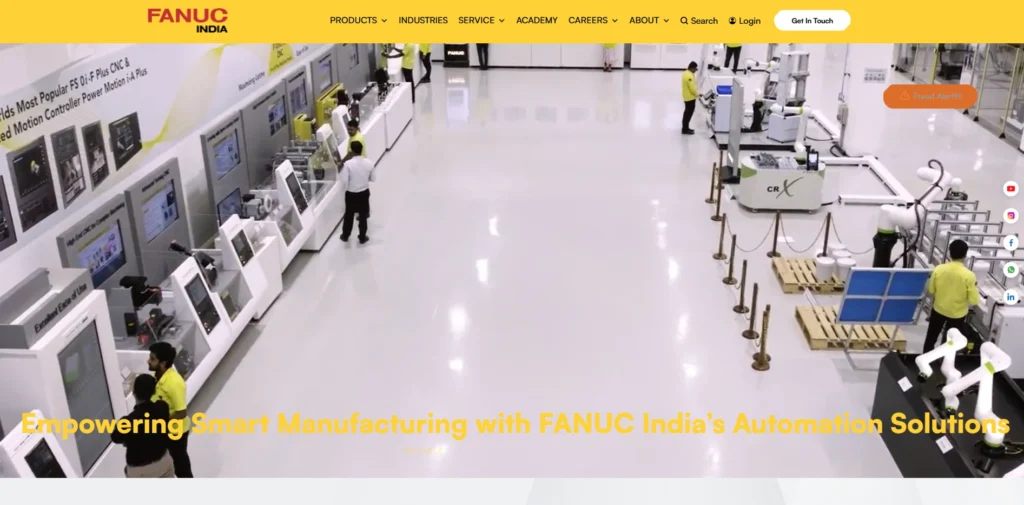
Fanuc India Private Limited, a wholly-owned subsidiary of Japanese giant Fanuc Corporation, is the market leader in factory automation in India, supplying cutting-edge CNC systems, robots, and manufacturing solutions. It was set up to cater to the Indian market, producing robot components such as servo motors and robot controllers at its facility, and providing value-added services like installation, commissioning, maintenance, and lifetime support for low total cost of ownership.
The company has installed more than 8,000 robots and 45,000 CNC systems in automotive, electronics and aerospace industries and delivers improved productivity through IIoT-based predictive maintenance and turnkey automation. Based in Bengaluru, it has a nationwide presence with competitive fixed prices and application support.
Key Products
- Welding, assembly, and painting robots (e.g., M-20iD, ARC Mate).
- CNC controllers (e.g., Series 0i-F Plus).
- ROBODRILL (vertical machining), ROBOSHOT (injection molding), ROBOCUT (wire EDM).
- Servo motors, IIoT solutions (FIELD system).
Clients
- Automotive, electronics, and aerospace manufacturers.
- More than 7,500 robots have been sold in India.
10. Yaskawa India

- Founded: 2010 (in India since 1980)
- HQ: Bangalore, Karnataka
- Founders: N/A (subsidiary of Yaskawa Electric Corporation, Japan)
- Website: https://yaskawaindia.in
Yaskawa India Private Limited, a wholly owned subsidiary of the Japanese Yaskawa Electric Corporation (established in 1915), is a pioneering industrial automation and robotics company in India. Starting with PLC business in 1980, AC drives in 1990, and robotics since 2005, the company is now offering advanced motion control and automation technology to various industries.
Its 55,000 sq. ft. manufacturing unit in Bangalore has three assembly lines, while it has a robotics division in Gurgaon and offices in major cities such as Pune, Chennai, and recently Ahmedabad. Yaskawa India specialises in drives, motion control, and robotics for process and manufacturing optimisation, making it one of the leading robot manufacturers in India, contributing to Industry 4.0 with more than 7,500 robots installed in the automotive, electronics, and other sectors.
Key Products:
- Robots (MOTOMAN series for welding, assembly, handling)
- AC drives and servo motors
- Motion controllers
Clients
- Automotive, consumer electronics, FMCG, metals
- Original equipment manufacturers, system integrators, tier 1/2 suppliers
11. Omron Automation India

- Founded: 1993 (in India)
- HQ: Mumbai, Maharashtra
- Founder: Kazuma Tateishi (Global)
- Website: https://www.omron-ap.co.in/
omron Automation India is a leading branch of the global Japanese conglomerate, focused on driving innovation in manufacturing with integrated, intelligent and interactive automation solutions. Omron offers a wide range of industrial automation products, serving industries such as packaging, food and beverages, material handling and automotive.
Through the use of cutting-edge technologies such as advanced robots, vision and motion control systems, Omron helps companies improve their safety, productivity, and efficiency. They have established local offices, repair shops and training facilities in India to provide localised, specialised support and services. The company continues to pursue its ambitious vision of contributing to a brighter future for the industry and society with innovative automation and IIoT solutions.
Key Products
- Collaborative robots (Cobots)
- Industrial robots
- PLCs and motion drives
- Smart sensors and vision technologies
- Machine safety components
Clients
- Automotive manufacturers
- Packaging industries
- Food and beverage companies
- Material handling sectors
12. Hi-Tech Robotic Systemz

- Founded year: 2004
- HQ: Gurgaon, Haryana, India
- Founders: Deep Kapuria (Chairman), Anuj Kapuria (CEO)
- Website: https://novushitech.com/
The Hi-Tec Robotics System is an Indian technology firm specializing in innovative products for future mobility and automation. Established in 2004, the company is known for its cutting-edge autonomous, driver-assistive technologies, and mobile robotics for people and material movement.
They have a range of expertise in AI-based software stacks for autonomous driving, advanced driver assist systems (ADAS), and sophisticated intralogistics material movement automation, making them a growing name among robot manufacturers in India. They deliver cutting-edge high-performance solutions that improve efficiency in a range of industries such as manufacturing, warehouses, and logistics.
They combine the best of research with real-world shop floor use-cases to deliver smart, flexible solutions that adapt to the needs of a changing industry.
Key Products
- Autonomous Mobile Robots (AMRs)
- Automated Guided Vehicles (AGVs)
- Advanced driver assistance systems (ADAS)
- Autonomous driving software stacks
- Automation and palletizing systems
Clients
- Automotive OEMs, manufacturing, warehouse, logistics and military applications.
13. Gridbots Technologies

- Founded year: 2007
- HQ: Ahmedabad, Gujarat, India
- Founders: Pulkit Gaur (founder and CEO; TED Fellow and MIT Young Innovator)
- Website: https://www.gridbots.com/
Gridbots Technologies is an Indian firm that develops industrial robots, machine-vision systems, and AI‑based solutions for smart factories, defense and infrastructure. It develops and manufactures custom robotic solutions that aid manufacturers in automating tasks like defect inspection, dimension measurement, sorting, grading and material handling to create Industry 4.0‑compatible smart manufacturing facilities. Its solutions are used in industrial and defense applications, integrating robotics, vision, and AI to provide high‑speed, high‑accuracy and cost‑effective automation for sorting, inspection, transportation and other niche applications such as underwater cleaning.
Key products:
- Material handling and automation robots and arms.
- Automated Guided Vehicles (AGVs) for material handling.
- Vision‑based and AI‑based inspection robots for quality control.
- Fast‑paced sorting solutions in industrial and logistics.
- Inspection and underwater robots for niche industrial and defense‑grade applications.
Clients
- Manufacturing plants (automotive, packaging, pharmaceutical, etc.),Defense and,strategic‑sector clients.,Smart‑factory and logistics clients with sorting, inspection, and AGV systems.
14. Invento Robotics

- Founded year: 2016
- HQ: Bengaluru, Karnataka, India
- Co-Founders: Balaji Viswanathan, Mahalakshmi Radhakrushnan, Bharath Kumar
- Website: https://mitrarobot.com/
Invento Robotics is a Bengaluru-based robotics firm that creates AI-driven humanoid robots that can engage with customers, greet people, help them, and automate processes in various industries such as hospitals, banks, airports, retail, and hospitality. The company’s most prominent robots, Mitra and Mitri, communicate with humans through speech, face and context recognition, and has partnered with some of India’s biggest corporates.
Key Products:
- Mitra.
- Mitri.
- AI humanoid service robots.
Clients:
- Zomato,Diageo.Smartworks.,PVR Cinemas,Accenture,Morris Garages,General Motors.,HDFC Bank.
15. Asimov Robotics

- Founded year: 2012
- Headquarters (HQ): Kinfra High‑Tech Park Kalamassery, Kochi (Ernakulam), Kerala, India
- Founders: Mr. Jayakrishnan
- Website: https://www.asimovrobotics.com/
Asimov Robotics Pvt. Ltd. is an Indian robotics automation firm that develops, produces, and services robots and robotics technologies for industrial, educational, medical, and service-sector applications. It provides robotic simulation and control, machine vision, autonomous navigation, and virtual reality-based solutions for research-grade and commercial-grade robots.
It also offers educational robots and research kits, robotic laboratories for institutions, and technical support and training services, making it a notable player among robot manufacturers in India.
Key products:
- Industrial collaborative robots (cobots) and service robots.
- Care giving robots and customer‑service robots for banks and hotels.
- COOL (Coordinated Links) robot arm and industrial robotic arms.
- COVID‑POLICE health‑screening and face‑based attendance robots.
- Machine‑vision systems, simulation and control software and modular sensors.
- Educational robots and hobby/research‑grade robot kits.
Clients:
- Academic and research clients using robot labs and classrooms.
- Medical, banking, retail and hospitality customers with service and caregiver robots.
- Automation and machine‑vision clients in the industrial and defense-related industries.
Comparison Table – Top Robot Manufacturers in India at a Glance
| Manufacturer | Founded | HQ Location | Primary Robot Types | Notable Clients |
| Addverb Technologies | 2016 | Noida, UP | AMRs/AGVs, ASRS, Sortation, Cobots, Humanoids | Reliance, Flipkart, Amazon, HUL |
| GreyOrange | 2011 | Gurugram, Haryana | AMRs, Goods-to-Person, AI Orchestration | Walmart, IKEA, Flipkart, Delhivery |
| Systemantics | 1995 | Bengaluru, Karnataka | Cobots (ASYSTR series), 6-axis arms | Automotive, Pharma, E-commerce |
| Hachidori Robotics | 2019 | Bengaluru, Karnataka | AMRs for material handling, AGVs | Automotive, Logistics, Manufacturing |
| ANSCER Robotics | 2020 | Bengaluru, Karnataka | AMRs/AGV hybrids, Pallet movers | US/India/Singapore enterprises |
| Wipro PARI | 1990 | Pune, Maharashtra | Robotic arms, Gantries, Welding, AGVs | Tata Motors, Mahindra, BMW, Ford |
| Tata Elxsi | 1989 | Bengaluru, Karnataka | Autonomous middleware, Healthcare robots | Tata Motors, 17 OEMs |
| KUKA India | 2006 | Gurgaon, Haryana | Industrial articulated, Welding cells | Tata Motors, Mahindra, Hyundai |
| Fanuc India | 1992 | Bengaluru, Karnataka | Welding/Assembly/Painting robots, CNC | Automotive, Electronics (>7,500 sold) |
| Yaskawa India | 2010 | Bangalore, Karnataka | MOTOMAN series (Welding/Handling) | Automotive, Electronics, FMCG |
| Omron Automation | 1993 | Mumbai, Maharashtra | Cobots, Industrial robots, Sensors | Automotive, Packaging, F&B |
| Hi-Tech Robotic | 2004 | Gurgaon, Haryana | AMRs/AGVs, ADAS, Palletizing | Automotive OEMs, Logistics |
| Gridbots Technologies | 2007 | Ahmedabad, Gujarat | Inspection/Vision robots, AGVs | Manufacturing, Defense |
| Invento Robotics | 2016 | Bengaluru, Karnataka | Humanoid service (Mitra/Mitri) | Zomato, HDFC, PVR Cinemas |
| Asimov Robotics | 2012 | Kochi, Kerala | Cobots, Service/Caregiver robots | Medical, Banking, Academic |
Industry-wise Robot Applications in India
Manufacturing and logistics dominate the adoption of robots in India, with new applications in healthcare, agriculture and defence. Here’s a simple breakdown by industry you can use in a report or blog.
1. Automotive
Welding, painting, material handling, machine tending and inspection are the common applications in Indian automotive plants. This is India’s largest segment for robotics; automobile manufacturing is one of the major users of industrial robots. This results in improved speed, accuracy, safety and quality.
2. Pharma
In the pharmaceutical industry, robots are used for packaging, palletising, picking and sorting, laboratory automation, and controlled atmosphere handling of products. Collaborative robots and automation is being used by Indian pharma to ensure compliance, minimise contamination and enhance traceability. This is particularly helpful in an industry that has to meet quality and regulatory standards.
3. Warehousing
Indian warehouses employ robots for picking, sorting, transporting, inventory management and order processing. Autonomous mobile robots and warehouse automation are increasing due to e-commerce and the demand for speedier operations. These robots increase accuracy, efficiency, and overcome staffing shortages in busy seasons.
4. Healthcare
Robots in healthcare are designed for surgical assistance, patient care assistance, pharmacy automation, drug dispensation, inventory management and telemedicine applications. In India, automation is also increasing the efficiency of hospitals by speeding up and automating the distribution of medicines and record keeping. The industry is still in its infancy but robots are becoming important for accuracy, safety and quality of service.
5. Agriculture
Robots and automation are applied in farming for planting, harvesting, monitoring, spraying, and gathering data. Farmers in India are starting to use these technologies to boost yields, eliminate tedious work and enable sustainable farming. This is a sector with long-term growth potential due to the shortage of manpower and need for intelligent farming.
6. Defense
The applications include surveillance, bomb disposal, border security, unmanned ground vehicles, drones and remote sensing. Defense robotics in India is mainly focused on enhancing soldier protection, awareness and access in dangerous situations. The primary benefits are saving lives in high-risk operations and improving speed and accuracy.
Challenges Facing Robot Manufacturers in India
Increasing the production and deployment of robots is a challenge for manufacturers in India. These are due to economic, technical and human factors specific to India’s manufacturing industry.
- High Initial Costs: The initial costs scare off small and medium enterprises (SMEs), which make up India’s manufacturing sector. The cost of a complete robotic system is INR 20-30 crore for a medium-sized factory, pushing back ROI beyond the 18-24 months expected.
- Skill Shortages: Skilled operator and maintenance personnel are lacking. While India has a young population, there are retention problems and a lack of training initiatives, and SMEs find reskilling difficult.
- Integration Issues: Factories with outdated infrastructure face challenges integrating robots. Almost 40% of SMEs find it hard, compounded by poor power and internet connections in rural areas.
- Infrastructure Gaps:Lack of power, transportation, and broadband slows operations, particularly in rural areas. This constrains growth for robot manufacturers in diverse areas.
- Regulatory Hurdles:Comprehensive policies and red tape increase investment uncertainty. Simpler regulations could help but are a hurdle.
- Cultural Resistance: Older attitudes prefer human jobs, opposing automation changes. Family-run businesses focus on short-term expenses
Future of Robotics Manufacturing in India
By 2030, the manufacturing landscape in India will have transformed from human-dominated assembly lines to smart factories with high levels of automation, powered by a combination of cutting-edge robotics and artificial intelligence (AI). This transformation will involve not replacing humans, but instead enabling “hybrid” production based on collaborative robots, or “cobots”, which can take over routine or precise tasks to enhance quality and efficiency.
The trend is driven by government support (such as the “Make in India” campaign and production-linked incentives) and the need to remain cost competitive, as well as address staffing challenges in complex assembly sectors such as automotive and electronics. In the end, by 2030, these technologies will no longer be optional for large multinational factories, but will be critical for all sizes of factories, helping to establish India as a manufacturing powerhouse.
Conclusion
India has emerged as a global robotics leader because the government supports its manufacturing sector through “Make in India” and the market demands automation solutions for its automotive, logistics and manufacturing industries. Companies that implement Industry 4.0 technologies to improve their accuracy and efficiency will discover a complete range of local and international manufacturing partners who offer products that range from collaborative robots to advanced AI warehouse systems.
Entrepreneurs and decision-makers need to find suitable partners who can help their businesses grow while maintaining control over their first-time expenses and operational requirements. The current growth pattern indicates that India will achieve two milestones by 2030, which include increasing its robot density and becoming Asia’s leading hub for smart automated industrial development.
FAQs
Q1: Which is the No.1 Robot Manufacturer In India?
There is no consensus on who is the No. 1 robot manufacturer in India but Fanuc India and Yaskawa India are the top industrial robots manufacturers, given their market share and reliability in applications such as automotive and electronics manufacturing.
Q2: Which Indian Companies Make Industrial Robots?
Major Indian manufacturers and subsidiaries of industrial robots include Fanuc India (Bengaluru), Yaskawa India (Bengaluru) and others such as ABB India, Siemens and L&T from robotics stock lists.
Q3: What is the Cost Of Industrial Robots in India?
The cost of industrial robots in India ranges from ₹5,00,000 to ₹50,00,000, while the average cost of importing robots is lower at $1.8 thousand per robot in recent years.
Q4: Is Robotics Manufacturing Profitable In India?
The robotics manufacturing industry has high growth prospects, with the market growing at 13-16.8% CAGR by 2030, but the cost of robots is a barrier to adoption and profitability for SMEs, despite government incentives.
Q5: Which Sector Uses Most Robots?
India’s largest users of industrial robots are the manufacturing sector, for automotive, electronics and assembly applications.
Q6: Does India Export Robots?
India is a net importer of robots (95K units in 2025) with little evidence of exports; its focus is on automation.