
Zudio, a popular value-fashion brand by Trent Ltd. (Tata Group), has gained significant popularity in India with its affordable clothing, footwear, and lifestyle products. With the growing demand for budget-friendly fashion retail, many entrepreneurs are interested in understanding the Zudio franchise cost in India and the investment required to start a store.
However, Zudio primarily follows a company-operated retail model rather than a traditional franchise system. The overall investment can vary depending on the store format, location, property size, interiors, inventory, and operational requirements. Entrepreneurs exploring a Zudio store opportunity should verify the latest partnership options directly with the company.
About Zudio - Brand Overview and Growth Story

Zudio is a value-fashion retail brand owned and operated by Trent Limited, a part of the renowned Tata Group. The brand was launched to make trendy and affordable fashion accessible to a wider segment of Indian consumers. Zudio offers a diverse range of products, including clothing, footwear, accessories, and beauty items for men, women, and children.
Its business model focuses on providing fashionable products at budget-friendly prices, helping it attract price-conscious shoppers across urban and semi-urban markets. Over the years, Zudio has experienced rapid expansion due to increasing demand for affordable fashion and strong brand trust associated with the Tata Group.
The company has opened hundreds of stores across India, particularly in tier-2 and tier-3 cities where organised fashion retail is growing quickly. Its efficient supply chain, strategic store locations, and attractive pricing strategy have made Zudio one of the fastest-growing fashion retail brands in India, strengthening its position in the country’s competitive apparel market.
Does Zudio Actually Offer a Franchise in 2026?
Zudio, a fast-growing fashion retail brand owned by Trent Ltd. (Tata Group), has attracted many entrepreneurs who want to invest in its business model. However, as of 2026, Zudio does not follow a traditional franchise model like many other retail brands.
Most Zudio stores are operated under a company-owned and company-managed model, where Trent Ltd. controls key aspects such as store operations, branding, product selection, pricing, and customer experience. This approach helps the brand maintain consistency across its outlets.
Entrepreneurs generally cannot directly purchase a standard Zudio franchise license and independently operate a store. Instead, possible opportunities may involve other business arrangements, such as:
- Real estate partnerships for suitable commercial spaces
- Leasing opportunities where property owners provide locations for stores
- Business collaborations based on company requirements
Anyone interested in opening a Zudio outlet should contact Trent Ltd. through official channels to check for current opportunities and eligibility criteria.
Why Does Zudio Avoid a Traditional Franchise Model?
A company-operated approach allows Zudio to:
- Maintain consistent brand standards
- Control product quality and pricing
- Manage customer experience across stores
- Expand strategically in selected markets
Therefore, while the demand for a Zudio franchise in India is high, investors should carefully verify official information before making any investment decisions.
Understanding the FOCO Model – How Zudio’s Partnership Works
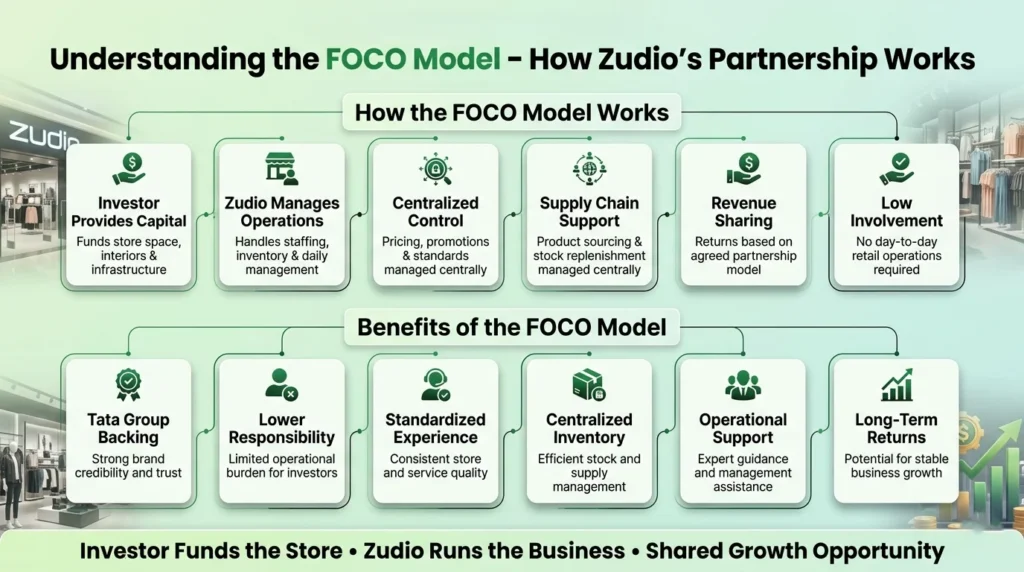
Zudio is widely associated with a FOCO (Franchise Owned, Company Operated) model in many discussions about its expansion strategy.
Under this arrangement, the investor provides the capital, commercial space, and store infrastructure, while the company manages day-to-day operations such as inventory, staffing, merchandising, pricing, and customer service. This allows the brand to maintain a consistent shopping experience across locations while enabling faster expansion with external investment support.
However, reports vary on the exact extent of FOCO partnerships, and some stores may operate under different ownership structures. Therefore, investors should always verify current partnership opportunities directly with Trent Limited.
How the FOCO Model Works
- Investor Provides the Capital: The partner invests in store setup, interiors, fixtures, and commercial space requirements needed to establish the outlet.
- Zudio Handles Operations: The company manages staffing, inventory procurement, billing systems, merchandising, and daily retail operations.
- Brand Control Remains with the Company: Product pricing, promotions, store layout, visual merchandising, and customer experience standards are controlled centrally.
- Centralised Supply Chain: Inventory replenishment and product sourcing are handled by the company, ensuring consistent stock availability and pricing.
- Revenue-Sharing Structure: Partners generally earn returns through an agreed revenue-sharing or rental arrangement rather than managing retail operations themselves.
- Reduced Operational Responsibility: Investors do not need retail management expertise because store operations are managed by the company’s professional team.
Benefits of the FOCO Model
- Strong brand backing from the Tata Group.
- Lower operational involvement for investors.
- Standardised customer experience across stores.
- Centralised inventory and supply chain management solutions.
- Faster expansion with professional operational support.
- Potential for stable long-term returns from a recognised fashion brand.
There is significant misinformation online regarding Zudio franchises and partnerships. Some sources state that many stores are company-operated, while others describe selective FOCO partnerships. Prospective investors should communicate only through official Trent Limited channels and avoid paying fees to unofficial franchise agents or websites.
Zudio Franchise Cost in India 2026 – Full Investment Breakdown
Starting a Zudio outlet requires substantial capital because the brand focuses on large-format fashion retail stores located in high-footfall commercial areas. The total investment depends on factors such as store size, city category, location quality, lease costs, and infrastructure requirements.
Since Zudio generally follows a company-controlled or partnership-based expansion approach, investment requirements can vary significantly. Entrepreneurs should evaluate setup expenses, operational costs, and working capital requirements carefully before considering an investment opportunity. Proper financial planning helps ensure smooth operations and improves long-term business sustainability.
One-Time Setup Costs for Zudio Franchise
The one-time setup costs include the initial investment required before the Zudio store becomes operational. These expenses cover store location, interiors, inventory, equipment, and legal requirements.
| Cost Component | Estimated Cost (₹) | Details |
|---|---|---|
| Franchise / Brand Fee | ₹10 – ₹15 lakh | One-time fee to use Zudio brand name |
| Security Deposit / Lease Advance | ₹20 – ₹30 lakh | Refundable amount for store lease |
| Registration & Stamp Duty | ₹10 – ₹20 lakh | Legal agreements and documentation |
| Store Interior & Fit-out | ₹40 lakh – ₹1.2 crore | Racks, lighting, flooring, trial rooms, branding |
| Initial Inventory Stock | ₹30 – ₹60 lakh | First bulk clothing stock |
| Technology Setup (POS, Billing) | ₹5 – ₹10 lakh | Billing systems, software, hardware |
| Marketing & Launch Expenses | ₹3 – ₹10 lakh | Opening promotion, local ads |
| Consultancy / Misc Costs | ₹2 – ₹5 lakh | Site selection, setup support |
Monthly Ongoing Expenses for Zudio Store
After the store launch, investors need to manage regular operational expenses required for running the business.
| Expense Component | Estimated Cost (₹/Month) | Details |
|---|---|---|
| Store Rent / Lease | ₹5 – ₹15 lakh | Depends on city tier, mall/high street location |
| Staff Salaries | ₹3 – ₹6 lakh | Store manager, cashiers, sales staff, security |
| Utilities (Electricity, Water, Internet) | ₹50,000 – ₹2 lakh | High AC and lighting usage in large stores |
| Maintenance & Upkeep | ₹25,000 – ₹1 lakh | Repairs, cleaning, store maintenance |
| Marketing & Local Promotion | ₹50,000 – ₹1 lakh | Local ads, in-store promotions |
| Inventory Replenishment (Operational flow) | Variable (50–60% of sales) | Stock purchase cycles, not fixed monthly cost |
| Miscellaneous Expenses | ₹25,000 – ₹1 lakh | Unexpected operational costs |
Working Capital Requirement for Zudio Store
Maintaining sufficient working capital is essential for managing daily operations. Even successful retail stores may require time to achieve stable sales and profitability.
Recommended Working Capital Reserve
Businesses should maintain funds for:
- 6–12 months of operating expenses
- Rent and employee salaries
- Inventory replenishment
- Utility payments
- Unexpected business expenses
- Seasonal sales fluctuations
Estimated Total Investment for Zudio Franchise
The total investment required depends on store size, location, operational structure, and business requirements.
Approximate Total Investment: ₹1.5 Crore – ₹10 Crore+
The actual investment depends on store size, location, inventory requirements, and partnership structure. Larger metro-city outlets generally require significantly higher capital than stores located in tier-2 and tier-3 cities.
A strong working capital reserve and careful financial planning can help investors manage operational challenges, support business growth, and maintain smooth day-to-day retail operations over the long term.
Suggested Read:
Factors That Affect Zudio Franchise Cost
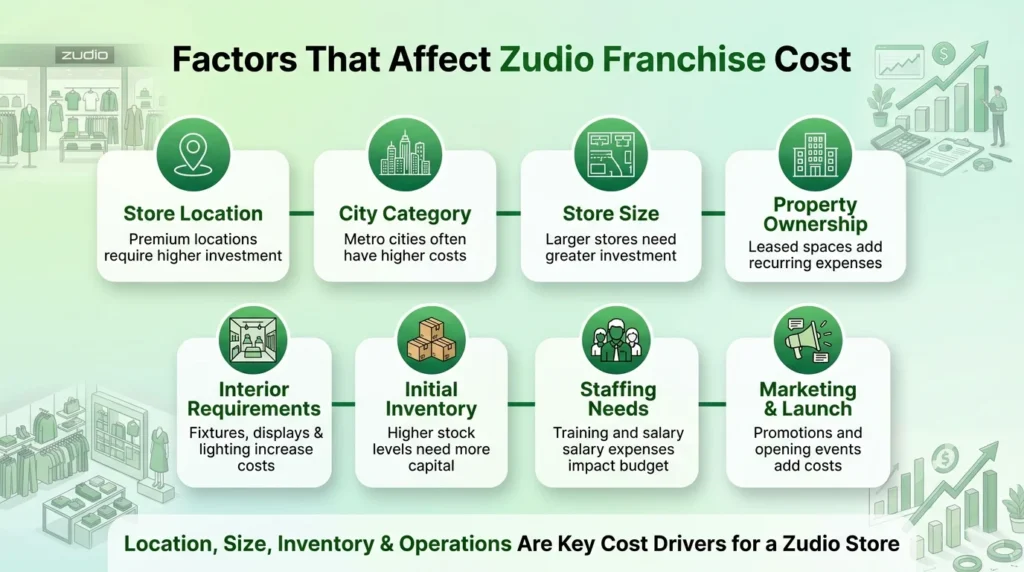
Opening a Zudio outlet requires significant investment, but the total cost varies based on several business and location-related factors. Understanding these factors helps investors estimate budgets accurately and plan finances effectively.
- Store Location: Premium commercial areas and high-footfall markets typically require higher investment due to increased property costs.
- City Category: Metro cities generally involve greater setup expenses, rentals, and operational costs than smaller cities.
- Store Size: Larger retail outlets require more investment for interiors, inventory, fixtures, and maintenance needs.
- Property Ownership: Owning commercial property reduces long-term rental expenses, while leased spaces increase recurring costs.
- Interior Design Requirements: Store interiors must meet brand standards, affecting spending on fixtures, lighting, and displays.
- Initial Inventory Volume: Higher inventory levels require greater capital investment to ensure product variety and availability.
- Staffing Requirements: Larger stores need more employees, increasing recruitment, training, and monthly salary expenses significantly.
- Marketing and Launch Activities: Local promotions, advertising campaigns, and grand opening events can substantially increase initial investment.
Zudio Franchise Profit Margin and ROI – What to Realistically Expect
Profitability is one of the primary reasons entrepreneurs are interested in Zudio-related investment opportunities. The brand has established a strong presence in India’s value-fashion segment by offering trendy products at affordable prices.
However, actual earnings depend on factors such as location, store size, customer footfall, operating costs, inventory turnover, and the partnership structure. Investors should focus on realistic expectations rather than assuming immediate high returns.
| Category | Details | Estimated Range |
|---|---|---|
| Average Profit Margin | Fashion retail profit after all expenses | 10% – 20% |
| Gross Margin | Profit before operating costs | 30% – 50%+ |
| Monthly Revenue Potential | Depends on location & footfall | ₹20 lakh – ₹1 crore+ |
| Monthly Profit Potential | After rent, salaries, expenses | ₹2 lakh – ₹20 lakh+ |
| Annual Profit Potential | Based on store performance | ₹25 lakh – ₹2 crore+ |
| ROI Period | Time to recover investment | 3 – 5 years |
| Break-Even Period | When costs are fully recovered | 2 – 5 years |
| Key Factors | Location, traffic, inventory, efficiency | Varies |
Space and Location Requirements for a Zudio Store
Starting a Zudio store requires a strategically located commercial property that can accommodate a large-format fashion retail outlet. The company generally prefers locations with strong visibility, accessibility, and customer footfall.
- Minimum Store Area: A retail space of approximately 8,000–15,000 sq. ft. is typically preferred for a standard Zudio store.
- Ground Floor Preference: Ground-floor locations are usually favored because they provide better visibility and easier customer access.
- High-Footfall Areas: Properties should be located in busy commercial markets, shopping districts, or high-traffic retail zones.
- Shopping Malls and Retail Complexes: Premium malls and established retail centers are often preferred due to consistent customer traffic.
- Wide Store Frontage: A broad storefront improves brand visibility and attracts more walk-in customers.
- Good Road Connectivity: The location should be easily accessible through major roads and public transportation networks.
- Adequate Parking Facilities: Sufficient parking space is important to ensure customer convenience and improve store accessibility.
- Strong Residential Catchment: Areas with dense residential populations and middle-class families generally offer better sales potential.
- Growing Tier-2 and Tier-3 Cities: The brand actively expands into emerging cities where organized fashion retail demand is increasing rapidly.
- Uninterrupted Utilities and Infrastructure: The property should have reliable electricity, water supply, internet connectivity, and other essential infrastructure.
- Compliance and Commercial Zoning: The premises must meet local commercial zoning regulations, safety requirements, and retail operating standards.
- Long-Term Lease Availability: A long-term lease agreement is generally preferred to support business stability and future growth plans.
Eligibility Criteria and Documents Required
Before applying for a Zudio store partnership or retail opportunity, applicants must meet certain financial, operational, and property-related requirements. Since Zudio focuses on large-format fashion retail stores, the company generally prefers investors who possess adequate capital, suitable commercial property, and the ability to support long-term business operations.
Eligibility Criteria
- Minimum Investment Capacity: Applicants should have sufficient financial resources to cover store setup, inventory, and operational expenses.
- Suitable Commercial Property: Investors should own or have access to a commercial retail space that meets the company’s location requirements.
- Business Experience (Preferred): Prior experience in retail, fashion, FMCG, or franchise management can be advantageous, though it may not always be mandatory.
- Strong Financial Background: The applicant should demonstrate financial stability and the ability to maintain working capital reserves.
- Long-Term Business Commitment: Retail operations require a long-term investment outlook and commitment to maintaining business standards.
- Compliance with Legal Requirements: Applicants must comply with local business regulations, taxation requirements, and commercial property norms.
Documents Required
| Documents | Purpose |
| PAN Card | Identity verification and tax compliance |
| Aadhar Card | Address and identity proof |
| Passport-Size Photographs | Application and documentation process |
| Bank Statements | Verification of financial capability |
| Income Tax Returns (ITR) | Assessment of financial stability |
| Net Worth Certificate | Demonstrates investment capacity |
| Property Ownership Documents | Proof of ownership of proposed retail space |
| Lease Agreement (If Applicable) | Verification of leased commercial property |
| GST Registration | Business tax compliance requirements |
| Business Registration Certificate | Applicable for companies, LLPs, or partnerships |
| Shop and Establishment Registration | Compliance with local business regulations |
| NOC from Property Owner | Required when the property is rented or leased |
| Utility Bills | Address verification for applicant or business premises |
| Company Incorporation Documents | Required for corporate applicants |
Additional Requirements
- Detailed property specifications and site photographs.
- Floor plan and layout of the proposed store.
- Commercial zoning approval where applicable.
- Financial projections and business profile (if requested).
- Any additional documents required during the company’s due diligence process.
Having complete documentation and a suitable commercial location can significantly improve the chances of being considered for a Zudio retail partnership opportunity.
Licenses and Legal Approvals Needed Before Opening
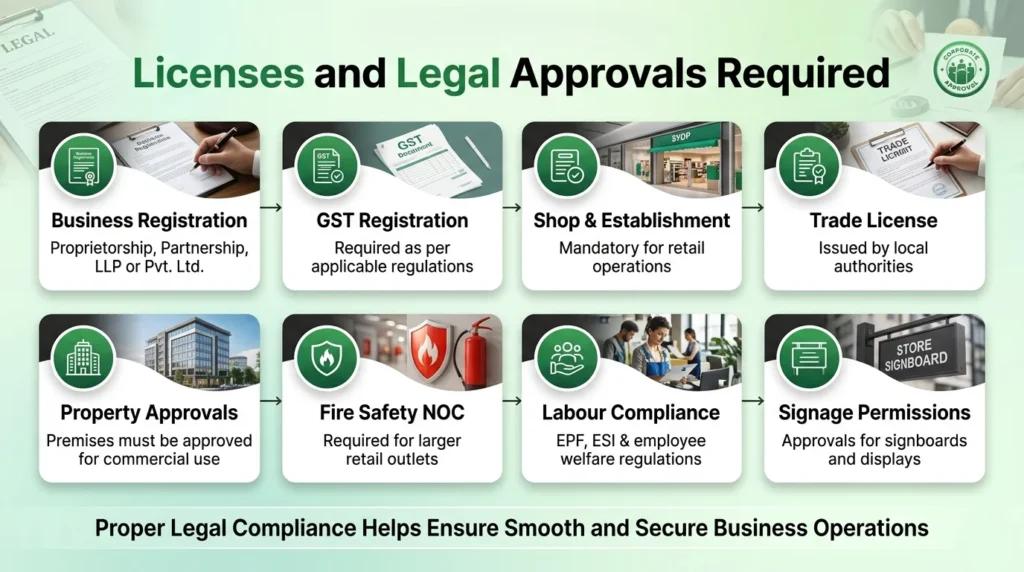
Opening a Zudio store or retail fashion outlet requires compliance with several business, taxation, labor, and commercial property regulations. The exact requirements may vary by state and business structure.
- Business Registration: Register the business as a Proprietorship, Partnership, LLP, or Private Limited Company before commencing operations.
- GST Registration: GST registration is mandatory if the business exceeds the prescribed turnover limits or conducts interstate sales.
- Shop and Establishment License: This registration is required under the respective state’s Shops and Establishments Act for retail operations.
- Trade License: Obtain a trade license from the local municipal authority to legally operate a commercial retail business.
- Commercial Property Approvals: The retail premises must have proper commercial zoning approvals and legal authorization for business use.
- Fire Safety NOC: Large retail stores generally require a Fire Department No Objection Certificate (NOC) to ensure safety compliance.
- Labour Law Registrations: Businesses employing staff must comply with labour laws, including EPF, ESI, minimum wages, and employee welfare regulations.
- Signage and Advertisement Permissions: Approval may be required from local authorities for exterior signboards, branding displays, and promotional advertisements.
How to Apply for Zudio Franchise in 2026 – Step-by-Step Process
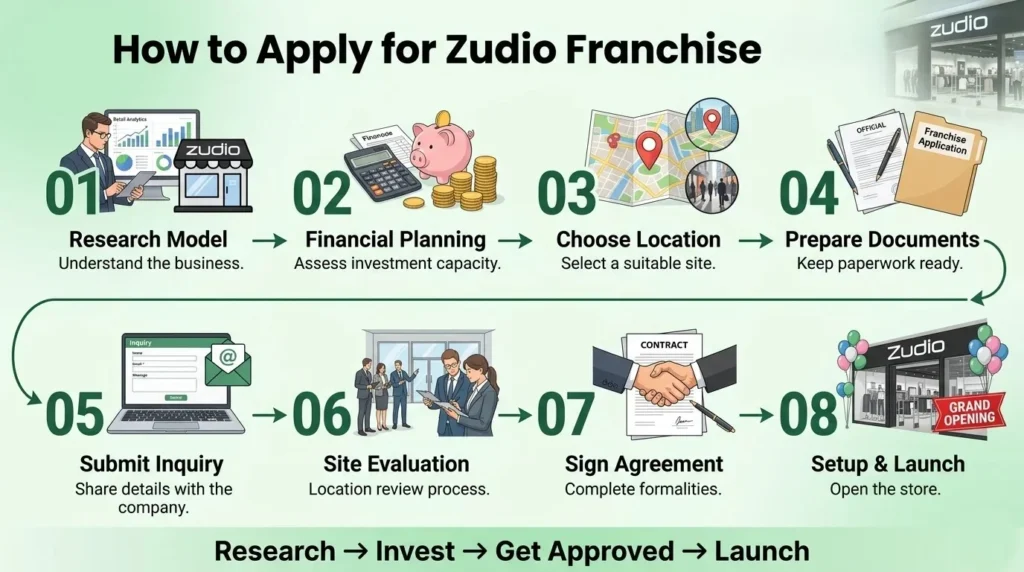
Step 1 – Understand Zudio’s Business Model
Before proceeding, understand that Zudio primarily expands through company-operated stores and selective partnership arrangements rather than a traditional franchise model. Investors should research the brand’s requirements, investment expectations, and expansion strategy carefully.
Step 2 – Assess Financial Readiness
Ensure you have sufficient capital for:
- Commercial property or lease expenses
- Store setup and interiors
- Initial inventory requirements
- Working capital reserve
- Operational and maintenance costs
Strong financial stability improves your chances of qualifying for potential partnership opportunities.
Step 3 – Secure a Suitable Commercial Property
Zudio generally prefers:
- 8,000–15,000+ sq. ft. retail space
- High-footfall commercial locations
- Shopping malls or prime high streets
- Ground-floor visibility
- Adequate parking and accessibility
Location selection plays a crucial role in business viability.
Step 4 – Prepare Required Documents
Keep the following documents ready:
- PAN Card
- Aadhaar Card
- Bank statements
- Income Tax Returns
- Property ownership or lease documents
- Business registration documents
- GST registration (if applicable)
Proper documentation helps streamline the evaluation process.
Step 5 – Submit an Expression of Interest
Interested investors should contact the company’s official business development or expansion team and submit details regarding:
- Proposed location
- Property specifications
- Investment capacity
- Business background
- Contact information
Providing complete information improves the likelihood of receiving a response.
Step 6 – Property Evaluation and Due Diligence
The company typically reviews:
- Location quality
- Customer footfall potential
- Accessibility
- Market demand
- Competitive environment
- Property suitability
Only locations meeting brand standards are considered for further discussions.
Step 7 – Finalise Commercial Agreement
If the proposal is approved, both parties proceed with:
- Partnership terms
- Commercial agreements
- Revenue-sharing arrangements (if applicable)
- Lease and operational conditions
- Compliance requirements
Carefully review all contractual obligations before signing.
Step 8 – Store Setup and Launch Preparation
Once approvals are completed, the store setup process begins, including:
- Interior development
- Branding installation
- Technology and POS systems
- Staff recruitment
- Inventory stocking
- Operational training
After final inspections and approvals, the store becomes ready for launch and customer operations.
Zudio vs. Competitors – How It Compares as a Franchise Investment
| Factor | Zudio | Max Fashion | Reliance Trends | Pantaloons | FirstCry |
| Primary Segment | Value Fashion | Value Fashion | Family Fashion | Mid-Premium Fashion | Kids & Baby Products |
| Brand Strength | Very Strong | Strong | Very Strong | Strong | Very Strong |
| Parent Company | Tata Group | Landmark Group | Reliance Retail | Aditya Birla Group | FirstCry |
| Investment Requirement | High | Moderate to High | High | High | Moderate |
| Store Size Requirement | 8,000–15,000+ sq. ft. | 5,000–10,000 sq. ft | 8,000–20,000 sq. ft | 10,000+ sq. ft. | 1,500–5,000 sq. ft. |
| Expansion Focus | Tier-2 & Tier-3 Cities | Metro & Tier-2 Cities | Nationwide | Metro & Tier-1 Cities | Nationwide |
| Product Categories | Apparel, Footwear, Accessories, Beauty | Apparel & Accessories | Apparel, Footwear, Lifestyle | Fashion & Lifestyle | Baby, Kids, Maternity |
| Inventory Turnover | High | Moderate to High | Moderate | Moderate | High |
| Operational Complexity | Moderate | Moderate | High | High | Moderate |
| Customer Footfall Potential | High | High | High | Moderate to High | High |
| ROI Potential | Moderate to High | Moderate | Moderate | Moderate | Moderate to High |
| Scalability | Strong | Strong | Strong | Moderate | Strong |
Zudio stands out because of its affordable pricing strategy, rapid expansion across emerging cities, and strong backing from the Tata Group. For investors seeking exposure to India’s fast-growing value-fashion segment, Zudio is often viewed as one of the most attractive large-format retail opportunities, particularly in tier-2 and tier-3 markets where demand for organized fashion retail continues to rise.
Is a Zudio Franchise Worth It in 2026?
A Zudio store partnership can be a worthwhile investment in 2026 for entrepreneurs with sufficient capital and access to a suitable commercial location. Backed by Trent Limited and the Tata Group, Zudio has become one of India’s fastest-growing value-fashion brands, benefiting from strong consumer demand for affordable and trendy apparel.
The brand’s rapid expansion into tier-2 and tier-3 cities creates significant growth opportunities, while its broad product range attracts a diverse customer base. However, the investment requirement is relatively high, and profitability depends heavily on location quality, footfall, and operational efficiency.
Investors should also remember that Zudio does not widely operate through a traditional franchise model. For those with long-term investment goals, strong finances, and suitable retail property, a Zudio partnership can offer attractive growth potential and brand-backed business stability.
Conclusion
In conclusion, investing in a Zudio outlet can be an attractive opportunity for entrepreneurs looking to enter India’s rapidly growing value-fashion retail sector. While understanding the Zudio Franchise Cost is important before planning the investment, the brand—backed by Trent Limited—benefits from strong customer trust, affordable pricing, and a widespread market presence.
However, prospective investors should carefully evaluate factors such as investment requirements, store location, operational costs, and local market demand before making a decision. A well-located store with efficient management and customer-focused service can improve business performance. Thorough planning and financial assessment are essential for maximizing long-term growth and profitability in this competitive retail segment.