
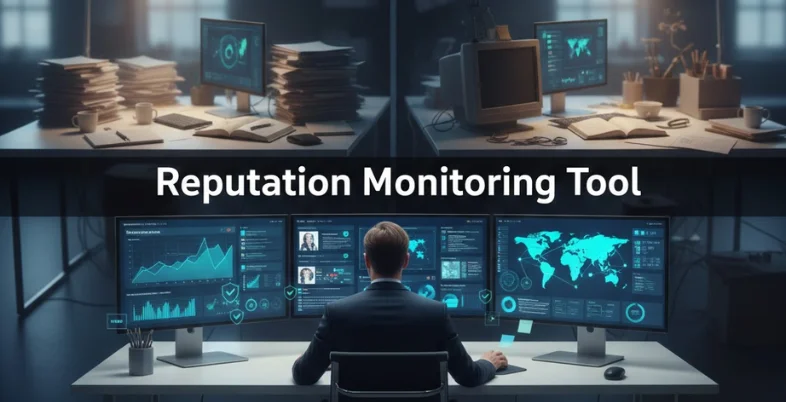
Most businesses start by searching for themselves.
They type their name into Google. They scroll through recent mentions. They check reviews on a few familiar platforms. For a while, that feels sufficient. The volume is manageable. The stakes feel low.
Then something changes.
The brand grows. Conversations multiply. Mentions spread across platforms that no one on the team checks regularly. And suddenly, manual searching stops revealing what actually matters.
That is the moment a reputation monitoring tool becomes more useful than manual effort.
Manual Searching Works Until It Doesn’t

Manual reputation checks fail quietly.
They do not break all at once. They simply start missing things. A comment buried in a forum. A complaint is gaining traction in a niche community. A review trend forms slowly enough to avoid notice until it becomes visible to everyone else.
Teams relying on manual searching tend to see what is obvious and miss what is emerging. They react after narratives have already formed, not while they are still flexible.
This is not a failure of attention. It is a failure of scale.
The Real Limitation Is Not Time. It Is Coverage.
Manual searching assumes that reputation lives in predictable places.
It assumes conversations happen on major platforms, during business hours, in formats that are easy to find. That assumption no longer holds.
Reputation now forms across fragmented ecosystems. Short-form video. Private communities. Employment review sites. Regional forums. Archived threads that resurface unexpectedly.
A reputation monitoring tool does not replace human judgment. It replaces blind spots.
Speed Changes the Outcome of Reputation Events
The difference between noticing an issue early and noticing it late is not cosmetic.
It determines whether a business participates in shaping the narrative or reacts to it after trust has already been affected. By the time a problem appears in branded search results, a brand monitoring tool shows that it has usually been circulating elsewhere for some time.
Manual searching discovers outcomes. Monitoring tools surface signals.
That distinction matters when response timing affects credibility.
Sentiment Is Not Always Obvious on the Surface
Humans are good at interpreting tone when reading individual comments.
They are not good at recognizing patterns across hundreds or thousands of mentions spread over time and platforms. Subtle shifts in language, recurring phrases, or changes in emotional framing are difficult to catch manually.
A reputation monitoring tool adds context by aggregating these signals. It shows when neutral commentary becomes skeptical, or when praise starts to flatten into indifference.
These changes rarely trigger alarms on their own. They become visible only when viewed collectively.
Trend Detection Reveals Problems Before They Feel Urgent

Most reputation risks do not arrive as crises.
They begin as questions, jokes, or repeated frustrations that seem minor in isolation. Manual searching tends to dismiss these early signals because they do not yet feel urgent.
Monitoring tools surface momentum.
They reveal when a topic is gaining traction, when mention velocity changes, or when specific concerns begin to cluster. This allows businesses to respond while the issue is still small enough to address calmly.
Scale Is the Point Where Manual Monitoring Breaks
There is a threshold beyond which manual searching becomes irresponsible.
For small organizations with limited visibility, occasional checks may be adequate. As soon as the mention volume increases, the risk of missing something meaningful rises sharply.
Growth does not just increase attention. It increases exposure.
At that point, relying on manual searching is not frugal. It is risky.
A Reputation Monitoring Tool Shifts the Role of the Team

The most important change is not efficiency.
It is a focus.
When teams stop hunting for mentions, they can spend their time interpreting them. Instead of scanning endlessly, they evaluate context, intent, and response strategy.
This shift turns reputation management from a reactive chore into an informed practice.
The Moment of Transition Is Easy to Miss
Many businesses adopt monitoring tools only after a visible issue forces the decision.
By then, the cost has already been paid in trust, confusion, or lost control of the narrative. The smarter transition happens earlier, when manual searching still feels workable but increasingly fragile.
That is when a reputation monitoring tool stops being optional and starts being practical.
Not because the business is in trouble.
But because it understands how reputation actually moves now.