
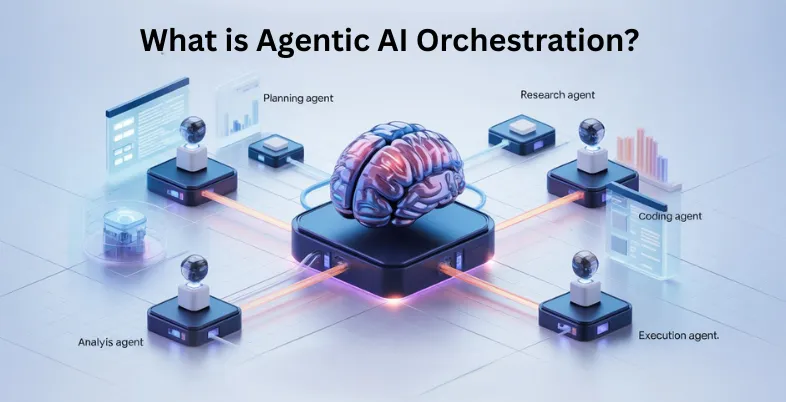
As AI continues to redefine organizations, the constraints of standalone AI systems are becoming increasingly evident. Agentic AI orchestration provides a highly transformative solution that coordinates many independent AI agents to work together seamlessly.
Agents specialize in specific capabilities, such as planning, data analysis, and reasoning, or executing tools, and a central orchestrator is responsible for communication, task distribution, and workflow supervision.
This combined framework empowers AI systems to handle complex, multi-step challenges with greater efficiency, accuracy, and resilience. From enabling developed research and innovation to automating organizational processes, agentic orchestration is setting a new standard for scalable, intelligent, and more adaptive AI systems.
In this article, we will understand agentic AI orchestration, its architecture, and its benefits. We will also go through some best practices and the future of agentic AI orchestration.
Understanding Agentic AI Orchestration
Agentic AI Orchestration is the coordination of multiple independent AI agents, each with its own objective, skills, or tools. These agents coordinate to solve complex problems together more effectively than an individual model. It includes governing agents’ communication, sharing information, delegating tasks, decision-making, and planning actions while upholding safety, consistency, and reliability.
In application, it plays the role of “central brain” or “conductor” which is responsible for organizing various specialized agents, like planner agent, research agent, coding agent, and execution agent into a well-structured workflow. This orchestration endows AI systems with the capability to be dynamic, adaptive, and cooperative in problem-solving. It enables the current generation of AI agents to be more proficient, efficient, and human-like in performing real-world multi-step tasks.
Architecture of Agentic AI Orchestration
- Central Orchestrator (Coordinator / Supervisor)- This part is the brain of the system. It decodes the main objective and divides it into smaller tasks, attributes these tasks to relevant agents, and ensures that all agents work in an order appropriate for them. It maintains the flow of work, direction, and preference.
- Specialized Agents (Role-Based or Skill-Based)- These are autonomous AI units designed for various specific tasks such as research, coding, planning, data analysis, or tool execution. Each agent appears with unique capabilities and permissions, and the orchestrator picks them based on the allotment of the tasks.
- Communication Layer (Messaging System)- This layer permits agents to exchange information among agents and with the orchestrator. It ensures smooth and reliable communication through message queues, internal protocols, or APIs, preventing coordination cases.
- Shared Memory System (Context and Knowledge Store)- All agents access a shared memory space that stores important information like previous actions, results, plans, and knowledge. This prevents redundancy and helps agents to stay aware of context, and enables them to build on each other’s outputs.
- Planning and Reasoning Module- This module handles multi-step reasoning and logical thinking. It splits complex goals into structured tasks, generates action sequences, checks dependencies, and ensures that the complex goals are transformed into coherent actions to make sense throughout.
- Tool and Environment Integration Layer- Agents utilize this to interact with external systems like APIs, software tools, databases, or physical devices. It is essential for tool usage to be safe, accurate, and permissioned.
- Monitoring, Logging, and Traceability System- This system tracks agent actions, logs all activities, tracks progress, and figures out failures or inefficiencies by maintaining transparency. It supports debugging and ensures reliability across the entire agent network.
- Safety, Governance, and Policy Enforcement- This is the part of the architecture that ensures that AI agents operate within specified rules and bounds. It does access control, enforces morality guidelines, prevents offensive behavior, and allows human override as needed.
Benefits of Agentic AI Orchestration
- Improved Efficiency and Speed- Several specialized agents work in parallel. They simultaneously tackle complex assignments, reduce the time to complete complicated tasks, and accelerate the workflow process.
- Better Task Accuracy and Reliability- Each agent focuses on exactly what it does: code, research, plan, and analysis, making things better, faster, and more accurate across the system.
- Enhanced Scalability- The system can grow simply by adding an agent or updating one already present. This aids the system to be capable of taking on more workload, or a harder workload, without re-architecting anything.
- Increased Automation Capabilities- Agentic orchestration supports fully automated multi-step processes. By utilizing this, it is made possible to automate workflows with the tiniest human intervention.
- Dynamic Adaptability- Agents can modify strategies, adjust plans, or assign new tasks during runtime based on failures, emerging information, or the continuing purposes.
- Higher System Resilience- If one agent overlooks something, the orchestrator can deliver tasks or activate fallback agents, helping prevent overall system failures.
- Enhanced Human-AI Interaction- With optional human-in-the-loop capabilities, there is the possibility for humans to purposely intervene or guide the system, which combines human judgment with AI pace and accuracy.
- Support for Complex, Real-World Workflows- Model orchestration enables AI to tackle multi-phase operations like research, analysis, execution, planning, and verification. This makes it well-suited for organizations, engineering, and creativity-oriented uses.
Best Practices for Using an Agentic AI Orchestration
1. Define Clear Goals and Task Boundaries
Define the objectives of the Agentic AI system and constraints or boundaries for each task. Well-defined objectives help the orchestrator and individual agents understand the predicted outcomes, decreasing misconceptions and preventing agents from performing unnecessary actions. Setting boundaries also guarantees that the system operates correctly and within the intended scope.
2. Use Specialized Agents Instead of One General Agent
Instead of relying on a single AI model, create specialized agents focused on particular tasks like planning, research, coding, analysis, or execution. Specialization allows for more efficient performance by each agent. By leveraging the strengths of each agent, the overall orchestration becomes highly coordinated, outcoming faster completion of complex multi-step workflows.
3. Implement Strong Orchestration Logic
The orchestrator is the main coordinator in Agentic AI systems. It should manage task assignment, decide the order of operations, handle dependencies, and figure out failures. Strong orchestration logic guarantees smooth communication between agents, discourages workflow bottlenecks, and keeps multi-agent operations organized and trustworthy even in complex cases.
4. Maintain a Robust Shared Memory System
Shared memory enables agents to access previous outputs, the system context, as well as accumulated knowledge. Strong memory helps agents to minimize the requirement of wasteful repetitions and enables them to take informed decisions on evidence from past readings. It enhances cooperation as well, so that agents can iterate on each other’s work and keep the workflow intact across multiple-step work.
5. Enforce Safety Rules and Guardrails
Set strict policies and access controls to ensure agents operate within secure boundaries. Limit the tools, resources, and APIs each agent can access, and enforce ethical or organizational guidelines. Include means for human intervention when necessary to discourage harmful actions, accidental errors, or violations of submission requirements.
6. Monitor Agent Behavior and System Logs
Continuously follow agent activities, reasoning processes, and interactions. Monitoring aids find anomalies, figure out inefficiencies, and sustain debugging. Detailed logs provide translucency into decision-making and permit teams to refine agent workflows, confirming that the Agentic AI system remains reliable, liable, and optimized over time.
7. Start with Small Workflows Before Scaling
Begin by implementing simple workflows with a restricted number of agents. Test these workflows extensively to find issues in task allocation, execution, or communication. Once these small workflows become stable, gradually increase complexity by adding more tasks. This phased approach guarantees stability by reducing the risk of cascading defeats in large-scale systems.
8. Test Workflows Thoroughly Before Deployment
In any Agentic AI orchestration system, testing is a vital step to ensure reliability, robustness, and efficiency before deployment in real-world environments. Since Agentic AI includes various autonomous agents working together on complicated, multi-step tasks, even small errors or defects can disrupt the overall workflow. Testing should involve simulation of normal operation, stress testing in high load situations, tests of corner/edge cases, and regularly practised failure recovery.
This comprehensive methodology ensures the correctness of all agents, communication protocols, and shared memory systems under various operational environments. TestMu AI plays an essential role in this process by providing a cloud-based automated testing platform that allows teams to test AI-driven workflows across multiple environments and configurations.
TestMu AI (Formerly LambdaTest) is a Full Stack Agentic AI Quality Engineering platform that empowers teams to test intelligently and ship faster.
TestMuAI also offers Agent to Agent testing that simulates real-world interactions with AI systems like chatbots and voice assistants. Multiple autonomous agents generate, execute, and validate test scenarios without manual scripting, acting in concert to explore complex behaviors and edge cases. This mimics the idea of orchestrating multiple AI agents to tackle a shared goal (comprehensive validation).
The Future of Agentic AI Orchestration
- Advanced Multi-Agent Collaboration- Future AI systems will have very complex, seamless networks of autonomous agents. These agents will work in a virtual environment where they learn to share tasks, learn to split actions wisely and reliably, thus reducing the need for continuous human oversight with better performance/accuracy.
- Multi-Modal Capabilities- The next generation of agents will be capable of processing different types of data, such as text, code, voice, images,s and real-world sensor inputs. This will allow AI systems to tackle multi-domain tasks, such as fusing robotics and data analysis, or combining text and visual critical thinking.
- Adaptive Learning and Self-Improvement- Agents will increasingly learn from their previous performance, shared experiences, and interactions within the system. They will streamline their workflow, improve decision procedure, and reinforce knowledge. This will result in an ability to make progress persistently without external retraining.
- Enhanced Safety, Ethics, and Governance- As agentic AI systems gain autonomy, safety mechanisms will become more potent. Ethical standards and policy compliance frameworks can ensure that agents will behave responsibly, make decisions to mitigate risk, and be in accordance with human values as they work across a variety of real-world environments.
- Scalable Enterprise and Industry Applications- There will be an expansion of agentic orchestration across organizations, scientific research, creativity, enterprise automation, and autonomous robotics. The end systems will scale better and be able to perform more complex tasks and even larger workloads with little or no re-design.
- Resilient and Intelligent Systems- Future orchestration frameworks will be resilient. Agents will detect errors, deliver tasks, and recover from defeats autonomously. This reliability will permit AI networks to handle highly unexpected, dynamic environments and sustain consistent performance under stress.
Conclusion
In conclusion, Agentic AI Orchestration is a major milestone in the course of development of artificial intelligence. By deploying multiple specialized agents working together in a coordinated system, it crushes the barriers of single-model AI systems and unleashes enhanced adaptability, efficiency, and problem-solving capabilities.
Given the growing complexity of organizational challenges, agentic orchestration provides us with a reliable route to intelligent automation, adaptive decision-making, and AI at scale. This is not just a technical development; it is also a strategic step towards social AI systems that can plan like humans and coordinate.