

The publishing world has become more competitive than ever. With over 16 million eBooks available on Amazon, thousands of new titles entering the market daily, and print book sales showing limited growth, simply writing a great book is no longer enough. The biggest challenge today is getting discovered by the right readers.
Your book title is now responsible for much more than creating a first impression. In 2026, optimizing book titles has become a strategic requirement because your title must perform three critical jobs at the same time:
- Capture human attention — A reader should instantly understand the value, emotion, or promise behind your book.
- Rank in search platforms — Your title must include relevant keywords and match what readers are actively searching for on platforms like Amazon.
- Communicate with AI systems — AI-powered recommendation engines like ChatGPT, Claude, and Amazon’s Rufus now analyze context, intent, and relevance to decide which books get discovered.
A title that worked five years ago may struggle today if it does not align with modern search behavior and AI-driven discovery. The future belongs to titles that combine creativity, data, and technology — making optimizing book titles for current industry trends and needs essential for authors who want stronger visibility, better reach, and long-term success.
New Reality of Book Discovery
Think about how readers discover books today.
Rarely are they browsing in physical bookstores. They’re scrolling on Amazon, seeing BookTok videos, or getting title recommendations in their social feeds. Savvy authors now use tools like Squibler’s book title generator to create attention-grabbing titles for these fleeting moments. You have maybe 2-3 seconds to grab their attention.
That’s it.
Your title needs to tell them in that split second what the book is about, who it’s for, and why they should care.
And it must be all of the above while being memorable, searchable, and on-trend.
Why Book Titles Matter More Than Ever in 2026
Book discovery has completely changed. Readers are no longer finding books only by browsing bookstores or scrolling through online categories. Today, they discover books through AI tools like ChatGPT and Gemini, social media platforms, online communities, and personalized recommendation systems.
This makes optimizing book titles essential. Your title is no longer just a name — it is the first signal that tells readers and algorithms what your book offers.
With thousands of books competing for attention, you often have only 2–3 seconds to capture a reader’s interest. A strong title needs to instantly communicate the book’s topic, value, and audience.
A well-optimized title helps your book:
- Get discovered through search and recommendations
- Stand out in crowded marketplaces
- Match what readers are actively looking for
- Help AI systems understand and recommend your content
AI-driven platforms now focus on meaning, context, and relevance rather than just keywords. This means a clear and strategic title can improve visibility across multiple discovery channels.
For Example:
Generic Title: The Success Formula
Optimized Title: The Success Formula: Proven Strategies to Build Better Habits and Achieve Goals
The second title gives readers and AI systems a clearer understanding of the book’s purpose, making it easier to find and connect with the right audience.
Top Industry Trends Shaping Book Title Success in 2026

The publishing industry is evolving rapidly, and book titles are evolving with it. What worked five years ago may not be enough to attract readers today. With AI-driven discovery, changing reader behavior, and increased competition across top online tools, authors need to understand the trends influencing how successful book titles are created.
Here are the biggest book title trends shaping discoverability and sales in 2026.
1. AI-Friendly Titles Are Becoming a Competitive Advantage
Artificial intelligence is now playing a major role in how readers discover books. Platforms such as ChatGPT, Gemini, Claude, Perplexity, and Amazon Rufus analyze titles and metadata to recommend books based on user queries. This means titles must clearly communicate the book’s topic, genre, or purpose. While creative and mysterious titles can still work, adding context through a descriptive subtitle often improves discoverability. The easier it is for AI systems to understand your book, the more likely it is to appear in relevant recommendations.
2. Short Titles with Strong Subtitles Continue to Dominate
Many bestselling books today follow a simple formula: a memorable title combined with a keyword-rich subtitle. Readers prefer short titles because they are easier to remember, share, and recognize on mobile devices. Meanwhile, subtitles provide additional information about the book’s topic, benefits, or target audience. For example, a title like Atomic Habits is memorable, while the subtitle clearly explains what readers will learn. This combination helps both human readers and search algorithms understand the book instantly.
3. Benefit-Driven Titles Are Winning in Nonfiction
Nonfiction readers are increasingly looking for solutions, skills, and measurable outcomes. As a result, titles that clearly communicate a benefit often outperform vague or overly creative alternatives.
Instead of leaving readers guessing, successful nonfiction titles answer an important question: “What’s in it for me?” Whether the goal is improving productivity, managing finances, building confidence, or learning a new skill, titles that promise a clear outcome tend to attract more clicks and conversions.
4. Emotional Titles Are Driving Fiction Sales
For fiction books, emotional connection starts with the title. Readers are naturally drawn to titles that evoke curiosity, excitement, romance, suspense, nostalgia, or mystery. A powerful emotional title creates an immediate reaction and encourages readers to learn more about the story. In an era where readers are constantly scrolling through recommendations, emotional impact can make the difference between getting noticed and getting ignored. This trend is particularly strong in romance, thriller, fantasy, and contemporary fiction categories.
5. Genre and Trope Signals Matter More Than Ever
Readers want to know immediately whether a book matches their interests. Successful titles now include subtle genre cues or references to popular tropes that readers actively search for.
For example, fantasy readers may respond to words like “dragon,” “shadow,” “crown,” or “kingdom,” while romance readers may be attracted to titles hinting at enemies-to-lovers, second-chance romance, or slow-burn relationships. The clearer your genre signal, the easier it becomes to attract the right audience.
6. Searchable Keywords Are Becoming Essential
Amazon’s search engine and AI recommendation tools rely heavily on keywords to understand what a book is about. Including relevant keywords naturally within the title or subtitle can significantly improve discoverability. Terms such as “leadership,” “productivity,” “mindset,” “personal finance,” or “healthy eating” help search algorithms connect books with interested readers. However, successful authors focus on clarity and relevance rather than stuffing multiple keywords into a title.
7. Mobile-First Titles Are Outperforming Long, Complex Titles
Most readers now discover books on smartphones through Amazon apps, social media platforms, newsletters, and online advertisements. Because screen space is limited, long titles often get cut off before readers can see the full message. Titles that are concise, easy to read, and instantly understandable tend to perform better across mobile devices. Before finalizing a title, authors should check how it appears on a phone screen, not just on a desktop computer.
8. GEO (Generative Engine Optimization) Is Influencing Title Creation
One of the newest trends in publishing is GEO, or Generative Engine Optimization. Instead of optimizing only for search engines, authors are now optimizing titles for AI-powered recommendation systems. AI tools don’t just look for keywords,they analyze context, intent, and meaning. This means titles that clearly describe the book’s topic, audience, and value are more likely to be recommended when users ask AI assistants for book suggestions. As AI becomes a primary discovery channel, GEO-friendly titles will become just as important as traditional SEO-friendly titles.
What Is GEO and Why It’s Replacing Traditional SEO for Book Titles
The way readers discover books is changing. Earlier, authors mainly focused on SEO (Search Engine Optimization) — adding popular keywords so their book titles could rank higher on Google searches. While SEO is still valuable, the rise of AI-powered search tools and recommendation systems has introduced a new approach: GEO (Generative Engine Optimization).
GEO focuses on making your book title, description, and content easy for AI platforms like ChatGPT, Gemini, Perplexity, and other generative search tools to understand, recommend, and summarize.
Unlike traditional search engines that show a list of links, AI search engines generate direct answers. This means your book title needs to communicate its topic, value, audience, and purpose clearly so AI systems can identify when it matches a reader’s query.
SEO vs GEO for Book Titles
Traditional SEO Approach:
- Targets search engine rankings
- Focuses on keywords and backlinks
- Optimizes for users typing exact phrases
- Example: A book titled “Digital Marketing Guide for Beginners” may rank for searches like “digital marketing guide”
GEO Approach:
- Targets AI-generated recommendations
- Focuses on meaning, context, and relevance
- Optimizes for conversational searches
- Example: A title like “The Beginner’s Blueprint to Digital Marketing: Build Skills, Grow Brands, and Drive Online Success” gives AI more context about the book’s purpose and audience
Why GEO Matters for Book Titles
AI tools now understand user intent instead of just matching keywords. A reader may ask:
“What is the best book to learn social media marketing from scratch?”
An AI system will look for books that clearly communicate beginner-level guidance, practical learning, and social media expertise. Titles with strong context have a better chance of being recommended.
How to Optimize Book Titles for GEO
- Make the topic obvious: Avoid overly vague titles that hide what the book is about.
- Add meaningful context: Include words that explain the audience, benefit, or outcome.
- Match natural language searches: Think about how readers ask questions, not just what keywords they type.
- Balance creativity with clarity: A memorable title should still tell AI and readers exactly what value the book provides.
In the modern publishing landscape, successful book titles are no longer created only for search rankings. They are designed to be understood by both humans and intelligent systems, making GEO an important part of book discoverability.
How to Use AI Tools to Create Better Book Titles
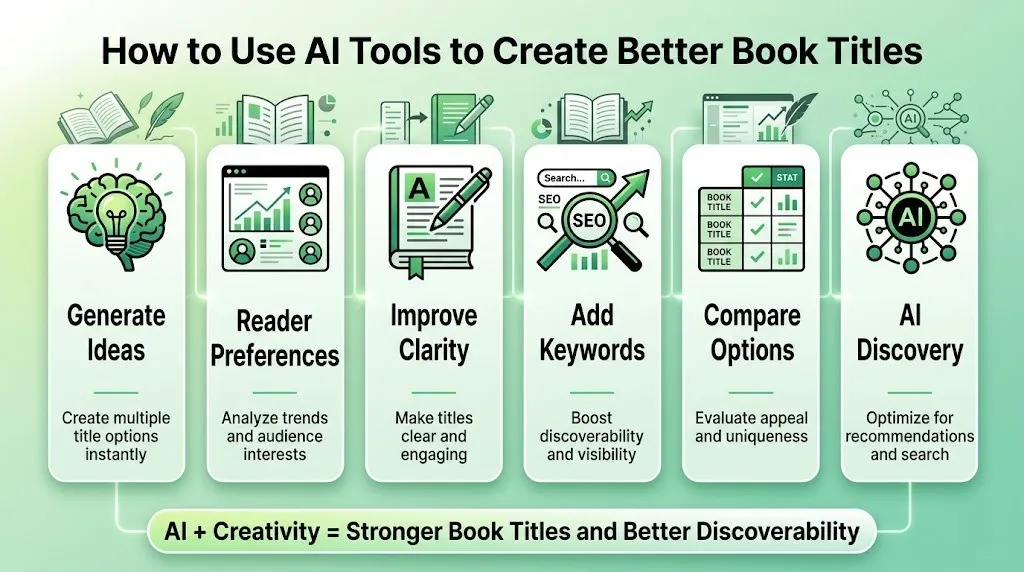
AI tools help authors create stronger book titles by combining creativity with data-driven insights. They can analyze your book’s topic, audience, and market trends to suggest titles that are more engaging, clear, and easier for readers to discover.
- Generate Multiple Title Ideas: AI can quickly create a wide range of title suggestions by understanding your book’s subject, genre, tone, and target readers. This allows authors to explore different creative approaches, compare ideas, and find titles that best represent the book’s message and value.
- Analyze Reader Preferences: AI tools can study audience interests, common search queries, and popular trends to suggest titles that connect better with potential readers. This helps authors create titles that match what their audience is actually looking for.
- Improve Title Clarity: AI can review an existing book title and identify whether it clearly explains the book’s topic and purpose. It suggests improvements to make the title easier to understand, more appealing, and more effective at attracting the right readers.
- Create Keyword-Friendly Titles: AI helps authors find relevant keywords and phrases related to their book’s topic. Including these terms naturally in a title can improve visibility on search engines, online bookstores, and AI-based recommendation platforms.
- Test Different Title Options: AI allows authors to compare multiple title ideas by analyzing factors like readability, emotional impact, uniqueness, and audience appeal. This helps in choosing a title that has stronger potential in the market.
- Optimize for AI Discovery (GEO): AI tools help create titles with clear meaning and context so that generative search platforms can easily understand what the book is about. A well-optimized title increases the chances of being recommended when readers ask AI tools for book suggestions.
Common Book Title Mistakes That Kill Your Rankings
Choosing the right book title is important, but many authors unknowingly make mistakes that reduce their book’s visibility and sales. Here are some common title mistakes to avoid:
1. Keyword Stuffing: Adding too many keywords to your title may seem like a good SEO strategy, but it can actually hurt your rankings. Amazon’s A10 algorithm now favors natural, reader-friendly titles over keyword-packed ones. Focus on clarity rather than cramming multiple keywords into the title.
2. Using Titles That Are Too Long Most readers discover books on their smartphones. If your title is too long, it may get cut off in Amazon search results, social media posts, and recommendation feeds. Short, clear titles are easier to read and remember.
3. Copying Trending Titles Without Adding Your Own Angle Following trends is smart, but directly copying bestselling titles can make your book blend into the crowd. Instead, take inspiration from successful titles and create something unique that fits your specific niche and audience.
4. Ignoring the Subtitle Many authors overlook the power of subtitles. A strong subtitle can explain the book’s topic, include important keywords, and help both readers and AI systems understand what the book offers.
5. Not Matching the Reader’s Expectations Your title should reflect the genre, topic, and overall feel of the book. If readers are searching for a practical guide, a mysterious title may confuse them. Similarly, fiction readers often look for certain emotions, themes, or tropes. Make sure your title matches the “vibe” your target audience expects.
Book Title: Formulas That Work in 2026
In 2026, successful book titles are no longer created only through creativity. With changing reader behavior, AI-powered search, and crowded online marketplaces, effective titles need to be clear, memorable, and optimized for discoverability. Book title formulas help authors create titles that quickly communicate value, attract the right audience, and perform better across search engines, bookstores, and AI platforms.
1. The “How To” Formula: Titles using the “How To” structure work well because they clearly promise a solution or learning outcome. They tell readers exactly what they will gain from the book.
Example: How to Build a Successful Online Business
2. The Problem + Solution Formula: This formula focuses on a reader’s challenge and presents the book as the answer. It works especially well for self-help, business, and educational books.
Example: Stop Overthinking: A Simple Guide to Finding Mental Clarity
3. The Benefit-Driven Formula: These titles highlight the result readers can expect after reading the book. They focus on transformation, improvement, or achieving a goal.
Example: The Confidence Blueprint: Build Skills and Become Your Best Self
4. The Audience-Specific Formula: Titles that clearly mention who the book is for help attract the right readers faster. They make the purpose of the book instantly understandable.
Example: Digital Marketing Guide for Small Business Owners
5. The Curiosity Formula: These titles create interest by using questions, unexpected ideas, or intriguing phrases that encourage readers to explore further.
Example: The Hidden Rules of Success
6. The Keyword + Value Formula: This approach combines important topic-related keywords with a clear benefit. It improves visibility while still keeping the title meaningful for readers and AI search systems.
Example: AI Marketing Strategies: A Practical Guide to Growing Your Business
7. The Transformation Formula: These titles focus on the journey from a current situation to a desired outcome. They are effective because they connect emotionally with readers.
Example: From Beginner to Expert: Mastering Public Speaking Skills
Using these formulas helps authors create book titles that are clear for readers, easier to discover, and better aligned with modern publishing trends.
Ending Note
In today’s competitive publishing landscape, a book title is no longer just a creative label — it is a powerful discovery tool. With millions of books competing for attention, Optimizing Book Titles has become essential for helping authors connect with readers, improve visibility, and increase discoverability across bookstores, search engines, and AI-powered platforms.
The future of successful titles lies in combining creativity, data, and technology. Authors who focus on clear messaging, relevant keywords, reader intent, mobile-friendly formatting, and GEO strategies can create titles that perform better across traditional search and AI-driven recommendations.
A well-optimized book title should instantly communicate value, match the audience’s expectations, and stand out in a crowded market. By using effective title formulas, avoiding common mistakes, and applying modern optimization strategies, authors can make their books easier to discover, more appealing to readers, and better positioned for long-term success.