
We live in an era of total digital connectivity, and this defines the central struggle for modern security teams: How do we get ahead of the accelerating curve of cyber threats? As enterprise networks become vast, intricate ecosystems and adversaries employ cutting-edge tactics, the age of relying on passive, perimeter-based defenses is over. Proactivity is the new perimeter.
Open source cybersecurity tools have emerged as powerful allies-offering transparency, community-driven innovation, and the freedom to customise solutions without vendor limitations. These tools don’t merely safeguard systems; they enable deeper visibility, faster incident response, and greater control over the entire security landscape. Supported by global developer communities, they evolve rapidly, adapt to emerging threats, and push the boundaries of defensive capability.
In this blog, we uncover the 15 Best Open-Source Cybersecurity Tools defining the future of cyber defense.
What are Open Source Cybersecurity Tools?
Open-source cybersecurity tools are cybersecurity-centered software applications, the source of which is publicly available, and anyone can study, modify, improve, and freely distribute it. As opposed to proprietary tools, open-source solutions enjoy the advantage of a worldwide community of developers, researchers and security experts who actively participate in updates, patches and improved features.
The tools are commonly applied in penetration testing, malware analysis, vulnerability scanning, threat monitoring, incident response, encryption, and network defense. Their cooperative approach helps them identify security vulnerabilities faster and creatively approach the problem.
The organizations prefer open-source security tools due to their transparency, affordability, flexibility, and the capability to interface with diverse IT environments. This transparency helps building trust as well as security innovation and quick adaptation to dynamic cyber threats.
List of 15 Best Open Source Cybersecurity Tools
1. Ghidra
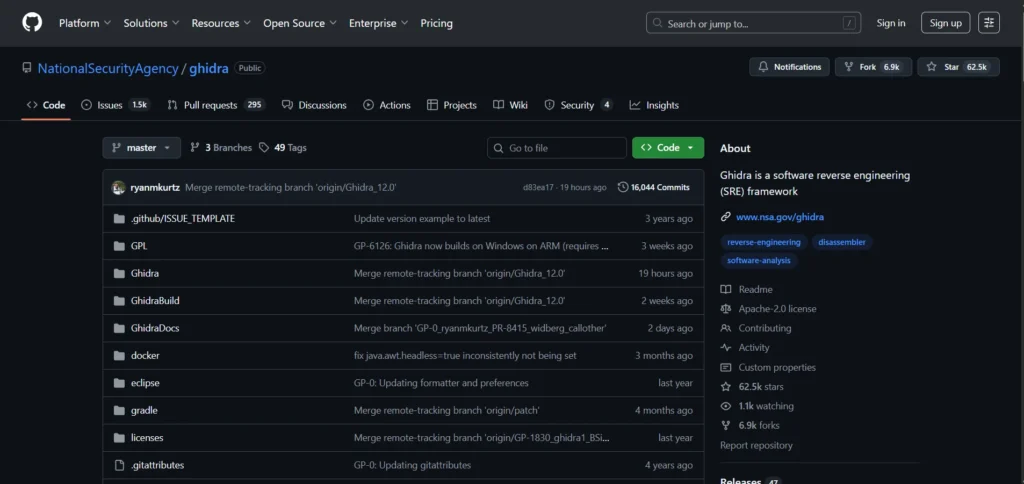
Ghidra is a powerful open-source reverse engineering suite developed by the U.S. National Security Agency, designed for analyzing software, malware, and compiled programs. It supports multiple architectures and executable formats, making it ideal for both research and defensive security operations.
The tool provides decompilation capabilities, collaboration support for team analysis, and scripted automation. Analysts use Ghidra to uncover hidden behaviors in malicious software, trace vulnerabilities inside binaries, and understand unknown code.
Its user-friendly GUI and plugin extensions allow customization at scale, while its active community ensures constant improvement. For malware researchers, exploit developers, and digital forensic experts, Ghidra remains indispensable.
Website: https://github.com/NationalSecurityAgency/ghidra
Key Features:
- Disassembly of compiled binaries for many processor architectures.
- Decompilation to high-level pseudocode (human-readable).
- Graphing and control-flow visualization for complex binaries.
- Scriptable analysis via Java or Python for automation.
- Support for Windows, macOS, Linux — cross-platform flexibility.
2. Security Onion
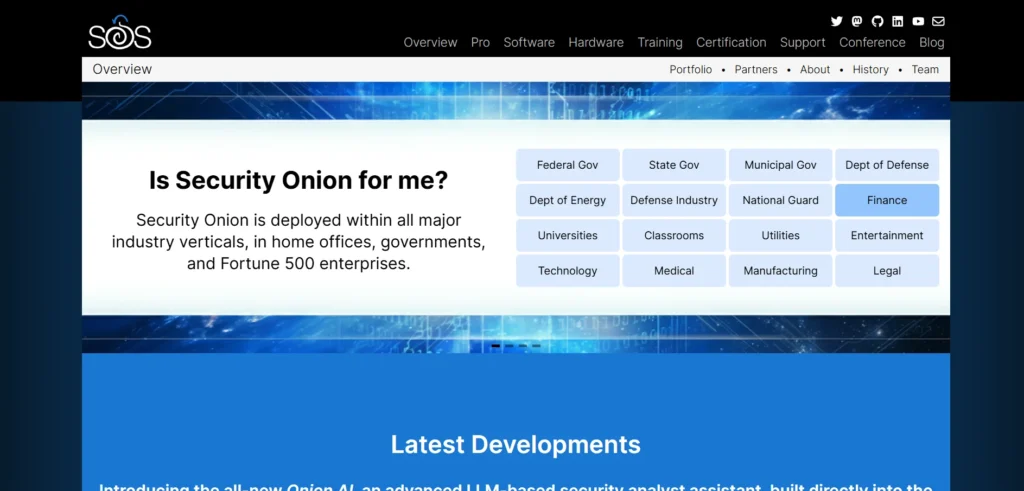
Security Onion is a complete Linux-based cybersecurity platform and one of the most powerful Open Source Cybersecurity Tools for enterprise-level security monitoring, threat hunting, and intrusion detection. It integrates tools such as Suricata, Zeek, Wazuh, Kibana, and Elastic to provide advanced visibility across network and host activity.
Ideal for SOC teams, it offers packet capture, log aggregation, alerting, visual dashboards, forensic investigation capability, and automated detection pipelines. Security Onion simplifies large-scale monitoring by centralizing data analysis in one place, reducing the complexity of multi-tool integration.
It is often deployed in enterprise networks, labs, and training environments for hands-on security event analysis. Highly scalable and community-supported, it is a full SIEM-class open-source stack.
Website: https://securityonionsolutions.com/
Key Features:
- Unified Linux distribution bundling multiple security tools.
- Network IDS/IPS integration (e.g. Suricata, Zeek, Snort).
- Centralized log aggregation using ELK stack (Elastic, Logstash, Kibana).
- Threat-hunting dashboards and log-analysis workflows.
- Scalable deployment for enterprise-scale monitoring across environments.
3. Suricata

Suricata is a new, multi threaded intrusion detection and prevention system aimed at real time inspection of packets and identifying threats in the networks. It is a high-speed traffic analysis engine based on signature and behavioral detection.
Suricata allows the use of automatic protocol parsing, TLS/SSL inspection, Lua scripting, file extraction and deep-packet inspection. It is used by organizations in identifying intrusions, malware communication, brute force attempts, DDoS behavior and policy violations.
Being an IDS/IPS engine, Suricata can be easily combined with SIEMs such as Wazuh and Security Onion to provide further security telemetry. Suricata is best suited to the enterprise, ISP, and cloud-scale security monitoring environments due to continuous rule changes and high-performance.
Website: https://suricata.io/
Key Features:
- Real-time intrusion detection and prevention via deep packet inspection.
- Multi-threaded engine for high performance on busy networks.
- Protocol parsing and support for many network protocols.
- Inline (IPS) or passive (IDS) deployment modes.
- File extraction and metadata logging from network traffic.
4. Snort
Snort is one of the most established open source cybersecurity tools and an intrusion detection and prevention engine widely used for network threat monitoring. It operates using rule-sets to detect malicious payloads, suspicious activity, exploitation attempts, and protocol anomalies.
Administrators deploy Snort to strengthen network perimeter security, enforce policy restrictions, and alert SOC teams about unauthorized access patterns. Although lightweight, Snort is highly customizable and can run on minimal infrastructure.
Its signature-based detection model helps block well-known attack vectors, while third-party signature databases extend its coverage. For more than two decades, Snort remains a trusted defensive tool in enterprise cybersecurity, penetration testing labs, and academic research.
Website: https://www.snort.org/
Key Features:
- Signature-based detection of known exploits and attacks.
- Real-time traffic analysis and packet logging for threats.
- Lightweight deployment possible on modest hardware / networks.
- Rule-set customization to tailor detection to environment.
- Wide community support and regular updates of rule databases.
5. Nmap
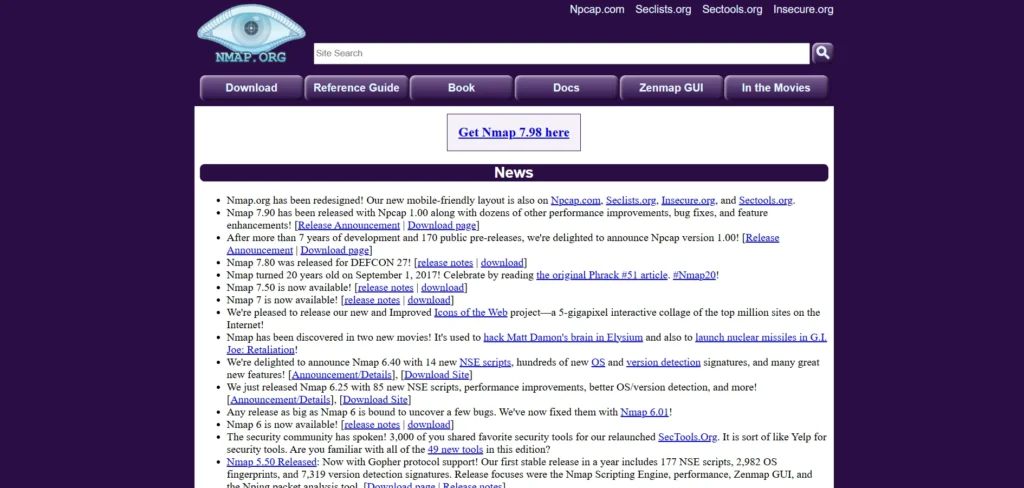
Nmap (Network Mapper) is a perfunctory reconnaissance, network audit and attack-surface discovery tool. It is scanned by security professionals in the process of detecting open ports, status of running services and identification of operating systems through networks.
Nmap is known to be automated when it comes to vulnerability enumeration, brute-force testing, misconfiguration testing, and service-specific security probing using its scripting engine (NSE). It is popular in penetration testing, network maintenance, bug bounties and SOC monitoring to map exposure prior to it being exploited by the attacker.
Nmap is compatible with visualization using Zenmap GUI and can be expanded to large scale scanning of enterprise size. Nmap is a well-known cybersecurity tool that is well-known because of its reliability, depth of insight, and speed.
Website: https://nmap.org/
Key Features:
- Network host discovery and active port scanning across subnets.
- Service detection and OS fingerprinting for target enumeration.
- NSE (Nmap Scripting Engine) automates vulnerability and configuration checks.
- Supports aggressive scanning and stealth scan techniques.
- Works across small to large networks — scalable mapping tool.
6. OpenVAS
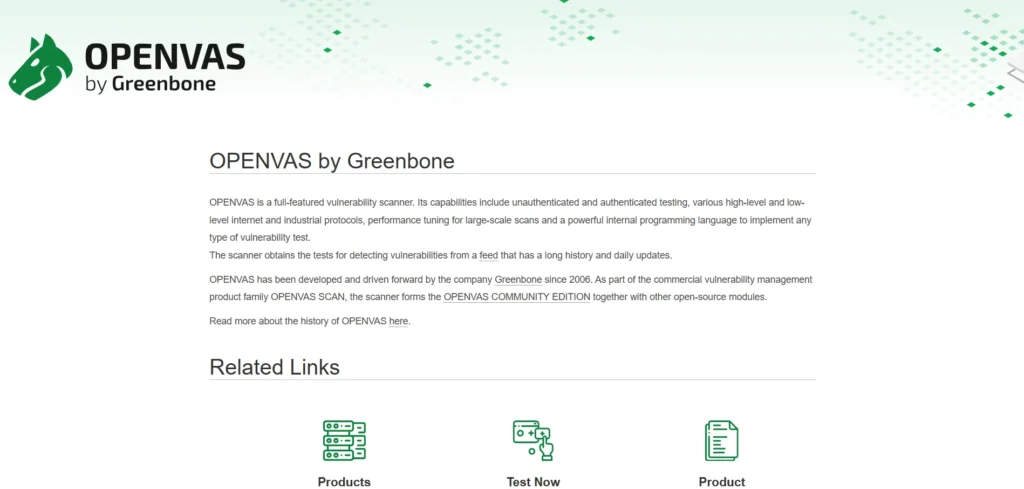
The open-source vulnerability scanner, OpenVAS (now part of Greenbone Vulnerability Management) is an effective example of Open Source Cybersecurity Tools, capable of identifying vulnerabilities in servers, applications, and networks. It has a large vulnerability database which is regularly refreshed to intercept outdated software, insecure configurations, missing patches, and potential points of exposure.
OpenVAS produces risk-scored reports in detail with remediation recommendations, which would be useful in compliance and continuous improvement. It is used by enterprises to conduct periodic security assessments, SOC vulnerability audits as well as pre-penetration testing hygiene checks.
OpenVAS is efficient on large companies with automation, scheduling, API integration, and scalable architecture. It is currently among the most reliable open-source vulnerability management engines.
Website: https://www.openvas.org/
Key Features:
- Comprehensive vulnerability scanning across servers and network devices.
- Maintains large, regularly-updated vulnerability database.
- Generates detailed risk-scored reports with remediation suggestions.
- Can schedule scans and integrate into regular security assessments.
- Useful for compliance audits and Patch Management Software–supported workflows.
7. Nikto
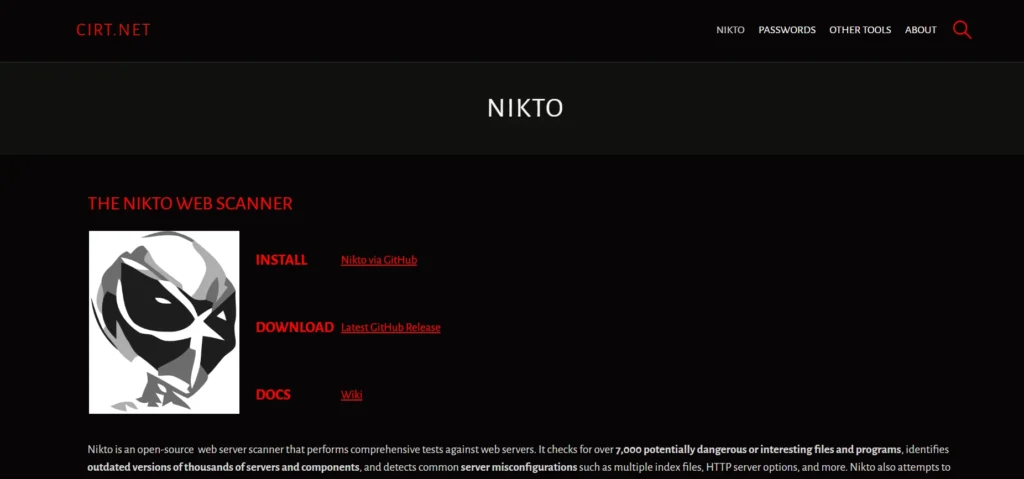
Nikto is a web-server scanning package that is open-source and is used to identify security weaknesses in web sites such as which software version is used, which configuration is vulnerable, uncovered directories, unsafe scripts, and which are entrance points that can be exploited.
It carries out detailed scans of thousands of established vulnerabilities and unsafe modules in minutes. Even though it is fast and lightweight, Nikto can be used to perform early-stage web penetration testing and red-team reconnaissance.
It is often used together with tools such as Burp, SQLMap and OWASP ZAP to explore further. Administrators deploy Nikto so as to enhance security levels on the server prior to deployment, as well as on-going monitoring. Nikto, a web-security necessity, is simple and script friendly and under active maintenance.
Website: https://cirt.net/nikto/
Key Features:
- Scans web servers for dangerous files, scripts, and configurations.
- Server Monitoring Tools that detect outdated and insecure server software versions.
- Looks for risky CGI, unsecured directories and misconfigurations.
- Captures and reports cookies returned by the server for inspection.
- Acts as quick reconnaissance scanner before deeper penetration testing.
8. YARA
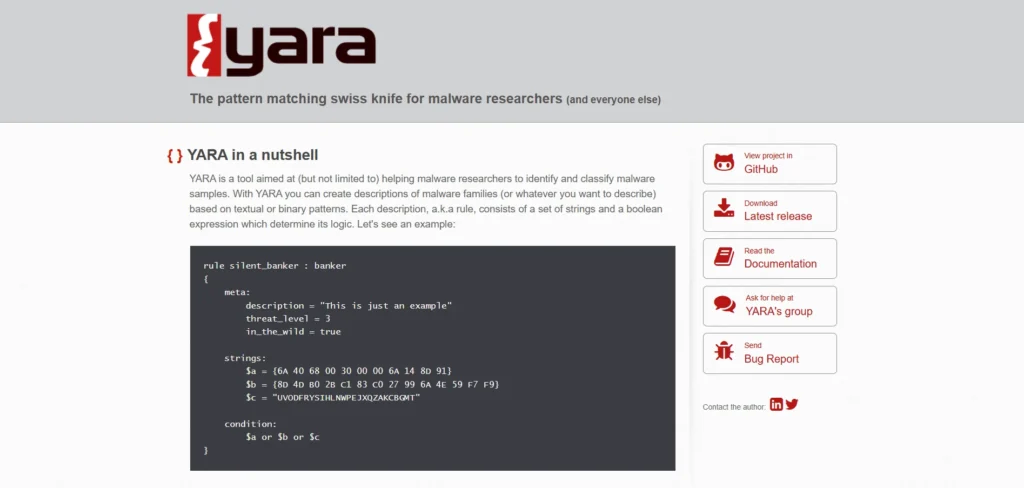
YARA is a malware detection and classification rule system and one of the most powerful open source cybersecurity tools with widespread application in incident response, threat hunting, and malware research laboratories.
The analysts are developing tailored signatures which identify the suspicious fingerprints of bytes, strings, behaviors and binary characteristics of malware families. YARA is used in automated pipelines to scan files, memory dumps and systems as a whole with a high level of efficiency. It is flexible and suitable in ransomware hunting, IOC research and malware triage workflows.
YARA enables security teams to follow the changing threats, label malicious items, and check the campaign attribution. YARA is also essential to the current malware protection strategy with the active community repositories of rules and scripting support.
Website: https://virustotal.github.io/yara/
Key Features:
- Rule-based detection of malware via custom pattern signatures.
- Scans binary files, memory dumps, and system artifacts for IOCs.
- Allows creation of complex rules combining strings, regex, and binary patterns.
- Useful in threat hunting, forensics, and malware classification workflows.
- Integrates with other security tools and automation pipelines.
9. OSQuery
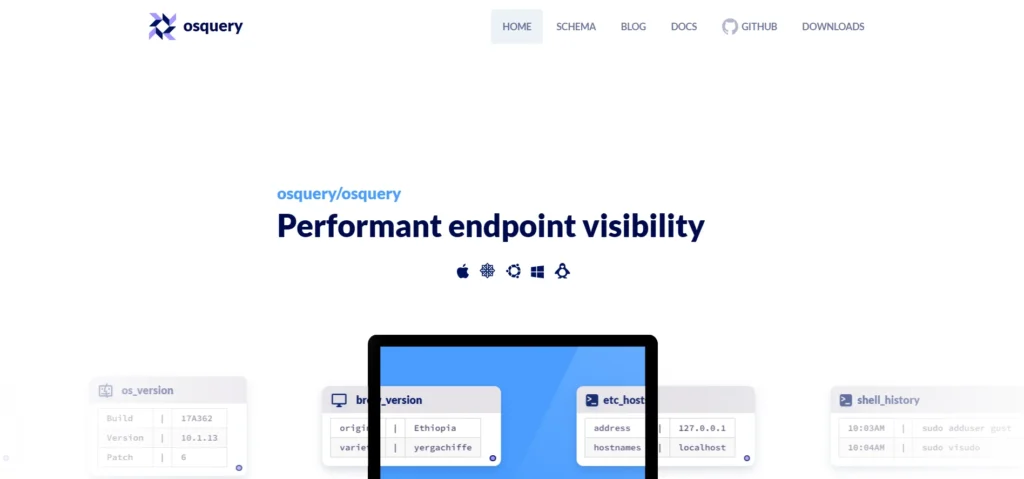
OSQuery converts operating-system data into a SQL-queryable database, allowing security teams to inspect system behavior in real time. Analysts can query processes, network connections, logs, kernel modules, USB activity, system integrity changes, and configuration parameters through simple commands.
This makes OSQuery invaluable for incident response, threat hunting, and compliance auditing. Cross-platform support across Windows, macOS, and Linux enables unified endpoint analysis at scale. OSQuery integrates well with SIEM platforms like Wazuh, Splunk, and Elastic, supporting distributed fleet monitoring.
Lightweight yet powerful, it provides visibility otherwise requiring multiple tools. For defenders, OSQuery is a transparent and flexible endpoint intelligence engine.
Website: https://osquery.io/
Key Features:
- Exposes OS internals via SQL-like queries (processes, network, logs).
- Works cross-platform: Windows, macOS, Linux — unified endpoint view.
- Enables real-time or scheduled system state checks for anomalies.
- Useful for incident response, compliance auditing, and system inventory.
- Lightweight — helpful as part of larger monitoring or EDR setups.
10. TheHive Project
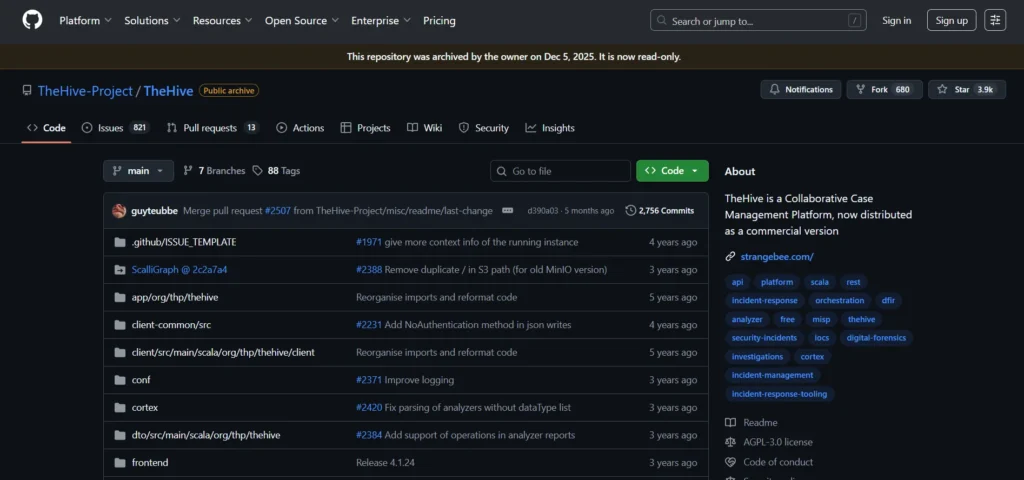
TheHive is a collaborative incident-response and case-management platform designed for SOC teams, IR analysts, and cyber-forensic units. It centralizes investigation data, indicators of compromise, malware samples, and response actions into organized workflows.
Analysts can assign cases, track evidence, link alerts, and automate enrichment through Cortex analyzers. TheHive improves response speed by enabling structured triage, shared documentation, and scalable teamwork for ongoing attacks.
Its integration with SIEM alerts, threat-intel feeds, and forensic tools helps organizations detect, investigate, and resolve incidents efficiently. With API automation and dashboards, TheHive remains one of the most powerful open-source platforms for coordinated cyber defense.
Website: https://github.com/TheHive-Project/TheHive
Key Features:
- Case-management workflows for security incidents and investigations.
- Centralizes alerts, IOCs, evidence and analyst notes for SOC teams.
- REST API supports integration with SIEM, alerting and other tools.
- Supports collaboration among multiple analysts, assignment and tracking.
- Helps organize structured incident-response workflows efficiently.
11. ClamAV
ClamAV is a widely used open-source antivirus engine and one of the most trusted Open Source Cybersecurity Tools for scanning and detecting malware, trojans, viruses, worms, ransomware, and suspicious file attachments. It integrates easily into email gateways, file servers, Linux environments, and automated cloud pipelines.
With real-time signature updates and heuristic detection, ClamAV helps prevent malicious files from entering or spreading across systems. Organizations deploy it for mail filtering, web proxy security, and threat hygiene in container environments.
Though lightweight, ClamAV supports command-line scanning, scheduled scans, multi-thread processing, and custom signature creation. It is frequently used as a defensive component in layered security architectures and Linux-based security stacks.
Website: https://www.clamav.net/
Key Features:
- Scans files for viruses, trojans, ransomware and malware signatures.
- Supports many archive and common document formats (ZIP, PDF, Office, etc.).
- Real-time scanning support for endpoints, mail servers, file shares.
- Heuristic and signature-based detection for unknown and known malware.
- Can integrate with other security platforms (e.g. loggers, SIEMs) for alerts.
12. OWASP ZAP
OWASP ZAP (Zed Attack Proxy) is a widely respected open-source tool for web-application penetration testing and vulnerability discovery. It identifies issues like injection flaws, insecure headers, authentication weaknesses, insecure cookies, and XSS exposures.
ZAP offers automated scanning, manual proxy-based inspection, fuzzing, authentication testing, and integration with CI/CD pipelines for DevSecOps workflows. As a dynamic testing tool, ZAP complements static application security testing approaches by identifying vulnerabilities that emerge during runtime. Security researchers favor ZAP for its intuitive UI, plugin-rich customization, and strong reporting formats.
It is ideal for developers, bug bounty hunters, and penetration testers who need to assess application security regularly. Backed by OWASP, ZAP grows continuously with global community contributions and frequent feature updates.
Website: https://www.zaproxy.org/
Key Features:
- Web-proxy for intercepting HTTP/S and analyzing traffic manually.
- Automated scanning for common web vulnerabilities (XSS, SQLi, etc.).
- Fuzzing and forced browsing capabilities to discover hidden endpoints.
- Integration with CI/CD pipelines for DevSecOps automated testing.
- Plugin-rich ecosystem for customization and extended testing abilities.
13. Metasploit Framework
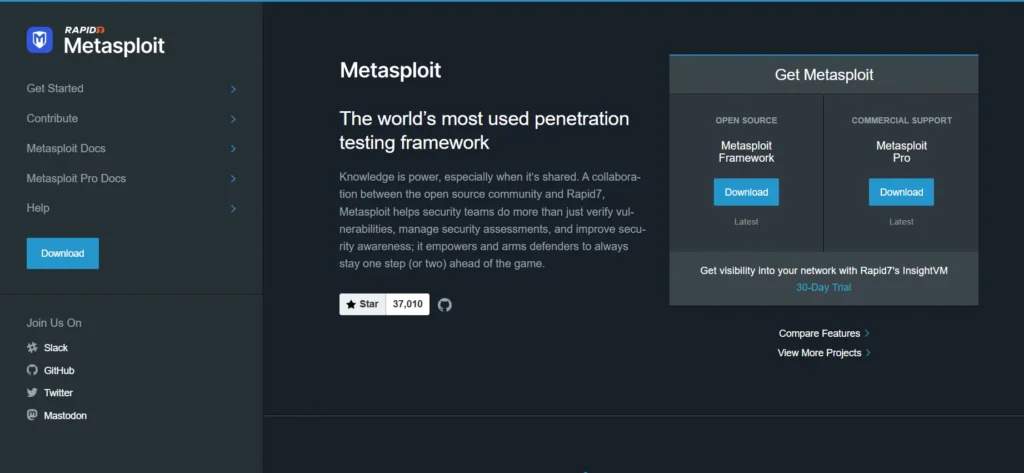
Metasploit Framework is the most iconic open-source penetration testing toolkit used to simulate real-world attacks, develop exploits, and validate system defenses. It offers hundreds of ready-to-use exploits, payloads, auxiliary scanners, and post-exploitation modules.
Red teams use Metasploit to test patch effectiveness, escalate privileges, and exploit vulnerabilities in controlled environments. With scripting, automation, and integration into other tools like Nmap, it supports full-kill-chain offensive testing. Metasploit also helps defenders understand attack vectors before adversaries exploit them.
Its active module repository ensures rapid coverage of emerging vulnerabilities, making Metasploit essential for offensive training, ethical hacking, and security research.
Website: https://metasploit.com/
Key Features:
- Hundreds of pre-built exploits and payloads for testing vulnerabilities.
- Ability to simulate realistic attacks in controlled environments (pentesting).
- Supports post-exploitation and privilege escalation modules.
- Integration with other tools (e.g. Nmap) for reconnaissance-to-exploitation workflows.
- Scripting and automation support to build custom attack chains.
14. Wazuh
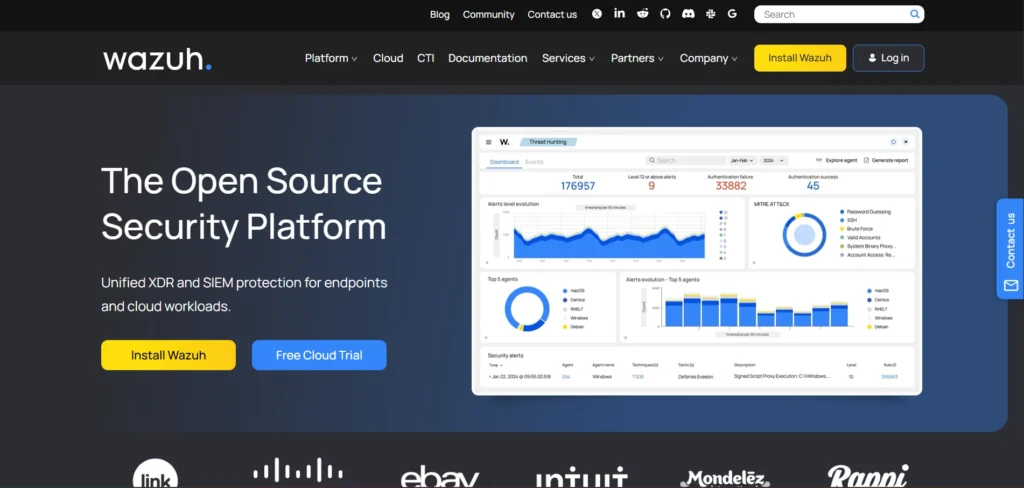
Wazuh is a comprehensive open-source security platform and one of the leading Open Source Cybersecurity Tools, offering SIEM functionality, threat detection, file integrity monitoring, compliance auditing, vulnerability analytics, and endpoint protection. It collects logs from servers, desktops, cloud environments, and network devices to generate alerts using security rules and behavior-based detection.
Wazuh integrates seamlessly with Elastic Search and Kibana to provide visual dashboards and large-scale monitoring capability. Organizations use Wazuh for SOC security automation, intrusion detection, compliance frameworks like PCI-DSS, and zero-trust endpoint monitoring.
Actively maintained, feature-rich, and scalable across thousands of devices, Wazuh stands as one of the strongest community-driven cybersecurity defense platforms.
Website: https://wazuh.com/
Key Features:
- Unified SIEM and XDR platform for endpoints and Cloud Workload Protection Platforms.
- Real-time log collection, event detection and alert generation.
- File integrity monitoring, malware detection and vulnerability assessment.
- Integration with other tools (e.g. TheHive) for incident response workflows.
- Scalable across on-premises and cloud deployments.
15. Kali NetHunter
Kali NetHunter is an Android-based mobile penetration-testing environment built on the popular Kali Linux ecosystem. It converts smartphones into portable security testing devices equipped with wireless attack tools, network scanning frameworks, HID keyboard emulation, and injection support for WiFi hacking assessments.
Red-team operators use NetHunter for on-site reconnaissance, wireless auditing, social-engineering payload deployment, and physical security evaluations. Its compatibility with hundreds of Kali modules makes it powerful for field penetration testing where laptops are inconvenient.
With kernel patches, exploit utilities, custom ROM builds, and community enhancements, Kali NetHunter enables professional cybersecurity operations directly from handheld mobile hardware.
Website: https://www.kali.org/
Key Features:
- Converts Android devices into portable penetration testing platforms.
- Supports wireless frame injection for WiFi and network vulnerability testing.
- Offers HID-keyboard emulation and BadUSB-style attack capabilities.
- Includes many tools from Kali Linux — comprehensive pentest toolkit on mobile.
- Useful for on-site assessments where laptops are inconvenient.
Quick Comparison
| Name | Pros | Cons |
| Ghidra | Powerful decompiler that reveals close-to-source code insights. | Steep learning curve for beginners unfamiliar with RE workflows. |
| Security Onion | All-in-one SOC monitoring stack reduces multi-tool overhead. | Resource-intensive — not ideal for low-spec hardware deployments. |
| Suricata | Multi-threaded engine handles high-throughput enterprise networks. | Requires signature tuning to reduce noisy or excessive alerts. |
| Snort | Trusted IDS with wide signature rule availability for threats. | Primarily signature-based, limited against 0-days without updates. |
| Nmap | Deep network visibility through granular scanning and NSE scripting. | Aggressive scans may trigger alerts or cause network disruption. |
| OpenVAS | Extensive vulnerability database with categorized risk scoring. | Large full-scope scans can be slow on dense networks. |
| Nikto | Quick detection of insecure web-server elements and exposures. | Generates many basic findings — requires manual verification. |
| YARA | Custom rules allow precise detection of malware indicators. | Effective use demands strong pattern-writing and malware knowledge. |
| OSQuery | SQL-like querying simplifies deep endpoint behavior visibility. | Alerting and response features rely heavily on external platforms. |
| TheHive Project | Enables collaborative IR case management for large SOC teams. | Requires configuration and separate Cortex setup for full utility. |
| ClamAV | Lightweight malware engine ideal for email and gateway scanning. | Depends mainly on signature updates — heuristic depth is limited. |
| OWASP ZAP | Strong web-app scanning with DevSecOps CI/CD integration. | Manual skill required to explore deep or custom web logic flaws. |
| Metasploit Framework | Huge exploit library enables realistic offensive security testing. | Can be misused — requires ethical and controlled usage policies. |
| Wazuh | Unified SIEM + endpoint security makes it a holistic defense tool. | Setup complexity increases with large, distributed environments. |
| Kali NetHunter | Turns mobile devices into full-scale pentesting environments. | Requires compatible Android hardware and custom ROM support. |
Ending Thoughts
In conclusion, open source cybersecurity tools have become essential assets in modern digital defense, offering transparency, flexibility, and cost-efficiency unmatched by many proprietary alternatives. Their community-driven development ensures continuous improvements, active vulnerability reporting, and rapid patching, making them dependable for both small organizations and large enterprises. These tools empower security teams to test system resilience, monitor threats, automate responses, and strengthen overall cyber readiness.
With open access to the codebase, users gain complete control and can tailor solutions to meet specific network environments. As cyberattacks grow in frequency and complexity, leveraging open-source tools fosters resilience, innovation, and collaboration across the cybersecurity domain, ultimately building a more secure digital ecosystem for all.
FAQs
Are open-source cybersecurity tools reliable?
Yes. Many open-source tools are maintained by vast communities of security professionals and developers who continually audit, update, and improve them, making them highly reliable when properly managed.
Can open-source tools replace paid security products?
They can, depending on organizational needs. Open-source tools offer powerful features, but paid solutions sometimes include advanced automation, support, and enterprise-grade functionality.
Are open-source tools free to use?
Most are completely free, but some may offer premium features or enterprise support at a cost. The core source code, however, remains openly accessible.
Do open-source security tools require technical expertise?
Often, yes. Many tools are designed for professionals with knowledge of networks, security testing, or command-line usage. Beginners may need time to learn configuration and usage.
Can open-source tools enhance overall organizational security?
Absolutely. When correctly implemented, open-source tools help identify vulnerabilities, detect threats early, improve monitoring, and strengthen defensive strategies across digital systems.