
A new Vietnamese market report just documented something every marketer is about to face: what happens to your positioning when the thing you were famous for becomes the industry minimum.
For about a decade, one promise sold consumer credit in Vietnam: fast. Approved in three minutes. Money in your account today. Card opened in five minutes. It worked, because it was genuinely hard to do, and only a few players could do it.
Then everyone learned how. eKYC got cheap. Automated underwriting became standard. Digital banking went mainstream. And a promise that used to be a differentiator quietly turned into a baseline expectation.
That shift is documented in detail in the Vaynhanh Fast Loan Market Report 2026, published in July 2026 by Vaynhanh Research in Hanoi. It is a serious piece of market research about consumer credit, not a marketing paper. But read it as a marketer and it turns into something more useful: a case study in what happens to an entire category when its main selling point commoditises, and what teams do next.
Here is what is in it, and the six lessons that apply well beyond fintech.
First, the market: a $42 billion niche inside a $764 billion system
Vietnam’s total banking system credit reached VND 20.03 quadrillion (roughly $764 billion) as of 29 June 2026, up 7.73% from the end of 2025, according to State Bank of Vietnam data cited in the report. Consumer lending grew about 26% during 2025, per FiinGroup figures the report references.
The “fast credit” slice, meaning small to mid-sized personal credit with quick decisions, light paperwork, and digital access, is estimated at VND 0.8 to 1.3 quadrillion, with a base case around VND 1.1 quadrillion. That is roughly $42 billion, or about 5% of total system credit.
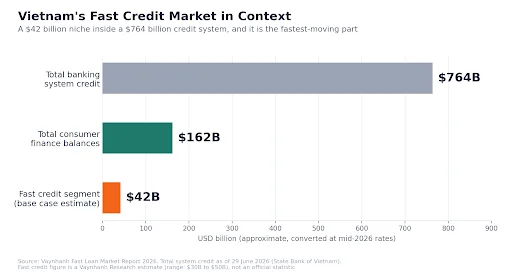
Fast credit is a small slice of Vietnam’s total credit system, but it is where the competitive action is.
Suggested alt text: bar chart comparing Vietnam total banking credit, consumer finance balances, and fast credit segment size in USD.
One number tells you how mature the audience already is: FE Credit reports serving over 14 million customers, and Home Credit Vietnam reports over 17 million. Those are company-published cumulative figures, and the report is careful to label them that way. But the scale point stands. This is not an early-adopter market you are educating from scratch. It is a market where tens of millions of people have already borrowed digitally at least once, and know what the experience is supposed to feel like.
Marketing translation: when your audience has already done the thing, “we make it easy” stops being a message. They know it is easy. They are now choosing on something else.
6 Marketing Lessons From Vietnam’s $42B Fast Loan Market
Lesson 1: When your category commoditises speed, you need a second axis fast
The report’s sixth headline conclusion is the one marketers should print out. It argues that as eKYC, process automation, and digital banking spread, processing time becomes hard to differentiate on for long. The next competitive layer, it suggests, is the ability to understand need, assess risk, be transparent about cost, and connect a borrower to a product that actually fits.
Notice what that is: a move from a feature claim to a judgment claim. “We are fast” is verifiable in seconds and copyable in a quarter. “We understand what you actually need” takes longer to prove and much longer to copy.
This pattern is not unique to lending. It is the same arc SaaS onboarding took (“get started in 60 seconds” is now table stakes), the same arc food delivery took, the same arc AI tools are living through right now. Once the capability ihttps://marketinghack4u.com/7-days-loan-app-list/s available to everyone, the claim stops selling.
What to do about it
- Audit your top three claims and ask which ones a well-funded competitor could match within two quarters. Those are not positioning, they are hygiene.
- Look for the claim that requires evidence rather than assertion. Evidence-based claims are slower to build and much harder to copy.
- Move your commoditised claim out of the headline and into the feature list where it still does useful work, just not as your differentiator.
Lesson 2: Segment by the problem, not by your product category
The report’s first headline finding is that fast credit is not the same thing as “loan apps.” Banks, consumer finance companies, credit cards, installment plans, BNPL, and embedded finance all end up serving overlapping liquidity needs, so the market should be read from what the borrower needs, not from what type of institution is supplying it.
In its foreword, the report makes the reframe explicit: this study does not just ask who is lending, it asks what financial problem the consumer is trying to solve, what options they can actually reach, and how credit is being allocated to them.
“A market that grows faster needs to be seen more clearly.”
Foreword, Vaynhanh Fast Loan Market Report 2026 (translated from Vietnamese)
For a marketer, this is a competitive-set problem, and most brands get it wrong. You benchmark against the companies in your category. Your customer does not. Someone who needs VND 30 million might compare a bank personal loan, a finance company cash loan, a credit card limit, and an installment plan. They are not thinking “this is a bank product and that is a fintech product.” They are thinking “which of these solves my problem this week.”
If you only track competitors who look like you, you are missing most of the options your buyer is actually weighing.
What to do about it
- Rebuild your competitive set around the job to be done, not the category label. Include the substitutes that do not look like you at all, including doing nothing.
- Write your positioning against the problem statement, not against the nearest branded competitor.
- Check your keyword research for problem-led queries, not just product-led ones. Problem-led search intent usually sits earlier in the journey and is cheaper to win.
Lesson 3: The real battle happens before anyone fills in a form
One of the report’s more quietly important observations is that competition increasingly happens before the application, at the stage of search, discovery, comparison, and product selection. Chapter 3 makes the same point structurally: banks and finance companies compete on funding and underwriting, BNPL and embedded finance compete at the moment the need appears, and digital distribution and comparison platforms compete at the discovery stage, before any application exists.
Chapter 8 then models the borrower’s journey as a narrowing set of options, and it maps almost exactly onto a marketing funnel.
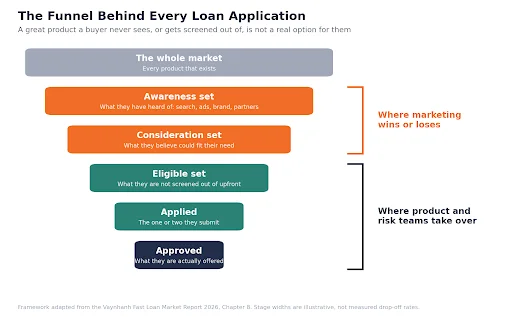
The buyer never chooses from the whole market. They choose from the shortlist they know about and believe they qualify for.
Suggested alt text: funnel diagram showing whole market, awareness set, consideration set, eligible set, applied, and approved stages.
The report’s conclusion is blunt: a good product that never enters the buyer’s option set, or that the buyer assumes they will not qualify for, is not really an option for that person at all.
That sentence should reframe how you think about your own funnel. You can have the best offer in the category and lose to a worse one that showed up earlier, explained eligibility more clearly, or simply made the buyer feel like the product was meant for someone like them.
What to do about it
- Measure how many qualified buyers never reach your site at all, not just how your on-site conversion rate is trending. Awareness-set loss is invisible in your analytics.
- Publish eligibility criteria clearly and early. Self-disqualification is a silent conversion killer, and vague criteria make cautious buyers assume the answer is no.
- Invest in the comparison stage: honest comparison pages, real scenarios, and content that helps people rule you out fast. Faster disqualification improves lead quality and trust at the same time.
Lesson 4: Your headline number is not your value proposition
Chapter 5 is the most consumer-facing part of the report, and its argument transfers straight into pricing pages everywhere. A loan cannot be called cheap or expensive from an advertised rate alone. Flat interest and declining-balance interest are not comparable as raw percentages. A promotional “0%” rate can still carry mandatory fees. To see the real cost you need the amount disbursed, the interest method, the fees, the periodic payment, and the total repayable, all at once.
Then there is the “from” price. The report explicitly discusses how a rate quoted as “from X%” acts as a price anchor, even though most applicants will not receive it. Any marketer who has ever written “starting at $9/month” for a plan almost nobody buys knows exactly what this is.
Here is the part that should make you uncomfortable: the report distinguishes perceived cost, which is the number the buyer sees and remembers, from economic cost, which is what they actually pay. Marketing controls the first. The gap between them is where churn, complaints, and refund requests are born.
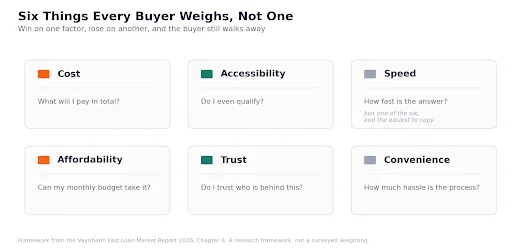
The report models buying decisions across six factors. Optimising one at the expense of the rest does not win the deal.
Suggested alt text: six-card diagram showing cost, accessibility, speed, affordability, trust, and convenience as buyer decision factors.
What to do about it
- Show total cost of ownership alongside your headline price, especially if your category is known for surprise fees. Being the first honest one is a positioning move.
- If you use a “from” price, show the realistic range too. Anchoring works in the short term and erodes trust in the long term.
- Test whether your lowest-friction plan is actually your best-converting one. Cheap that does not fit still loses to appropriate that costs more.
Lesson 5: Data just became a liability as well as an asset
Chapter 10 flags two regulatory changes that took effect on 1 January 2026: Vietnam’s Personal Data Protection Law (Law No. 91/2025/QH15) and its implementing decree (Decree 356/2025/ND-CP). Together, they now shape how lenders can collect and use borrower data. Separately, Decree 94/2025/ND-CP created a regulatory sandbox covering credit scoring, open API data sharing, and peer-to-peer lending.
The report’s framing is worth borrowing: data is a strategic asset that now carries higher legal obligations. It also warns that collecting more data is not automatically a licence to use it, and that more data can create new forms of exclusion rather than removing old ones.
If you run growth in any market with a modern privacy regime, and that is most markets now, the strategic read is the same. The era where the team with the biggest data pile automatically won is closing. The team that can earn consent, explain what it collects, and still target well is the one with the durable advantage.
Trust is starting to look like a distribution channel. If people are willing to give you accurate information, you can serve them better than a competitor working from scraped and inferred data.
What to do about it
- Move consent from a compliance checkbox to a value exchange. Tell people what they get for what they give.
- Audit which of your targeting depends on data you would be uncomfortable explaining on your own landing page.
- Build first-party data collection into the product experience, not just the marketing layer, so the data stays accurate as regulations tighten.
Lesson 6: Publishing your uncertainty is a credibility strategy
This is the lesson hiding in the report’s methodology, and it is the most counterintuitive one for anyone who writes marketing copy.
Every figure in the report is tagged by evidence type: [F] for an external fact, [D] for a figure the team calculated from source data, [E] for a model-based estimate, [P] for a claim a provider published about itself, [H] for a research hypothesis, and [FC] for a forecast. Estimates are never allowed to read as facts. A provider’s “3-minute approval” claim is never generalised into a universal outcome.
The team even downgraded its own headline number. An earlier draft used a base case of VND 1.05 quadrillion. After the audit, the recalculated model produced about 1.07, which the report rounds to “approximately 1.1” specifically because the input assumptions are too wide to justify two-decimal precision. They also decline to publish a single “fast credit cost index” and an access index, on the grounds that the underlying data cannot yet support either responsibly.
Think about how rare that is. A research brand voluntarily made its own flagship statistic look less precise, and explained why. The report’s own principle is that publishing honest uncertainty beats manufacturing a number more precise than the data allows.
In a content environment saturated with confident AI-generated claims and unsourced statistics, showing your working is becoming a differentiator on its own. Readers, journalists, and increasingly AI systems reward content that is checkable. Content that cites nothing and claims everything is getting cheaper by the day, which means it is also getting less valuable by the day.
What to do about it
- Label your estimates as estimates in your own reports and case studies. “We estimate” builds more trust than a fake-precise number.
- Publish your methodology alongside your data, especially for original research. It is the single easiest way to earn links and citations.
- Round your numbers to the precision your data actually supports. Over-precision reads as confidence to a skimmer and as sloppiness to an expert.
The scorecard: what to measure in 2027
The report closes with five hypotheses it commits to testing next year, each with a specific indicator. Reframed as marketing metrics, it is a genuinely good annual planning checklist for any category going through commoditisation.
| The shift | What to track |
| Speed becomes baseline, not advantage | Whether your speed claim still moves conversion, or has stopped mattering |
| Matching beats listing | Conversion and qualification rates after comparison, not just traffic volume |
| Better data widens the addressable audience | Whether previously excluded segments now convert at acceptable quality |
| Trust becomes hard to copy | Complaint volume, refund rates, disclosure clarity, and review sentiment |
| Distribution keeps embedding into other platforms | Share of acquisition coming from partners and embedded placements versus owned channels |
Key takeaways
- Commoditisation is a marketing problem before it is a product problem. When your headline capability becomes standard, the claim stops selling long before the capability stops working.
- Your buyer’s competitive set is bigger than yours. They compare by problem, not by category, and they include options that look nothing like your product.
- Most of the funnel loss happens before your form. Awareness, consideration, and self-disqualification decide more outcomes than your landing page does.
- Headline pricing and real pricing are different products. The gap between what buyers perceive and what they pay is where trust gets destroyed.
- Consent is becoming the new targeting advantage. Accurate data given willingly beats inferred data collected quietly, especially as privacy law tightens.
- Showing your working is a growth tactic. In a market flooded with confident, unsourced content, checkable claims stand out.
The bottom line
The VayNhanh report boils its own ambition down to six words: right credit, right borrower, right time. Strip out the word “credit” and you have a reasonable description of what good marketing has always tried to do. Right offer, right person, right moment.
What is changing is which part is hard. Being fast used to be hard. Being reachable used to be hard. Both are now largely solved problems, in lending and in most other categories. What remains genuinely difficult, and therefore genuinely defensible, is knowing who your offer is actually right for, saying so clearly, and being willing to tell the rest of the market that it is not for them.
That is not a growth hack. It is slower, harder, and much less copyable. Which is exactly why it is worth building.
Sources and notes
All figures and frameworks are drawn from the Vaynhanh Fast Loan Market Report 2026, published by Vaynhanh Research (Hanoi, July 2026), which lists a data cutoff of 27 July 2026. Total system credit data originates with the State Bank of Vietnam; consumer lending growth and asset quality figures originate with FiinGroup as cited in the report. Customer counts for FE Credit and Home Credit are company-published cumulative figures. The fast credit market size is a Vaynhanh Research estimate, not an official statistic. USD conversions are approximate, at mid-2026 rates. Quotations are translated from the original Vietnamese.