LinkedIn Learning still tops Google for “online courses,” but the ground just shifted. In December 2025, Coursera and Udemy sealed a $2.5 billion merger—creating the largest skills platform yet. Recruiters also note that 86 percent of employers view micro-credentials as résumé gold.
If LinkedIn Learning’s brisk slide decks and shrug-worthy certificates leave you wanting more, you have options. Recurring complaints such as steep subscription fees, video-only lessons, and credentials that carry limited professional weight are teased out in GoSkills’ a guide to LinkedIn Learning alternatives, which sets the scene for the deeper scoring below. We scored two dozen competitors on depth, value, credential weight, enterprise features, and engagement. The nine stand-outs follow in rank order so you can choose the mix that turns “I should learn this” into “I just proved it.”
How We Picked the Winners
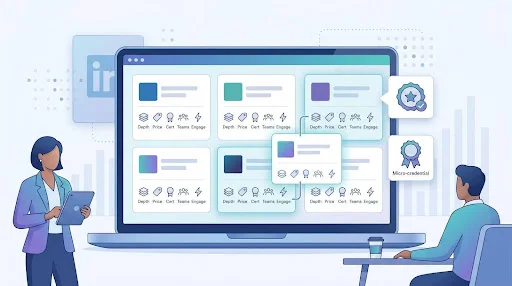
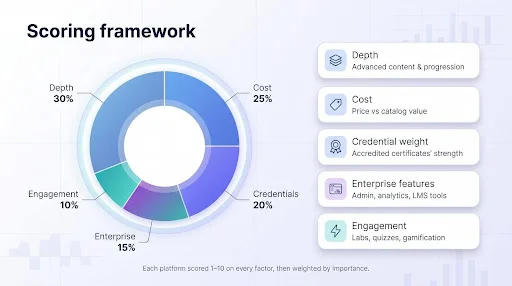
First, we scored what matters when you click “Enroll.”
Depth topped the list. If a platform stops at beginner tips, you stall, so content quality and progression paths counted for 30 percent of the score.
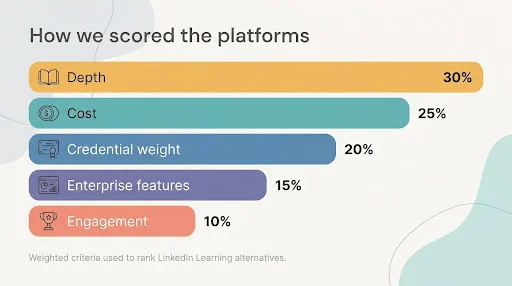
Cost had to make sense. A low price means little if the catalog is thin, so price-to-value carried 25 percent.
Next came credential weight. Does the certificate come from a university or an accredited body? That credibility made up 20 percent.
Corporate readers need proof that the tool scales, so we gave 15 percent to enterprise features (admin dashboards, analytics, and simple LMS connections).
Finally, learning should stick. Interactive labs, bite-size lessons, and smart gamification filled the engagement bucket, the last 10 percent.
Each contender earned a one-to-ten score on every factor, then we applied the weights and ranked the totals. The nine platforms ahead finished well above the pack, giving us a confident order.
List Of Best LinkedIn Learning Alternatives
Now, let’s dive into the list.
1. GoSkills: Best All-in-one Platform for Business Skills and Teams
GoSkills began as a micro-course studio; today it feels like a pocket-sized business academy with a learning management system built in.
Lessons run three to seven minutes, so you can finish a module between meetings instead of blocking an afternoon. Each clip ends with a short quiz or practice file that locks the skill in place.
Those bursts add up. The catalog now tops 500 courses (thanks to a recent collaboration with Madecraft) and covers high-impact tools every knowledge worker needs: Excel, Power BI, project management, finance, design, and a growing list of soft-skill tracks.
Credibility is baked in. Every completed course issues an accredited certificate recognised by CPD in the UK and by PMI for professional development units, giving your résumé proof instead of fluff.
For solo learners the math is simple: $39 a month or $299 a year unlocks everything, with a seven-day free trial to test the waters. Teams get sliding-scale pricing, admin dashboards, and a drag-and-drop course builder that lets you add your own content alongside GoSkills originals (no separate LMS needed).
Engagement stays high thanks to gentle gamification. Earn coins, badges, and even bonus subscription days as you progress. An AI assistant called Genie recommends the next lesson, answers quick questions, and helps managers stitch custom micro-courses from existing clips.
Where does GoSkills stumble? Depth in hyper-niche tech topics is limited, and the mobile experience still runs through a browser rather than a native app. Power users who live on their phones may feel that friction.
For most professionals, especially small and mid-size companies seeking a turnkey learning hub, GoSkills offers a rare mix of bite-size content, accredited credentials, and enterprise controls without straining the budget.
In short, if LinkedIn Learning leaves you hungry for rigor or admin visibility, start with GoSkills.
2. Udemy: Best for Affordable, On-Demand Depth
If GoSkills offers a fixed menu, Udemy is an all-you-can-eat buffet with 250 000 courses and counting.
Most instructors price their work high, then join near-permanent sales that cut tags to fifteen or twenty dollars. You pay once, keep the course for life, and dip back in whenever a project demands a forgotten trick.
Choice is Udemy’s superpower. Need a 40-hour Python masterclass, a crash course in Midjourney prompts, or a weekend tutorial on sourdough starters? You will find several of each, ranked by thousands of student reviews. That crowd feedback weeds out weak content fast, so the top sellers usually earn their stars.
There is a trade-off. Because anyone can publish, quality ranges from brilliant to barely-edited webcam rants. Savvy learners preview videos, scan ratings, and read recent comments before clicking Buy.
For companies, Udemy Business bundles roughly 28 000 pre-vetted courses into a seat-based subscription. Managers get usage dashboards and can sync completions with HR systems, turning Udemy into more than a hobby shop.
Certificates carry weight similar to LinkedIn Learning’s: fine for showing commitment, less so for impressing a hiring committee. Still, when speed and price matter, Udemy wins. Grab the specific skill you need, when you need it, and move on without an extra monthly fee.
3. Coursera: Best for Recognized Credentials and Structured Paths
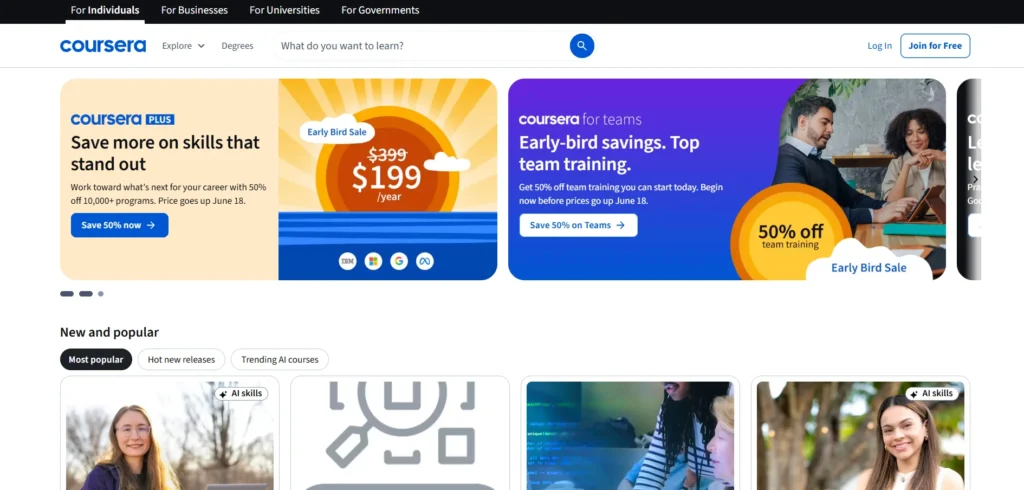
Picture trading a one-hour overview for a six-week university course without quitting your job or adding loan stress. That is the Coursera promise.
Every class comes from a name you know. Stanford, Google, IBM, and more than 370 partners supply syllabi, graded quizzes, peer-reviewed projects, and, most important, a certificate with their logo. Hiring managers trust those brands, so the badge signals real substance.
Learning feels like college but runs at your pace. Most courses unlock all material on day one, so you can binge on a weekend or spread tasks across evenings. When you want a bigger challenge, Specializations and Professional Certificates link several courses into a guided path and finish with a capstone project you can show recruiters.
Cost stays flexible. Audit mode lets you watch videos free; pay only when you need the certificate. Power users pick Coursera Plus at fifty-nine dollars a month and collect unlimited certs for the price of two dinners.
Companies choose Coursera for Business to roll out curated tracks, such as Data Analyst or Digital Marketing, and to track progress in clean dashboards. It lacks the custom-content tools of GoSkills, yet for firms chasing brand-name credentials at scale, the trade-off works.
Downsides? Depth takes time. A single course may ask five hours a week for a month, far more than LinkedIn Learning’s quick hits. While Plus covers most catalog items, a few marquee programs cost extra, so check fees first.
If your next role, promotion, or visa hinges on a credential people respect, Coursera turns online study into résumé gold.
4. Pluralsight: Best for Deep, Hands-on Tech Mastery
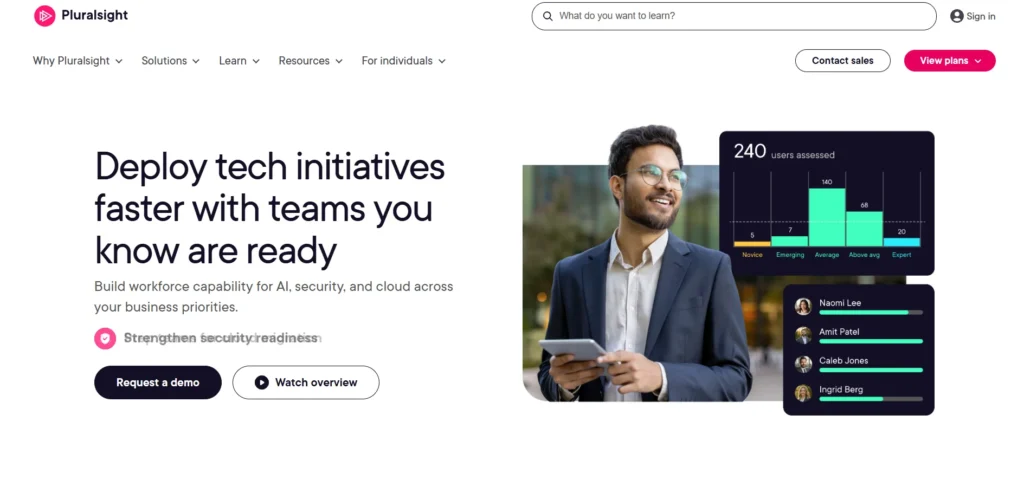
LinkedIn Learning scratches the tech surface. Pluralsight drills to the bedrock.
The catalog spans seven thousand courses focused on software development, cloud, cybersecurity, and data. Content updates race alongside industry releases, so last month’s AWS feature already has a walkthrough.
Before lesson one you take a Skill IQ test, twenty rapid-fire questions that pinpoint your level. The platform then lines up a personalised path, so you spend zero minutes on topics you already know.
Learning never stays theoretical. Premium members open live sandboxes spun up in real cloud accounts. You deploy, break, and redeploy infrastructure without risking the company environment. Finish a module and you see an instant Skill IQ bump, a dopamine hit that keeps developers coming back.
Managers track progress in an analytics board that flags skill gaps across the engineering team. That clarity turns training from “nice to have” into a roadmap for promotions and project staffing.
Price reflects the specialist focus: $299 a year for individuals, more for labs and certification prep. Yet teams replacing scattered textbooks, conferences, and exam vouchers often save by consolidating here.
Pluralsight’s narrow scope is both strength and limit. Designers, marketers, or HR staff will find little for them. But if code, cloud, or security sits in your job description, this is where you move from competent to expert.
5. edX: Best for Free, University-Grade Learning
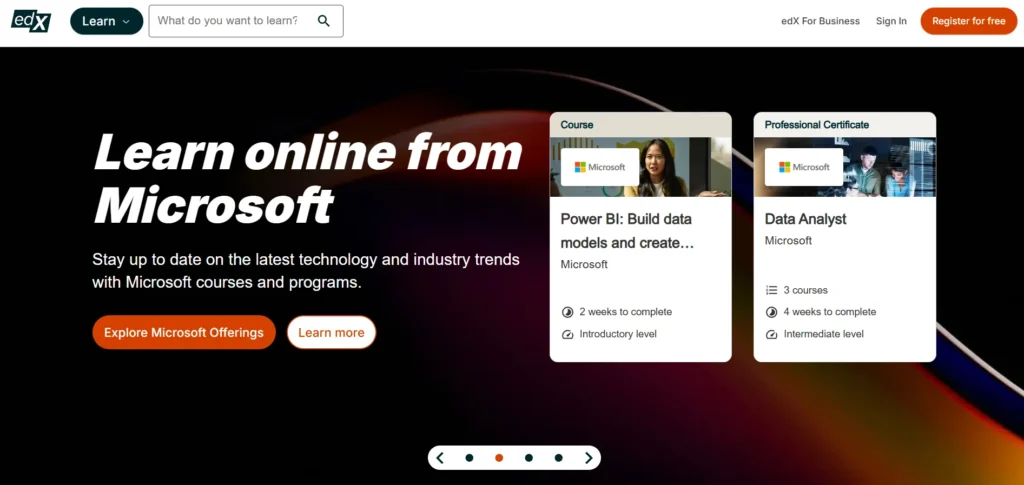
If Coursera is a digital campus, edX is the open front gate. Most courses let you audit for free, so you can sit in Harvard’s CS50 or MIT’s supply-chain class without spending a cent.
Choose the verified track to unlock graded work and a certificate that carries the university seal. Those credentials cost fifty to three hundred dollars, far less than a community-college credit and far more respected than a generic completion badge.
edX leans academic. Expect problem sets, peer forums, and the occasional proctored exam. Finishing feels like an achievement, not a checkbox.
MicroMasters bundles five to eight graduate-level courses into one package. Complete the series and many partner schools will let you apply the credits toward a future master’s, turning self-paced study into a tuition discount.
The flip side: practical business skills are limited, and nothing here is bite-size. If you struggled to finish a two-hour LinkedIn video, a six-week edX course will test your resolve. Certificates also require a one-time fee per course; there is no flat subscription.
For learners craving depth, brand prestige, and pay-as-you-go flexibility, edX remains the gold standard of open academia online.
6. Skillshare: Best for Fast, Creative Inspiration
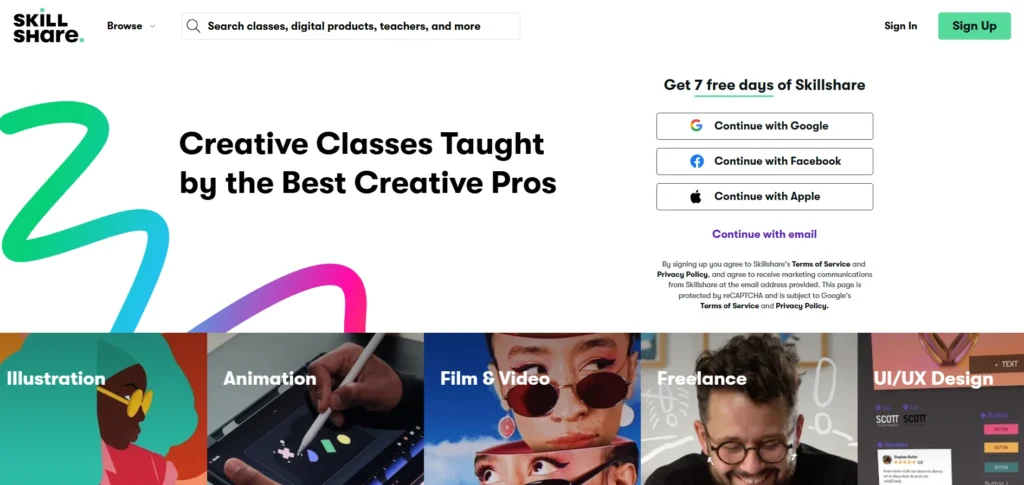
Skillshare feels less like school and more like an always-open studio.
Open the app and you will see thousands of short, project-based classes on illustration, photography, copywriting, motion graphics, and every creative corner in between. Most run under an hour, broken into snack-size lessons that fit a lunch break.
Each class ends with a project prompt. You upload your work, browse peer submissions, and trade feedback. That gallery turns passive watching into active doing, a key reason Skillshare’s completion rates beat typical MOOCs.
Cost is simple: an annual fee of about one hundred sixty-five dollars unlocks the full library. A one-month free trial lets you binge a few courses before the card is charged.
Trade-offs exist. Skillshare issues no certificates, and quality varies because anyone can teach. The community rating system surfaces the gems quickly, and for pure creative spark, formal badges rarely matter.
If LinkedIn Learning’s Adobe tutorials left you yawning, jump into Skillshare’s hand-lettering challenge or colour-grading workshop. You will finish with a portfolio piece and a jolt of motivation, not just another video ticked off a list.
7. O’Reilly Online Learning: Best for Continuous Tech Reference and Live Events
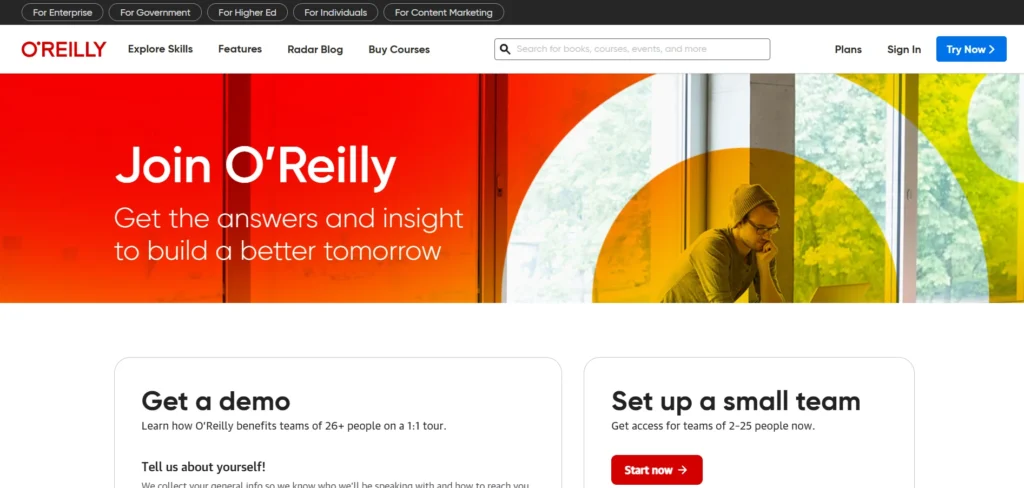
Picture a digital shelf packed with every O’Reilly “animal” book you ever wanted, plus video courses, podcasts, and a steady stream of live workshops. That mix is O’Reilly Online Learning.
The platform suits engineers who learn in the flow of work. Search a topic, skim a code snippet from a best-selling title, then jump into a five-minute video or launch a Kubernetes sandbox to test the idea, all without leaving the site.
Live content sets O’Reilly apart. More than two hundred instructor-led sessions stream each month, so you can quiz experts on the week’s newest AI library instead of waiting for a conference.
Enterprises appreciate the depth and the tracking. Managers assign curated playlists, watch engagement stats, and verify that certification prep modules are used before exam vouchers go out.
For individuals the price, just under five hundred dollars a year, may sting, yet it replaces a shelf of tech books and a couple of training events. Many users access it free through public-library partnerships, a handy workaround if you are budget-tight but knowledge-hungry.
You will not earn formal certificates here, and non-tech learners may feel lost. For developers and data pros chasing the bleeding edge, O’Reilly delivers an unmatched blend of reference, practice, and real-time expertise.
8. DataCamp: Best for Interactive Data Science Practice
Plenty of platforms teach Python. DataCamp makes you type it until muscle memory sets in.
Courses pair a minute or two of explanation with an in-browser coding task. You write real code, click Run, and watch an automated checker nudge you if a semicolon slips. That loop keeps you engaged and speeds the jump from theory to usable skill.
Tracks bundle twenty to thirty courses into a clear ladder such as Data Analyst with SQL, Data Scientist with Python, or Machine Learning Engineer. Follow a path and you log roughly one hundred hours of hands-on practice plus portfolio-ready projects built on live datasets.
Gamified XP and daily streaks look playful, yet they serve a purpose: nudging busy professionals back for one more exercise. Managers view those metrics in team dashboards and spot who needs support before a deadline.
Pricing lands at twenty-five dollars a month when billed annually, with a forever-free tier that unlocks the first chapter of every course. Enterprise plans add single sign-on, progress analytics, and dedicated customer success support.
Drawbacks? Content lives almost exclusively in the data stack—ideal if you wrangle numbers, irrelevant if you design logos. DataCamp’s new proctored certificates carry weight inside analytics circles but lack the brand punch of a university seal.
For anyone stalled after passive Python videos on LinkedIn Learning, DataCamp’s code-first model turns curiosity into confident keyboard shortcuts.
9. MasterClass: Best for High-impact Storytelling and Soft-Skill Insight
Some learning goals call for inspiration, not spreadsheets. MasterClass meets that need by placing you in the virtual room with world-class performers.
Production feels cinematic. The camera follows Gordon Ramsay through a pristine kitchen or lets Margaret Atwood mark up a manuscript in real time. You absorb craft and mindset through story, not slides.
Each class runs two to four hours in total, sliced into bite-size segments you can binge like a mini-series. A companion PDF workbook lists exercises, but participation is self-directed with no quizzes or grades, only practical prompts to try after the credits roll.
Pricing is clear: one hundred twenty dollars a year opens the full library. Higher tiers add offline downloads and extra household seats, turning it into a family pass.
MasterClass skips certificates, and depth varies. You will not be ready to publish a novel after one course, yet you will gain the frameworks and mental models that propelled the instructor to the top.
For leaders, marketers, and creatives who find LinkedIn Learning’s soft-skill content sterile, a session with Bob Iger on decision-making or Chris Voss on negotiation can spark genuine behaviour change.
Quick Comparison at a Glance
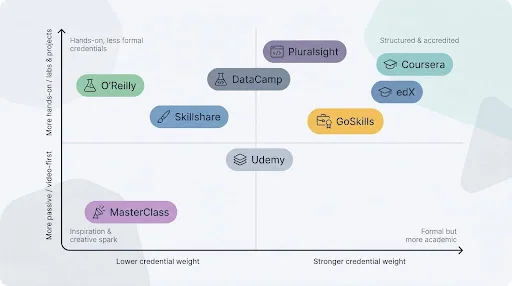
Scan the field in sixty seconds, then return to the deeper blurbs when time allows. The two tables below show price, credential value, and standout features without extra scrolling.
Table 1 – Price, Trial, and Certificate Snapshot
| Platform | Best for | Individual price | Free option | Certificate type |
| GoSkills | Business skills + LMS | $39 mo / $299 yr | 7-day trial | CPD & PMI accredited |
| Udemy | Low-cost depth | $15–$25 per course (sale) | 1 000s of free minis | Completion PDF |
| Coursera | Recognised credentials | $59 mo (Plus) | Audit videos free | Univ./Industry seal |
| Pluralsight | Advanced tech | $299 yr (Standard) | 10-day or 200 min | Completion + Skill IQ |
| edX | Academic rigour | $50–$300 per course | Audit free | Univ. verified |
| Skillshare | Creative spark | $165 yr | 1-month trial | None |
| O’Reilly | Tech reference | $499 yr | Public-library access | None |
| DataCamp | Hands-on data | $25 mo (annual) | Free first chapters | DataCamp cert |
| MasterClass | Inspiration | $120 yr | 30-day refund | None |
Table 2 – Feature Matrix
| Feature | GoSkills | Udemy | Coursera | Pluralsight | edX | Skillshare | O’Reilly | DataCamp | MasterClass |
| Interactive labs | ✓ | ✓ | ✓ | ||||||
| Gamification | ✓ | ✓ | ✓ | ✓ | |||||
| Team admin dash | ✓ | ✓ | ✓ | ✓ | ✓ | ✓ | |||
| Mobile offline | Browser | ✓ | ✓ | ✓ | Limited | ✓ | ✓ | ✓ | |
| Accredited cert | ✓ | ✓ | ✓ | ||||||
| Live events | ✓ | ||||||||
| Course builder | ✓ | ||||||||
| Free always-on content | Some | Audit | Audit | Library* | Chapters |
*Many public libraries provide free O’Reilly accounts; check your local branch.
Use these grids to confirm fit before starting a trial. If you need accredited certificates, look to GoSkills, Coursera, or edX. Need hands-on labs? Pluralsight, O’Reilly, and DataCamp stand ready.
Conclusion
Use these grids to confirm fit before starting a trial. If you need accredited certificates, look to GoSkills, Coursera, or edX. Need hands-on labs? Pluralsight, O’Reilly, and DataCamp stand ready.
Frequently Asked questions
Is LinkedIn Learning still worth the monthly fee?
If you already have LinkedIn Premium and dip into a few courses each week, the built-in library is convenient. When you need accredited certificates, deeper tech practice, or a stronger creative community, one of the alternatives above delivers more value for the same price or less.
What is the cheapest credible option?
Two paths stand out. Audit university courses on edX or Coursera for free and pay only if you want the certificate. For one-off practical skills, wait for a Udemy sale and grab lifetime access for about fifteen dollars. Either route beats paying thirty dollars every month for content you may not finish.
Do employers actually care about these online certificates?
Yes. A recent survey found that 86 percent of employers agree micro-credentials strengthen a candidate’s application, especially when paired with a portfolio link. University badges from Coursera or edX and CPD or PMI credits from GoSkills carry the most weight.
Why did Coursera and Udemy merge, and does it matter to me?
The December 2025 deal created a $2.5 billion giant aimed at the AI-driven reskilling wave. Learners can expect a larger catalogue under one roof and possible changes in pricing once the integration settles. Watch for Plus-style bundles that may combine both libraries.
Which platform should my small team start with?
If you need admin dashboards, accredited business courses, and the option to add your own modules, GoSkills is the fastest turnkey choice. Tech-heavy teams lean toward Pluralsight or O’Reilly for labs and analytics, while design agencies often pair Skillshare for inspiration with Coursera for formal leadership development.