
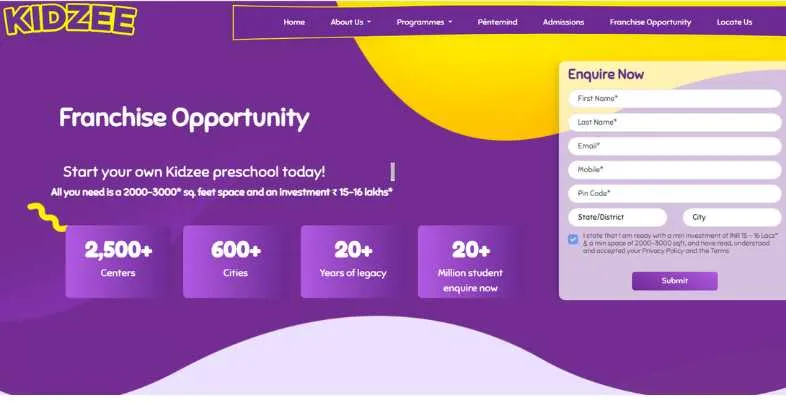
Are you wishing to start a Kidzee franchise? Then you’ve come to the right place. In this article, we’ll be discussing everything about this topic, kidzee franchise cost, kidzee opening format, and so on. One of the flagship initiatives by Zee Learn Ltd, Kidzee, revolutionized the standard of preschool education in India and Nepal. Today, it connects over 2,000 centers across 750+ cities. Its phenomenal growth affected over 1.5 million children, thus earning it a title as Asia’s largest preschool chain.
The number game is not a success of the institution but much deeper commitment toward nurturing minds at the most crucial developmental years. To realize wholesome prospects far beyond mere academics-a dream shared by every Kidzee center what every center strives for.
Kidzee Edge: What Makes It Stand Out
Kidzee has undoubtedly emerged as a distinct player in today’s competitive landscape of education through innovative approaches toward early childhood education. Through the proprietary Interactive Learning Approach of the brand, various intelligences in children can be developed to facilitate the nurturing of an individual child’s unique learning style.
The curricula in this school are not about teaching ABCs and 123s but rather preparing for more lifelong learning. This fact has generated much trust from the parents, making them top choices for early childhood education.
Why Invest in a Kidzee Franchise in 2026?
The Indian preschool market is rated USD 4.6 billion today and in the next seven years will grow to almost USD 11billion. The Kidzee franchise is one of the safe, proven and intentional investments in this rapidly growing landscape.
Kidzee is the largest preschool chain in Asia with 2,000+ centers operating in 750+ cities. Zee Learn Ltd. supports the brand, and thus the brand has institutional credibility that small chains cannot match. To an investor in 2026, this will translate to less risk and an acceleration in enrollment in Tier-2 and Tier-3 cities where branded preschools are in high demand but are not being built at the necessary rate.
The Kidzee franchise model is particularly appealing due to the no-royalty policy, which will allow you to keep a larger share of your monthly revenue starting at the very beginning of your business. It operates at an almost halved profit margin (20-30%) and break even in less than a year on average (1-2), which is a business that pays itself with only a small time frame and making a tangible difference in the lives of children.
Total Investment Breakdown (Kidzee Franchise Cost 2026)
Before beginning this educational journey, let’s break down the Kidzee franchise cost structure. Detailed Break-up of the Investment Structure is as under:
Franchise Fee vs. Setup Cost
- Franchise Fee: ₹2.5 – ₹5 lakhs (based on city tier) Covers brand usage, iLLUME curriculum & support (6-year agreement)
- Setup Cost: ₹5 – ₹8 lakhs , Includes interiors, furniture, play equipment, safety setup & branding
Hidden Costs (Often Overlooked)
- Working Capital: ₹3 – ₹5 lakhs – Salaries, rent, utilities, daily operations
- Marketing: ₹50,000 – ₹1 lakh – Local ads, hoardings, digital promotions
- Licenses & Compliance: ₹1 – ₹2 lakhs – GST, fire safety, NOC, approvals
Total Investment Overview
- Minimum Investment: Rs. 12 lakhs
- Maximum Investment: Rs. 20 lakhs
- No Royalty Fees
- Duration of Agreement: 6 years
Profitability & ROI: How Much Can You Earn?
The Kidzee franchise has been designed to be profitable. Its average profit margin of 20-30 percent and a break-even period of only 12 to 24 months make it far outdo many other pocket-sized investments in India today.
The main sources of revenue are the admission fee and monthly tuition, which generally range from 1000 to 3000 per kid per month, depending on your city. A facility with 75-100 enrolled students can comfortably earn a gross revenue of 1.5 to 3.5 lakhs/ month. On top of operational costs, staff wages, rent, utilities, and materials, the net profit potential per year of a well-organized center will be approximately 18 to 21 lakhs, net, after all the expenses mentioned above.
Faster ROI is typical of Tier-2 and Tier-3 cities because of lower expenses and reduced competition as well as solid demand in that locality of a well-known brand nationally such as Kidzee.
Kidzee Franchise Profit Per Month
The monthly revenues of a Kidzee franchise are significantly dependent on the enrollment level and the city level, although the figures are promising even on the first year of operation in a kids center.
A center with 50 students, at an average monthly fee of 2000, generates approximately 1 lakh in tuition fees per month. Scale that up to 100 students and monthly, your gross is at 2.5-3.5 lakhs. When staff salaries (the highest expenditure, about 3540 per cent of revenue), rent, utilities, and materials are eliminated, most Kidszee owners show a monthly net profit of 50,000AED to 175,000AED, with intake stable at around 150 children at most.
Success Factors for Maximizing Returns
- Location Quality
- Enrollment numbers
- Operational efficiency
- Marketing effectiveness
- Staff quality
- Parent satisfaction
Space & Infrastructure Requirements
An average 2-3 thousand sq. ft. of a well-designed space at a Kidzee center is required to conform to the brand and provide a quality learning experience. The following should be considered before signing a lease in 2026.
- Location: Unit on the ground floor in a residential area and well accessible by the parents with a good road network and a good parking area available around.
- Classrooms: Separate, age-specific rooms that house Playgroup, Nursery, JKG, and SKG, all well-ventilated, with natural lighting and child-proofing.
- Play Zone: A shaded and fenced outdoor or semi-outdoor playground, with age-safe, safety-approved playground equipment and soft-surface playground.
- Washrooms: Child-height washrooms with hygienic fittings, adjacent to classrooms, and washed regularly during the school day.
- Admin Area: There should be a dedicated reception and office area where the administration will receive and provide administrative support, conduct parent meetings, coordinate staff, and maintain records.
Starting Your Journey: Step-by-Step Process
- Step 1: Enquiry & Registration: Visit the official website and fill out the franchise enquiry form with your basic details and budget. This starts your application process.
- Step 2: Initial Discussion: The Kidzee team contacts you to understand your background, investment capacity, and interest. This helps them evaluate your suitability.
- Step 3: Location Finalization: Select a suitable property and get it approved after a site visit. Location plays a key role in your franchise success.
- Step 4: Agreement & Payment: Sign the franchise agreement and pay the required franchise fee. You officially become a Kidzee partner.
- Step 5: Setup & Training: Start setting up classrooms and hire staff while receiving training and curriculum support from Kidzee. This prepares you for operations.
- Step 6: Launch & Admissions: Begin local marketing and open admissions before launch. Once ready, your preschool starts operations.
Support Systems and Training
Initial Training
- 80-90 hours of intensive training
- Teaching methodology
- Administrative processes
- Marketing strategies
- Parent communication
- Emergency protocols
Ongoing Support
- Regular curriculum updates
- Marketing assistance
- Quality control measures
- Staff development programs
- Technology support
- Business guidance
Market Analysis and Growth Potential in the Indian Preschool Sector
The Indian preschool sector in 2026 is showing strong growth backed by solid market numbers. The industry was valued at around USD 4.6 billion in 2024 and is expected to reach nearly USD 11 billion by 2033, growing at a steady CAGR of ~9.5%. This consistent growth makes it one of the fastest-expanding segments in the education sector.
The demand is rising due to factors such as dual-income households, urbanization, and greater awareness of early education. Reports also show the market growing at ~9.7% CAGR between 2025 and 2030, with significant expansion in Tier 2 and Tier 3 cities.
For investors, this means a high-potential market with low entry cost and recurring revenue opportunities. With projections suggesting the market could exceed USD 15 billion by 2035, the preschool sector in India.
Operational Challenges and Strategic Solutions
Enrollment Management
The foundation of any good preschool business plan is the ability to attract and retain children in the school. Marketing strategy is a critical resource in this effort, as it should involve more than mere advertising. These preschools are very effective in their parent interaction programs and promote a cohesive local image of the center. There are no stronger promoters than satisfied parents, and word of mouth is one of the most potent marketing strategies.
Training and Employee Retention
Teaching is the key input in determining the quality of education to be delivered and consequently, the quality of the teaching profession is critical. Training packages are the core of staff development, which means that educators stay updated on teaching methods and contemporary developments in children’s growth. The development of a healthy work culture, coupled with performance rewards, ensures one can encourage the best performers comprising educators in the institution to remain productive.
Quality Assurance
For quality standards to be maintained and improvements to be made, there must be a systematic approach to assessment. Schedules inspections are useful in checking compliance with the set quality standards in the course of production. The action of parent feedback is used to establish the areas that require improvement and to guarantee that the services respond to changes in the families’ demands. Its effective staff development has to be a continuous process and has to encompass not only the instructional skills of the personnel but also the personal development of the teachers.
Proactively Implementing and Sustaining Improvement Initiative
The increase in competitiveness of preschool provision requires constant enhancement of the sector in question. This entails constant review of the teaching practices, upgrading of contents, and improving the infrastructure of a school. This paper advocates that parent engagement programs should be formatted in a way that enables the continual reporting of child progress while offering important feedback that can be used to enhance service delivery.
Financial Management
Proper financial planning makes the foundation of long-term solvency. This includes good planning and control of expenditure, proper utilization of resources, and balanced control of cash inflows and outflows. Costs of the resources and the infrastructure that is acquired need to be aligned with operations costs to make the courses sustainable as the quality of education is enhanced.
All these dimensions of the process of creating and organizing the preschool franchise are aimed at responding to the great potential of the sector and the necessary nuances that must be overcome to achieve success. If analyzed and assessed, the different aspects of the franchise model will enable the owners to take advantage of the expanding market offering quality educational services to the community.
Also Read: Kalyan Jewellers Franchise Cost
Kidzee vs. Competitors: A 2026 Comparison
| Parameter | Kidzee | EuroKids | Little Millennium |
| Total Investment | ₹12–20 Lakhs | ₹15–20 Lakhs | ₹10–15 Lakhs |
| Franchise Fee | ₹2.5–5 Lakhs | ₹2–3.5 Lakhs | ₹2–3 Lakhs |
| Royalty | 8–12% | 10–15% | 10–12% |
| Break-even | 1–2 Years | 18–24 Months | ~18 Months |
| Annual ROI | 20–30% | 30–40% | 35–50% |
| Network Size | 2,000+ Centers | 2,200+ Centers | 750+ Centers |
| Curriculum | iLLUME/PéNTEMiND | EUNOIA | Seven-Petal |
| Space Required | 2,000–3,000 sq. ft. | 1,500–2,000 sq. ft. | 1,500–2,500 sq. ft. |
| Agreement Term | 6 Years | 3 Years | 3 Years |
| Brand Strength | Highest (Asia’s largest) | Very High | High |
| Best City Tier | All tiers, esp. T2/T3 | Metro & T1 cities | T2 & T3 cities |
Conclusion
In 2024, understanding the Kidzee franchise cost is crucial for making an informed decision. Opening a franchise at Kidzee is as unique an opportunity as it gets — to do business while achieving something that matters. Kidzee, through its patented business model, comprehensive support system, and brand recognition, provides an easy way into entrepreneurship in the education space.
The initial investment of Rs. 12-20 lakhs is substantial, but it promises healthy returns, which are financial as well as social. Commitment, passion for education, and an understanding of operational management would make the venture work.
The decision must be taken after a proper evaluation of all the aspects such as financial readiness, location options, and commitment toward quality education. Proper approach and dedication make a Kidzee franchise your gateway to a rewarding career in early childhood education with a profitable business enterprise.
FAQs
1. How much does it cost to invest in a Kidzee franchise?
Rs.12 lakhs as it covers the franchise fee, fixed, and initial working capital for setting up the premises.
2. How long does it take to regain the investment?
Most of the franchisees have regained their investment within 1-2 years with proper management and marketing.
3. Is educational experience a prerequisite?
While helpful, not compulsory. Passion for education and business acumen are a priority.
4. What type of support does Kidzee offer to franchisees?
Kidzee offers robust support to its franchisees-training, curriculum development, marketing support along operating services.
5. Can I have multiple Kidzee centers?
Yes, for outstanding franchisees after establishing their first center, they can open more and more centers.