The IPL net worth has become a major topic of interest as the Indian Premier League (IPL) has grown from a domestic T20 cricket tournament into one of the world’s most valuable sporting businesses. Since its launch in 2008, the league has attracted international cricket stars, major corporate sponsors, global broadcasters, and wealthy investors. Its combination of competitive cricket, entertainment, advertising, and digital viewership has created a business that generates substantial revenue every season.
The IPL’s financial success goes far beyond ticket sales and prize money. Broadcasting rights, sponsorship agreements, franchise partnerships, merchandise, and digital advertising all contribute to its commercial value. The franchises themselves have also become valuable investments, with recent ownership deals involving billions of dollars.
In 2026, the IPL reached another major financial milestone, with its overall business value estimated at $20.6 billion. This raises an important question: how much is the IPL actually worth, which team is the most valuable, and where does the league’s money come from? The IPL net worth in 2026 reflects the league’s growing commercial strength, investor interest, and expanding influence in the global sports industry.
What Is the IPL’s Net Worth in 2026?

The Indian Premier League’s estimated business value reached approximately $20.6 billion, or ₹1.97 lakh crore, in 2026. Its standalone brand value was estimated at around $4.3 billion, or ₹41,100 crore.
These figures measure different things. The overall business value estimates the economic value of the league as a commercial property, while standalone brand value focuses on the financial strength of the IPL name and identity.
Unlike an individual celebrity, the IPL does not have a personal net worth. It is a commercial sports league involving the BCCI, broadcasting partners, sponsors, franchise owners, and other business stakeholders. Its valuation reflects the expected financial potential of this wider ecosystem.
The IPL’s business value increased by approximately 11.4% in 2026, while its standalone brand value grew by around 10.3%. This growth reflects the league’s strong commercial appeal, established audience, sponsorship opportunities, and investor interest in its franchises.
IPL Net Worth: Quick Overview
| Detail | Information |
| Full name | Indian Premier League |
| Common abbreviation | IPL |
| Launched | 2008 |
| Governing body | Board of Control for Cricket in India (BCCI) |
| Number of franchises | 10 |
| Estimated business value in 2026 | $20.6 billion |
| Approximate business value in Indian rupees | ₹1.97 lakh crore |
| Estimated standalone brand value | $4.3 billion |
| Approximate brand value in Indian rupees | ₹41,100 crore |
| Main revenue sources | Media rights, sponsorships, advertising, tickets and merchandise |
| Business model | Franchise-based professional cricket league |
These figures represent valuation estimates rather than cash held in a single IPL account. The league’s business value should not be confused with its annual revenue, operating profit, or the combined personal wealth of its franchise owners.
How Has the IPL’s Value Grown Since 2008?
When the IPL began in 2008, its franchise-based format introduced a new way of presenting professional cricket. Teams represented different cities, international players competed alongside Indian cricketers, and matches were designed to appeal to both traditional cricket fans and entertainment audiences.
The first season helped establish a format that combined sport with commercial partnerships. As the tournament gained popularity, broadcasters and advertisers recognised the value of reaching a large audience within a relatively short period.
Over the years, the IPL expanded its commercial reach through television coverage, online streaming, sponsorship deals, and franchise development. Team owners also invested in player recruitment, marketing, fan engagement, and merchandise to strengthen their brands.
The league’s growth has made IPL franchises attractive to institutional investors and wealthy individuals. Recent franchise transactions have demonstrated that ownership of an IPL team can involve investments worth billions of dollars.
The IPL’s rise also reflects a broader change in professional sport. Teams are increasingly viewed as long-term entertainment and media businesses rather than organisations that earn money only on match days.
IPL Business Value vs Brand Value: What Is the Difference?
The terms business value, brand value, and revenue are often used interchangeably in discussions about the IPL. However, they describe different financial measures.
For example, the IPL’s estimated business value of $20.6 billion is much higher than its standalone brand value of $4.3 billion. This is because business valuation can reflect expected cash flows and the broader commercial structure, while brand valuation focuses on the value attributable to the brand itself.
Similarly, the IPL’s business value does not mean that the BCCI or the league has ₹1.97 lakh crore sitting in a bank account. It is an estimate of economic worth, not a cash balance.
Understanding this distinction is essential when comparing the IPL with other sporting leagues or calculating the value of its franchises.
How Does the IPL Make Money?
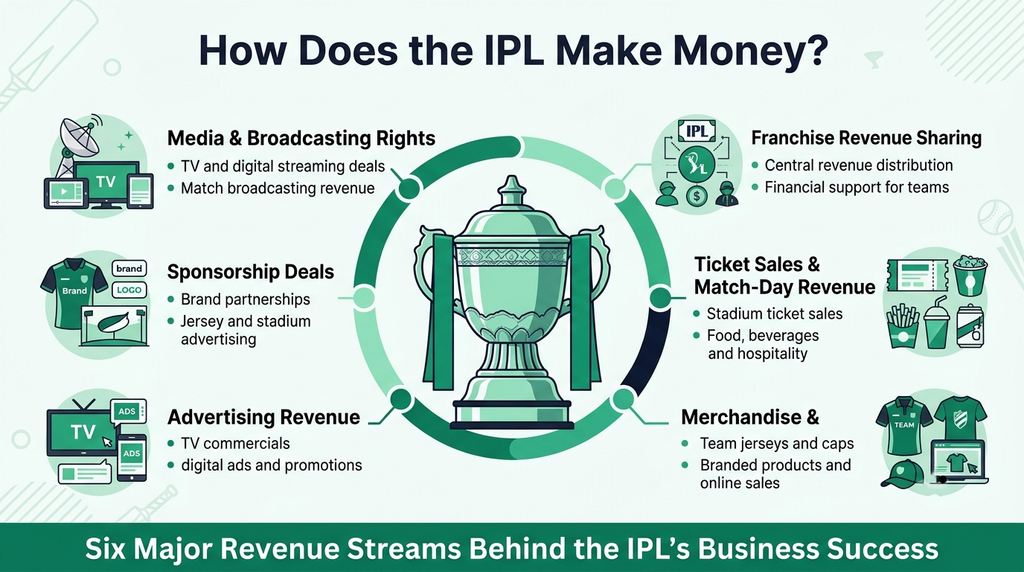
The IPL earns money through several commercial channels. Its strongest financial advantage is the ability to combine cricket viewership with advertising, sponsorship, and long-term media agreements.
1. Media and Broadcasting Rights
- Media rights are among the most important sources of IPL revenue. Broadcasters and digital platforms pay for the opportunity to show matches and distribute tournament content to viewers.
- These agreements are commercially valuable because the IPL attracts a large audience during a concentrated tournament window. Advertisers want access to that audience, while media companies compete for the rights to distribute the matches.
- Broadcasting arrangements can generate revenue for the league and its franchises through central revenue-sharing structures. The value of future media deals will depend on audience growth, advertiser demand, competition among bidders, and changes in viewing habits.
- Digital streaming platforms have also expanded the IPL’s reach by allowing fans to watch live matches online through services such as JioCinema.
2. Sponsorship Deals
- The IPL attracts sponsors from a wide range of industries, including consumer goods, financial services, technology, automobiles, and telecommunications.
- Sponsors may pay to associate their brands with the tournament, teams, or individual players. Their branding can appear on jerseys, stadium advertising, broadcast graphics, digital content, and promotional campaigns.
- The league’s limited duration and large audience make it attractive to companies seeking high visibility. Sponsorship income also provides a commercial revenue stream beyond ticket sales.
- Fantasy sports platforms have also become part of India’s cricket business ecosystem. Companies such as Dream11 connect fans with major sporting events through interactive sports experiences, highlighting the commercial opportunities surrounding cricket.
3. Advertising Revenue
- Advertising is another major part of the IPL’s business model. Television commercials, digital advertisements, branded segments, and in-stream promotions help media partners monetise their audiences.
- Matches attract viewers across different age groups and regions, creating opportunities for brands to promote products and services. High-profile games can be particularly valuable because advertisers compete for limited commercial slots.
- The growth of digital viewing has also expanded advertising formats, including interactive campaigns and targeted promotions.
4. Franchise Revenue Sharing
- The IPL operates through a franchise model in which teams receive revenue under central distribution arrangements and generate additional income independently.
- Central revenue can include the franchises’ share of media rights and central sponsorship arrangements. The amount distributed depends on the applicable agreements and league structure.
- This arrangement helps teams access revenue beyond their own local markets. It also provides a financial foundation for player recruitment, coaching, travel, operations, and other expenses.
5. Ticket Sales and Match-Day Revenue
- Teams can earn money from ticket sales for home matches. Stadium attendance also creates opportunities for hospitality packages, food and beverage sales, and other match-day activities, depending on the commercial arrangements.
- The amount earned depends on stadium capacity, ticket prices, the popularity of the teams, and demand for individual matches. High-profile games can attract strong attendance, but ticket revenue is only one part of the overall business model.
- Fans can conveniently purchase match tickets through an online ticket-booking platform, making it easier to attend live IPL matches.
6. Merchandise and Licensing
- IPL teams can earn additional income through jerseys, caps, fan accessories, and other branded merchandise. Licensing agreements allow approved products to use team names, logos, and other brand assets.
- Merchandise helps franchises extend their commercial presence beyond the tournament itself. Supporters can purchase team products throughout the year, while online stores can reach fans who live far from a team’s home city.
- The success of merchandise sales depends on fan loyalty, product availability, pricing, and the team’s ability to maintain a strong brand identity.
Explore More:
Most Valuable IPL Teams in 2026
The value of an IPL team depends on several factors, including its fan base, commercial partnerships, media visibility, financial performance, and future earning potential.
According to 2026 brand valuation estimates, Royal Challengers Bengaluru leads the league’s franchise brands. Mumbai Indians and Kolkata Knight Riders also rank among the strongest commercial names.
The following table shows the estimated brand values of the ten IPL franchises in 2026. These figures are not the same as the full business valuation or sale price of each team.
| Rank | IPL team | Estimated brand value |
| 1 | Royal Challengers Bengaluru (RCB) | $312 million |
| 2 | Mumbai Indians (MI) | $264 million |
| 3 | Kolkata Knight Riders (KKR) | $245 million |
| 4 | Chennai Super Kings (CSK) | $244 million |
| 5 | Sunrisers Hyderabad (SRH) | $168 million |
| 6 | Rajasthan Royals (RR) | $161 million |
| 7 | Punjab Kings (PBKS) | $158 million |
| 8 | Gujarat Titans (GT) | $157 million |
| 9 | Delhi Capitals (DC) | $156 million |
| 10 | Lucknow Super Giants (LSG) | $122 million |
RCB’s brand value increased significantly in 2026, supported by its commercial popularity and sporting success. Mumbai Indians continue to benefit from a strong fan base and established brand identity, while KKR has built considerable recognition through its performance and entertainment-oriented marketing.
These rankings show that a franchise’s commercial value does not depend entirely on its position in the points table. A team can have a strong brand and attract sponsors even during a difficult season.
Which IPL Team Is the Most Valuable in 2026?
Royal Challengers Bengaluru recorded the highest estimated brand value among IPL franchises in 2026, at approximately $312 million. This placed it ahead of Mumbai Indians and Kolkata Knight Riders in the brand valuation rankings.
RCB’s commercial strength is supported by its large fan base, prominent players, sponsorship appeal, and national visibility. Its association with star cricketers has helped the franchise build a recognisable identity among supporters.
The franchise also attracted major investor interest. In 2026, a consortium acquired RCB in a transaction valued at approximately $1.78 billion. That deal value was substantially higher than the team’s standalone brand value because a franchise sale considers more than the name and brand alone.
This distinction matters. The brand value indicates the commercial worth attributed to the franchise’s identity, while a sale valuation can incorporate expected future earnings, business operations, and growth opportunities.
IPL Team Owners and Their Business Interests
IPL ownership connects cricket with some of India’s most prominent business and entertainment groups. The owners bring capital, marketing experience, commercial relationships, and the ability to build businesses around the sport.
- Mumbai Indians: Associated with the Reliance Industries group, which has interests across energy, retail, telecommunications, and other sectors.
- Chennai Super Kings: Operated through Chennai Super Kings Cricket Limited, with strong commercial associations around the CSK brand.
- Kolkata Knight Riders: Associated with a group led by Shah Rukh Khan, Juhi Chawla, and Jay Mehta.
- Royal Challengers Bengaluru: Ownership changed in 2026 through a major transaction involving a consortium of investors.
- Rajasthan Royals: The franchise also underwent a major ownership transaction in 2026 involving a consortium led by new investors.
- Delhi Capitals: Associated with the GMR Group and the JSW Group.
Other franchises are connected with corporate groups and investors involved in sectors such as pharmaceuticals, infrastructure, media, and manufacturing.
Ownership arrangements can change over time, so the identity of the owner and the value of a franchise should be checked against the relevant transaction date. The wealth of an owner should also not be confused with the value of the IPL team itself.
How Much Revenue Does the IPL Generate?
The IPL’s commercial ecosystem generates revenue through central media and sponsorship arrangements, franchise-specific deals, tickets, merchandise, and other activities. The precise total varies by financial year and by the way revenue is measured.
In 2026, the league’s commercial growth continued alongside rising franchise valuations. The wider business ecosystem includes the league, its franchises, media partners, sponsors, stadium operators, and service providers.
For franchises, central revenue-sharing arrangements can provide a substantial and relatively predictable financial base. Teams can then supplement this income with local sponsorships, match-day earnings, merchandise, and other commercial opportunities.
However, revenue is not the same as profit. Franchises must pay player salaries, coaching staff, travel costs, stadium expenses, marketing costs, and other operational expenses. The BCCI and other stakeholders also receive revenue under the league’s applicable arrangements.
A meaningful financial assessment therefore looks at revenue, operating costs, profitability, and future cash flows rather than relying only on a headline valuation.
Why Are IPL Teams Worth Billions of Dollars?
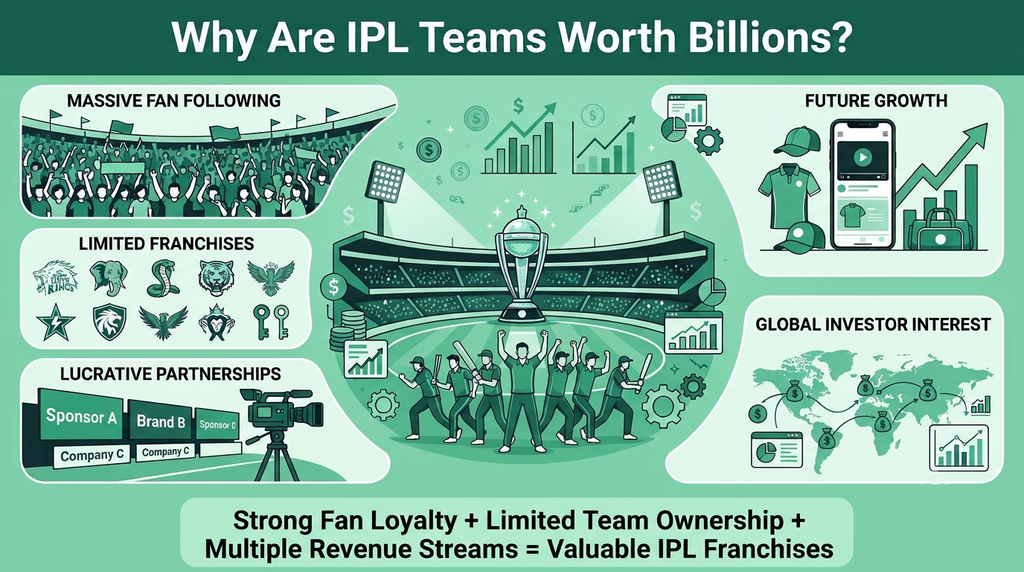
Several factors help explain the rising value of IPL franchises.
- A Large and Engaged Audience: Cricket has a substantial following in India, and the IPL brings fans together around city-based teams and high-profile players. This audience creates opportunities for sponsors, advertisers, broadcasters, and merchandise businesses.
- Limited Availability of Franchises: There are only ten IPL teams. Because ownership opportunities are limited, investors may compete for the few franchises that become available for sale. This scarcity can increase transaction prices.
- Strong Commercial Partnerships: Franchises can build long-term relationships with sponsors and media partners. These relationships help generate recurring revenue and make future earnings easier to estimate.
- Global Investment Interest: The IPL has attracted attention from investors who view sports franchises as valuable long-term assets. Ownership can offer both potential financial returns and access to a high-profile entertainment property.
- Future Growth Potential: Investors may expect the IPL to grow through improved digital distribution, new sponsorship opportunities, merchandise, international audiences, and more effective commercial partnerships.
These factors can support high valuations, but they do not eliminate risk. Changes in media rights, regulations, advertising markets, team performance, or operating costs could affect future earnings.
IPL Net Worth Compared With Other Sporting Leagues
The IPL is among the world’s most valuable sporting properties, particularly when measured by its business value and commercial potential. Its financial model differs from leagues such as the National Football League (NFL), the English Premier League (EPL), and the National Basketball Association (NBA).
The IPL has a relatively short annual tournament, while many other major leagues operate across much longer seasons. However, the IPL can generate intense audience engagement and significant advertising demand within a concentrated period.
Its commercial structure also differs from that of football leagues, where clubs often earn substantial income from domestic and international competitions, ticket sales, merchandise, and player transfers.
Comparing leagues requires care because different reports may measure brand value, total business value, franchise value, or annual revenue. These numbers cannot be compared directly without understanding what each valuation includes.
The IPL’s 2026 business value of $20.6 billion reflects the strength of its commercial ecosystem. Its future position among global sports businesses will depend on continued audience growth, effective media distribution, and the ability to maintain its appeal to sponsors and investors.
What Is the Future of the IPL’s Valuation?
The IPL’s future value will depend on how effectively it builds on its established audience and commercial partnerships. Digital streaming, international fan engagement, merchandise, and new sponsorship categories could create additional opportunities.
Franchise owners may also explore new ways to strengthen their businesses beyond the tournament, including fan membership programmes, year-round content, licensed products, and broader sports-entertainment activities.
However, further growth is not guaranteed. Media companies must justify the cost of broadcasting rights, sponsors must continue to see value in advertising, and franchises must control operating expenses. The league also needs to maintain competitive cricket and a positive experience for supporters.
The most useful indicators to watch are future media-rights agreements, franchise revenue, sponsorship demand, operating profitability, and ownership transactions. These measures provide a clearer picture of the IPL’s financial health than brand popularity alone.
Final Thoughts
The IPL net worth in 2026 highlights how the tournament has evolved into far more than a cricket competition. Its estimated business value of $20.6 billion reflects the commercial strength of its broadcasting arrangements, sponsorships, franchises, and global audience.
Its financial success also shows why IPL teams are increasingly treated as major sports investments. Franchises such as RCB, Mumbai Indians, and KKR have built valuable brands, while ownership deals demonstrate the level of investor interest in the league.
Still, business value, brand value, revenue, and profit are different measures. Understanding these distinctions gives a more accurate picture of the IPL’s wealth and its place in the global sports industry.
Frequently Asked Questions About IPL Net Worth
Q1. What Is The IPL’s Net Worth In 2026?
The IPL’s overall business value was estimated at $20.6 billion, approximately ₹1.97 lakh crore, in 2026. Its standalone brand value was estimated at $4.3 billion, or around ₹41,100 crore. These are different valuation measures, not the league’s cash balance.
Q2. Which Is The Most Valuable IPL Team In 2026?
Royal Challengers Bengaluru had the highest estimated franchise brand value in 2026, at approximately $312 million. This measures brand value and is different from the full business valuation of the team.
Q3. How Does The IPL Make Money?
The IPL generates commercial income through media rights, central sponsorships, advertising, and other business arrangements. Franchises also earn through local sponsors, tickets, merchandise, and licensing.
Q4. Who Owns The IPL?
The IPL is governed by the Board of Control for Cricket in India (BCCI). Individual franchises are owned by separate corporate groups, investors, and business or entertainment personalities.
Q5. Is The IPL Worth More Than ₹1 Lakh Crore?
Yes. Its estimated 2026 business value of approximately ₹1.97 lakh crore is well above ₹1 lakh crore. This is a valuation estimate of the league’s business ecosystem, not the amount of cash it holds.