
Starting a jewelry brand isn’t just about sketching rings or stringing beads. It is a highly profitable sector that rewards sharp positioning just as much as good design. Whether you are an artisan handcrafting bespoke pieces or an entrepreneur exploring scalable trading business ideas through wholesale sourcing, the potential for high margins is massive.
Today, the barrier to entry is remarkably low. You no longer need a brick-and-mortar store or huge upfront capital to break into the market. E-commerce platforms and targeted social media marketing make it possible to launch a global brand right from your desk.
But because it is so accessible, the market is heavily saturated. Standing out requires more than just listing pretty products online—you need a solid strategy. This article breaks down how to start a jewellery business step by step, covering everything from defining your niche to finding reliable suppliers, pricing your inventory for profit, and setting up a storefront that actually drives sales.
What Is a Jewellery Business and How Does It Work?
At its core, a jewelry business involves designing, manufacturing, or curating wearable accessories to sell to consumers at a profit. The industry spans a massive spectrum, ranging from high-end fine jewelry crafted with precious metals to affordable, trend-driven fashion accessories. Depending on your skillset and available capital, you might operate as a bench jeweler creating bespoke pieces, a designer partnering with a production factory, or a curator who buys wholesale. Ultimately, the success of the business relies on identifying a specific target audience, sourcing products that match their aesthetic, and building a compelling brand narrative around those items.
The day-to-day mechanics depend entirely on your chosen operational model. If you are manufacturing in-house, your workflow revolves around raw material procurement, prototyping, and hands-on production. Alternatively, many entrepreneurs prefer to focus purely on the retail and marketing side. In fact, when looking at different trading business ideas, sourcing finished jewelry in bulk from manufacturers and reselling it under a private label is one of the most popular and scalable routes. Regardless of the path you choose, a profitable operation hinges on strict inventory control, strategic pricing to maintain healthy margins, and a highly visual marketing strategy to consistently drive traffic to your storefront.
Jewellery Business Market Size and Opportunity in 2026
If you are wondering whether there is still room for a new brand, the numbers speak for themselves. The global jewelry market is valued at over $400 billion and is on a steady trajectory to surpass $570 billion by 2033. This consistent 5.5% annual growth is fueled by a mix of timeless traditions, like wedding and engagement rings, and rapidly shifting fashion trends. E-commerce plays a massive role in this expansion. The online jewelry segment alone is growing at a double-digit pace, driven by social commerce on platforms like Instagram and TikTok, making it easier than ever to reach customers without opening a physical storefront.
For new entrepreneurs, the current landscape offers several low-barrier entry points. You do not have to mine diamonds or melt gold to take a slice of this massive pie. Exploring different profitable business ideas, such as sourcing wholesale stainless steel pieces, private labeling trend-driven collections, or drop-shipping affordable accessories, allows you to tap into consumer demand with minimal overhead. Furthermore, specialized niches like minimalist everyday wear, personalized pieces, and sustainable lab-grown diamonds are currently booming. By targeting a specific aesthetic and leveraging the power of digital marketing, even a small startup can carve out a highly profitable space in today’s global market.
Why Start a Jewellery Business in 2026?
You might be wondering if it is too late to break into the market. The short answer is no. If you are researching how to start a jewellery business, this is actually one of the best times to enter the industry. It has shifted significantly over the past few years, making it far more accessible for newcomers who know how to position themselves. If you are on the fence about launching your own brand, here is why it makes so much sense right now:
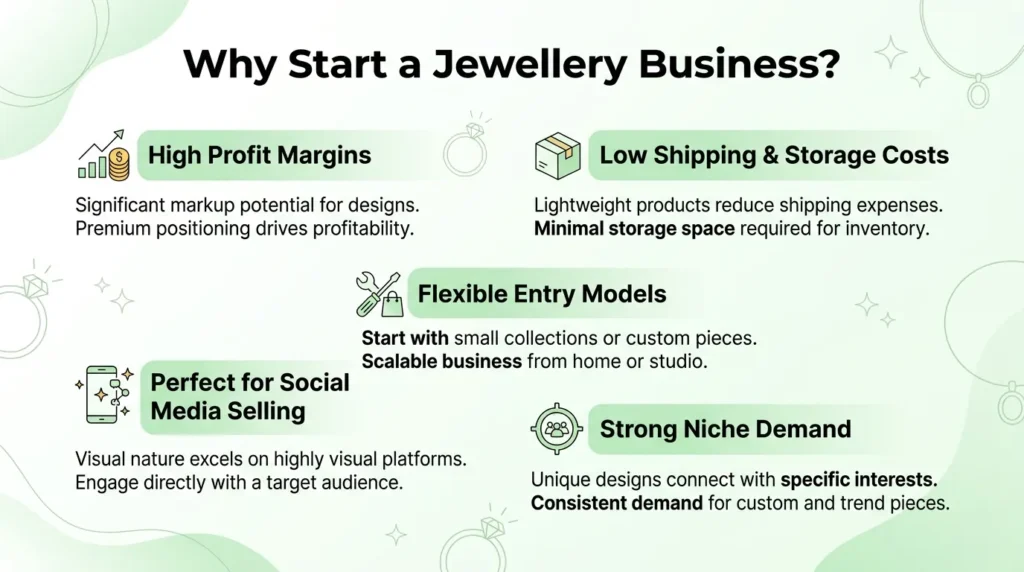
- Exceptional profit margins: You do not need a massive volume of sales to run a healthy operation. Jewelry typically carries a much higher markup compared to clothing, electronics, or homeware. Depending on the materials you use and how you position your brand, margins often range from 50% to over 70%, giving you plenty of room to scale your marketing.
- Low shipping and storage costs: Unlike selling bulky furniture or fragile glassware, jewelry is tiny. You can easily manage your initial inventory from a single desk drawer or spare closet. Because the items are lightweight, you will save a fortune on packaging and shipping logistics, allowing you to offer competitive rates or even free shipping.
- Flexible entry models: You are not forced to become a master metalsmith to enter the market. If you are comparing different trading business ideas, purchasing finished, trend-focused pieces at wholesale prices to resell under your own label is a highly effective, low-risk route. You can start generating revenue quickly without the overhead of heavy manufacturing machinery.
- Tailor-made for social commerce: Jewelry is inherently visual, which makes marketing it incredibly straightforward. Short-form platforms like Instagram Reels, TikTok, and Pinterest are built for showing off aesthetic unboxings, styling tips, and catching the light on a new ring. A single well-lit video demonstrating that your pieces are waterproof or tarnish-free can sell out your stock overnight.
- A shift toward specific, loyal niches: Consumers are actively moving away from generic fast fashion and looking for brands that solve specific problems. Whether you focus on sustainable lab-grown diamonds, hypoallergenic metals for sensitive skin, or minimalist permanent jewelry, targeting a hyper-specific niche allows you to build a fiercely loyal customer base right from day one.
Types of Jewellery Business Models to Choose From
Before you source a single clasp or gemstone, you need to decide how your operation will actually run. The model you choose dictates everything from your initial startup costs to what your day-to-day workflow looks like. Here are the most common and profitable paths you can take:
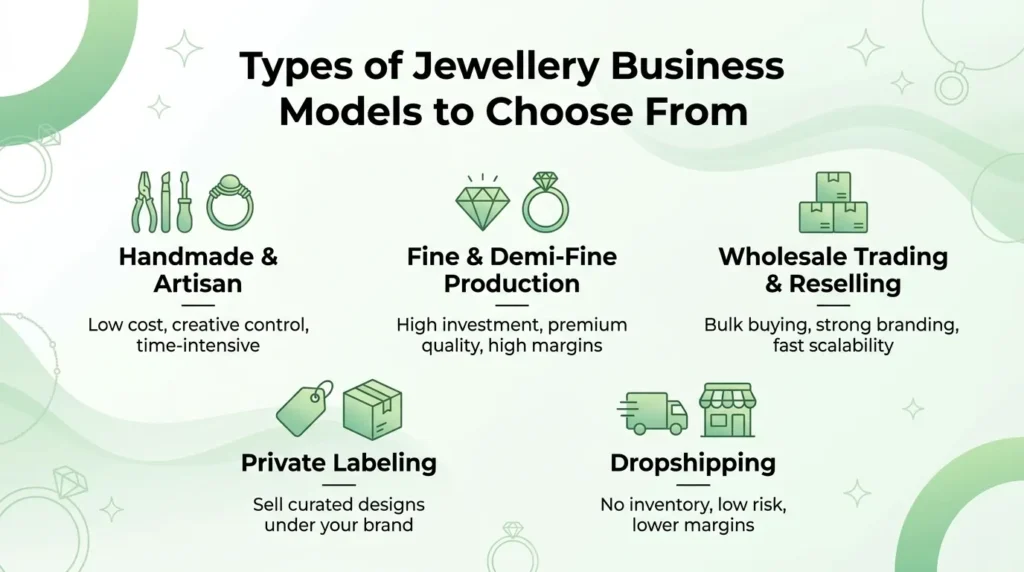
- Handmade and Artisan: If you are a creative who loves physically making things whether that means wire-wrapping, working with polymer clay, or silversmithing this is your lane. It requires minimal upfront capital, but it is highly time-intensive. Your main challenge here will be figuring out how to scale when your production is tied directly to your own two hands.
- Fine and Demi-Fine Production: This involves designing pieces made from precious metals (like solid gold or sterling silver) and genuine gemstones. You will likely partner with specialized manufacturers or CAD designers to bring your sketches to life. The startup costs are significantly higher, but the profit margins and the heirloom-quality value of your brand make it highly lucrative.
- Wholesale Trading and Reselling: If your strengths lie in branding and marketing rather than manufacturing, this is a fantastic route. When looking at various trading business ideas, buying finished, trend-driven jewelry in bulk at wholesale prices and selling it at a retail markup is incredibly popular. It allows you to scale rapidly and maintain a large inventory without ever touching a soldering iron.
- Private Labeling: This is a step up from basic reselling. You work with a manufacturer to curate a collection of their existing designs, but you package and sell them under your own brand name. It is a brilliant way to launch a professional, cohesive collection quickly while building strong brand recognition.
- Dropshipping: The ultimate low-risk entry point. In this model, you set up an online storefront and market the products, but a third-party supplier handles all the inventory and shipping directly to your customer. While your profit margins will be lower compared to holding your own stock, it is the safest way to test which styles your audience actually wants to buy before committing your capital.
How to Start a Jewellery Business Step-by-Step
Taking the leap from a rough concept to a live storefront can feel overwhelming, but it is entirely manageable when you break it down. If you are learning how to start a jewellery business, this roadmap will guide you step by step to launch your brand from scratch.
Building a jewellery business from scratch becomes much easier when you follow a structured path instead of trying to figure everything out at once. Each step plays a role in shaping your brand, attracting the right customers, and ensuring long-term profitability. Here’s a practical breakdown to guide you:
1. Choose Your Jewellery Niche
The first step is deciding what type of jewellery you want to sell. A focused niche helps you stand out and connect better with your target audience. You can explore categories like handmade jewellery, fine jewellery, or fashion jewellery depending on your budget and goals, with specific product niches such as a Swarovski necklace collection also offering a way to target customers looking for crystal jewellery. Handmade pieces offer uniqueness, fine jewellery targets premium buyers, while fashion jewellery is more affordable and mass-friendly. Your niche should align with your ideal customer and market demand.
There are a few niche jewellery categories to consider:
- Handmade jewellery: People discover handmade jewellery alluring due to its particular nature, making it difficult to imitate. Although it can be more costly to set up this sort of business particularly since you can not depend on dropshipping you can make yourself a faithful customer base.
- Fine jewellery: Fine jewelries are of high quality and mostly produced from valuable materials such as metals or gemstones. This is largely because fine jewellery is more often than not more costly, and people don’t purchase many at a go, which makes it an even more challenging market for little business proprietors to penetrate.
- Fashion jewellery: Also known as costume jewellery, fashion jewellery highlights a lower cost point than fine gems and is more suitable for normal wear. It’s easier to make, since it can be mass-produced and is more attractive to the general customer.
2. Plan Your Business Strategy
Once your niche is clear, map out your business direction. Define what you want to achieve, who your customers are, and how you will reach them. Think about your pricing range, sales channels, and marketing approach. A well-thought-out plan helps you stay focused and avoid unnecessary mistakes in the early stages.
- Define Your Goals and Vision: Clearly decide what you want your jewellery business to achieve. For example, you may aim to build a premium brand, a trendy fashion label, or an affordable everyday jewellery store.
- Identify Your Target Audience: Understand who your ideal customers are, including their age, style preferences, budget, and buying habits. This helps you create products and marketing that truly connect with them.
- Set Your Pricing Strategy: Decide how you will price your products based on your niche, costs, and competition. Your pricing should balance profitability with market demand.
- Choose Your Sales Channels: Select where you will sell your jewellery, such as your own website, online marketplaces, social media platforms, or offline stores.
- Plan Your Marketing Approach: Decide how you will promote your brand, whether through social media, influencer marketing, SEO, or paid ads. Focus on platforms where your audience is most active.
- Outline Your Operations: Plan how your business will run daily, including sourcing, inventory management, packaging, and delivery. This ensures smooth and efficient operations from the start.
3. Register Your Business Legally
To run your jewellery business smoothly, you need to take care of legal formalities. Choose a name for your jewelry business that reflects your brand and register it. Decide on a suitable business structure and obtain necessary licenses or registrations. Keeping your finances separate with a business account also makes operations more organized.
- Choose a Business Name: Select an important, brand-relevant name that reflects your jewellery’s fashion and appeal. Guarantee that it’s accessible and not already in use by checking with local and national trade registries.
- Legal Structure: Choose on the best legal structure for your trade, such as a sole proprietorship, LLC, or corporation. An LLC, for case, gives risk security and is common for little businesses.
- Obtain Necessary Licences and Permits: Depending on your location, you may require a general trade licence, sales tax permit, and possibly a domestic occupation permit if working from home. Ensure you comply with local, state, and federal controls.
- Apply for a Tax ID: Obtain an Employer Identification Number (EIN) from the IRS for tax purposes. This step is noteworthy, especially if you arrange to contract employees or open a business bank account.
- Open a Business Bank Account: Keep your funds organised by separating individual and business reserves. A dedicated exchange account simplifies following expenses, managing cash flow, and preparing taxes.
4. Find Reliable Suppliers or Materials
Once you have design concepts for your jewellery line, you’ll need to research potential producers and decide whether or not you need to produce products locally or abroad. If you’re hand-making your plans, you’ll need to buy jewellery-making tools and equipment.
It can be beneficial also to ask other jewellery designers, almost trustworthy wholesale distributors or see into getting a reseller permit so you can forgo paying local deals taxes once you buy in bulk.
5. Design Your Product Line
If you’re getting into jewellery because it’s your passion, then the product design is the easy part.
If not, there are so many great places to find inspiration, like your favourite jewellery designers, the latest trends, insight from doing market research, and more. If you’re making handmade jewellery, learning the trade via jewellery classes and tutorials will be important.
Once you’ve got your products designed, you would like to figure out how to handle production and procuring supplies in bulk.
6. Set Up Your Online Store
Creating an online store is essential to reach a wider audience and start selling your jewellery effectively. Your website should be visually appealing, easy to navigate, and mobile-friendly so customers can browse and shop without confusion.
- Choose an E-commerce Platform: Select a platform that fits your budget and needs, such as Shopify, Wix, or marketplace options. Make sure it supports secure payments and is easy to manage.
- Register a Domain Name: Pick a simple and memorable domain name that matches your brand identity. This helps build trust and makes your store look professional.
- Create Product Pages: Upload high-quality images and write clear, engaging descriptions for each product. Highlight key details like material, size, and usage.
- Enable Payment Options: Add secure payment gateways such as UPI, cards, wallets, or net banking to make checkout smooth for customers.
- Set Up Shipping and Delivery: Define your shipping charges, delivery timelines, and return policy clearly to avoid confusion and build customer confidence.
- Test Your Store Before Launch: Check the full buying process, from product selection to payment, to ensure everything works properly before going live.
7. Decide Pricing and Profit Margins
Setting the right price is crucial for the success of your jewellery business. Your pricing should not only attract customers but also ensure you make a sustainable profit.
- Calculate Your Costs: Start by adding all expenses, including materials or sourcing, packaging, shipping, and marketing. This gives you a clear base cost for each product.
- Research Competitor Pricing: Look at similar products in your niche to understand the market price range. This helps you stay competitive without undervaluing your products.
- Choose a Pricing Strategy: Decide whether you want to position your brand as premium, mid-range, or budget-friendly. Your pricing should reflect your brand value and target audience.
- Set Your Profit Margin: Add a reasonable margin on top of your costs to ensure profitability. Many jewellery businesses aim for higher margins due to low storage and shipping costs.
- Include Extra Charges: Don’t forget to factor in taxes, platform fees, discounts, and returns, as these can impact your overall profit.
A well-planned pricing strategy ensures you cover costs, stay competitive, and grow your jewellery business profitably.
8. Build a Strong Marketing Strategy
A strong marketing strategy is essential to attract customers and grow your jewellery business. Without proper promotion, even the best products can go unnoticed.
- Use Social Media Platforms: Share high-quality images and videos of your jewellery on platforms like Facebook and Instagram captions that attract views. Visual content helps showcase your designs and attract attention.
- Leverage Influencer Marketing: Collaborate with influencers in your niche to reach a wider audience and build trust quickly.
- Focus on SEO and Content: Optimize your website and product pages with relevant keywords so customers can find your brand through search engines.
- Run Paid Advertisements: Use ads on social media and search engines to target specific audiences and increase visibility.
- Build Customer Relationships: Use email marketing, offers, and consistent engagement to retain customers and encourage repeat purchases.
A well-planned marketing strategy helps you reach the right audience, increase brand awareness, and drive consistent sales.
9. Launch and Grow Your Business
Once everything is ready, it’s time to launch your jewellery business and start selling. Begin with a small inventory and focus on testing your products in the market rather than investing heavily upfront.
- Start Small and Test: Launch with a limited collection to see what customers like. This reduces risk and helps you understand demand.
- Gather Customer Feedback: Pay attention to reviews, comments, and buying patterns to improve your designs and offerings.
- Focus on Best-Selling Products: Identify which items perform well and invest more in those to increase profits.
- Scale Your Operations: As demand grows, expand your product range, improve your packaging, and increase marketing efforts.
- Explore New Markets: Consider selling on multiple platforms or expanding to new locations to reach more customers.
Following this step-by-step approach allows you to build a jewellery business in a structured and confident way, turning your idea into a sustainable and profitable venture.
Proven Strategies to Grow Your Jewellery Business Online
Growing your jewellery business online requires a balanced mix of branding, SEO, marketing, and customer experience. Here are 8 key strategies that actually make a difference:
- Build a Strong Brand Identity: Create a unique brand name, logo, and packaging style that reflects your niche. A strong brand helps you stand out and builds trust with customers.
- Create an SEO-Optimized Website: Ensure your website is fast, mobile-friendly, and optimized with keywords in product titles, descriptions, and meta tags to rank higher on search engines.
- Use High-Quality Visual Content: Invest in professional photos and videos. Show your jewellery in real-life use, styling ideas, and close-up shots to attract buyers.
- Leverage Social Media Consistently: Stay active on platforms like Instagram and Pinterest. Post reels, stories, and engaging content to build visibility and connect with your audience.
- Run Targeted Ads and Campaigns: Use Facebook, Instagram, and Google Ads to reach the right audience and drive quick traffic and sales.
- Collaborate with Influencers: Partner with influencers and creators in your niche to build credibility and reach new potential customers.
- Focus on Customer Experience: Offer easy navigation, smooth checkout, multiple payment options, and clear return policies to improve conversions and trust.
- Track, Analyze, and Scale: Use analytics tools to monitor performance, understand customer behavior, and scale what works best for consistent growth.
By combining these strategies, you can build a strong online presence, attract the right audience, and grow your jewellery business in a sustainable way.
How Much Does It Cost to Start a Jewellery Business in 2026?
The beauty of the jewelry industry is that you can scale your initial investment to match your current budget. You do not need to take out a massive bank loan to get off the ground unless you are diving straight into high-end, bespoke fine jewelry.
Your startup costs will dictate how quickly you can move, but starting small is entirely feasible. Here is a realistic breakdown of what you can expect to spend depending on the scale and model of your launch:
| Level | Investment | Includes |
| Dropshipping / Bootstrapped | $100 – $500 | Domain name, basic e-commerce subscription (e.g., Shopify), ordering a few physical product samples, and minimal DIY marketing. |
| Handmade / Wholesale Trading | $1,000 – $5,000 | Purchasing bulk inventory for trading business ideas, raw materials and hand tools, custom branded packaging, photography props, and a modest social media ad budget. |
| Fine Jewellery / Private Label | $5,000 – $20,000+ | Sourcing precious metals and genuine gems, professional CAD design or manufacturing fees, premium unboxing materials, legal entity setup, and professional photoshoots. |
Legal Requirements in India
Starting a brand in India comes with a specific set of regulations you need to follow to keep your business fully compliant and trusted by your customers. It might sound tedious, but getting your paperwork sorted early on will save you from heavy fines or operational headaches down the line. Here are the four primary registrations you will need to get started:
GST Registration
If you plan to sell your products online across state borders or through e-commerce platforms like Amazon and Myntra, obtaining a Goods and Services Tax (GST) registration is mandatory right from the start, regardless of your turnover. For local, intra-state offline sales, you only need to register if your annual turnover crosses the ₹40 lakh threshold. Beyond simply keeping you legal, having a GST number allows you to claim input tax credit on the raw materials, packaging, or wholesale jewelry you purchase.
Udyam (MSME) Registration
While not strictly mandatory to make a sale, registering your business under the Udyam portal as a Micro, Small, or Medium Enterprise (MSME) is highly recommended. It is a completely free, government-backed online process that offers massive benefits. An MSME certificate makes it significantly easier to open a business bank account, secure collateral-free business loans, and take advantage of government subsidies designed to support new entrepreneurs.
BIS Hallmarking
If your business model involves selling real gold or silver, this is a strict, non-negotiable step. The Bureau of Indian Standards (BIS) has made hallmarking mandatory across the vast majority of districts in India to protect consumers and ensure purity. In 2026, every piece of gold jewelry you sell must carry a 6-digit alphanumeric Hallmark Unique Identification (HUID) code alongside the BIS logo and the purity grade (like 22K916). You must actively register your brand with BIS to legally sell these precious metals; bypassing this can result in severe legal penalties and loss of stock.
Business License
To legally operate your venture even if you are just running an online store from a spare room in your house you need a local business license. In India, this usually falls under the Shop and Establishment Act (often referred to as a Gumasta license in states like Maharashtra). You will apply for this through your local state municipal corporation. It acts as the foundational proof of your commercial identity and is almost always required by payment gateways and banks when you set up your online store’s financial infrastructure.
Best Platforms to Sell Jewellery Online
Having great products is only half the battle; putting them in front of the right buyers is what actually generates revenue. Relying on a single sales channel is a risky move. The most successful modern brands use a multi-channel approach, blending their own storefront with established marketplaces. Here are the top platforms to consider:
1. Shopify (Your Brand Headquarters)
If you want to build a long-term, recognizable brand, you need your own dedicated website. Shopify remains the undisputed leader for this. It gives you total control over your customer data, your profit margins, and your store’s aesthetic. While you have to drive your own traffic here, owning your site means you aren’t at the mercy of sudden algorithm changes or marketplace rule updates that could bury your listings.
2. Instagram and Pinterest (Social Commerce)
People rarely log onto social media explicitly to buy jewelry, but they do log on to be inspired. Social commerce is where impulse buying thrives. By setting up an Instagram Shop or using Pinterest’s shoppable pins, you allow customers to buy a necklace the moment they see it styled in a beautiful photo or reel, without ever leaving the app. For highly visual products like jewelry, this frictionless checkout is a goldmine.
3. Etsy (The Artisan Market)
If your business model revolves around handmade, personalized, or vintage-style jewelry, Etsy is still a powerhouse. The biggest advantage of Etsy is its built-in search engine; millions of buyers go there specifically looking for unique accessories. However, the space is heavily saturated. To win here, you need highly optimized product titles and exceptional photography to stand out against thousands of similar listings.
4. Amazon and Flipkart (The Volume Drivers)
If you are adopting a trading or private-label model and selling trend-focused pieces at a high volume, massive marketplaces like Amazon and Flipkart are essential. They offer unparalleled reach and the logistical magic of next-day delivery. The tradeoff is that you have zero brand control, the fees can be steep, and you are competing strictly on price and reviews rather than aesthetic and vibe.
5. Myntra and Nykaa Fashion (Curated Marketplaces)
For those operating in the Indian market, getting listed on platforms like Myntra, Nykaa Fashion, or Ajio is a massive trust signal for consumers. These platforms curate their offerings, meaning you will have to pass strict quality and onboarding checks. However, once you are in, customers are far more likely to buy your brand simply because it is associated with a trusted fashion giant.
Jewellery Business Trends in 2026
If you want your brand to gain traction quickly, you cannot just rely on classic staples. Consumer tastes shift rapidly, and aligning your inventory with the current market direction is the easiest way to generate early momentum. Here is what is actually driving sales and capturing attention in 2026:
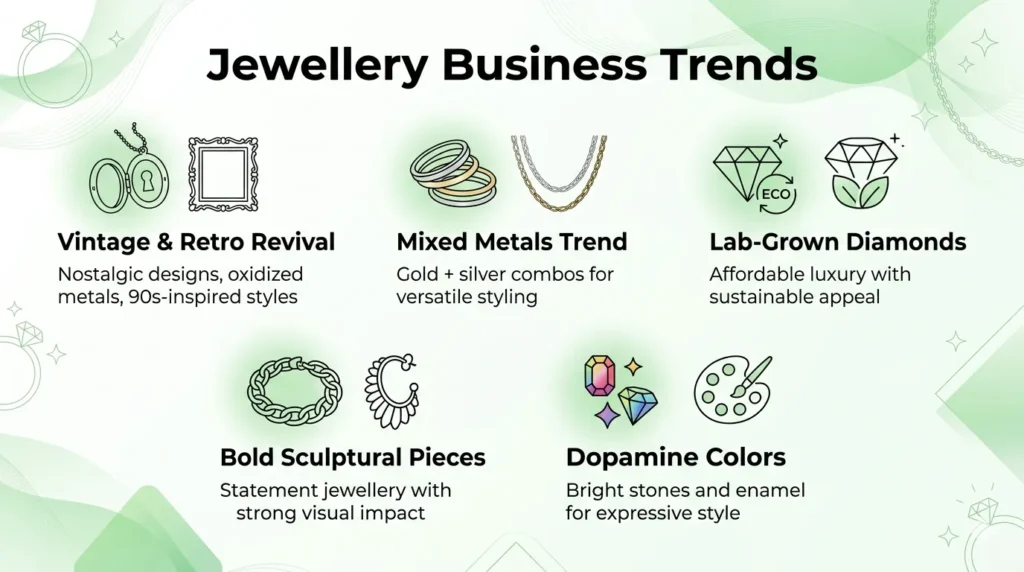
- The Vintage and Retro Revival: Nostalgia is a massive selling point right now. Shoppers are actively hunting for pieces that evoke a distinct, lived-in aesthetic. We are seeing a huge surge in demand for Pinterest-inspired 90s visuals, heirloom-style lockets, and traditional, oxidized metals that style perfectly with everything from everyday denim to classic cotton sarees. Tapping into this retro vibe gives your brand a clear, recognizable identity.
- Mixed Metals: For decades, wearing gold and silver together was considered a styling mistake. Today, it is the standard. Brands are confidently blending rose gold, platinum, and yellow gold into single, cohesive pieces. Offering mixed-metal chains or two-tone rings allows buyers to seamlessly integrate your new products with the jewelry they already own.
- Lab-Grown Diamonds: Sustainability meets smart luxury. Lab-grown stones offer the exact same physical and chemical makeup as mined diamonds but at a significantly lower price point. They are currently dominating the engagement market and rapidly pushing diamonds out of the vault and into the everyday-wear category.
- Bold, Sculptural Silhouettes: The ultra-minimalist era is stepping aside for bolder statements. Think chunky chains, oversized link bracelets, and heavy, architectural cuffs. If you are actively exploring different trading business ideas, sourcing these substantial statement pieces in affordable materials like stainless steel or gold-plated brass is a fast, highly profitable way to capitalize on the trend.
- Dopamine Colors: Consumers want vibrant, mood-boosting designs. Rich gemstones like deep emeralds, bright sapphires, and colorful enamels are replacing plain white stones. They are being used as the main focus in cocktail rings and large earrings, adding an expressive, joyful element to modern wardrobes.
Common Mistakes to Avoid In a Jewellery Business
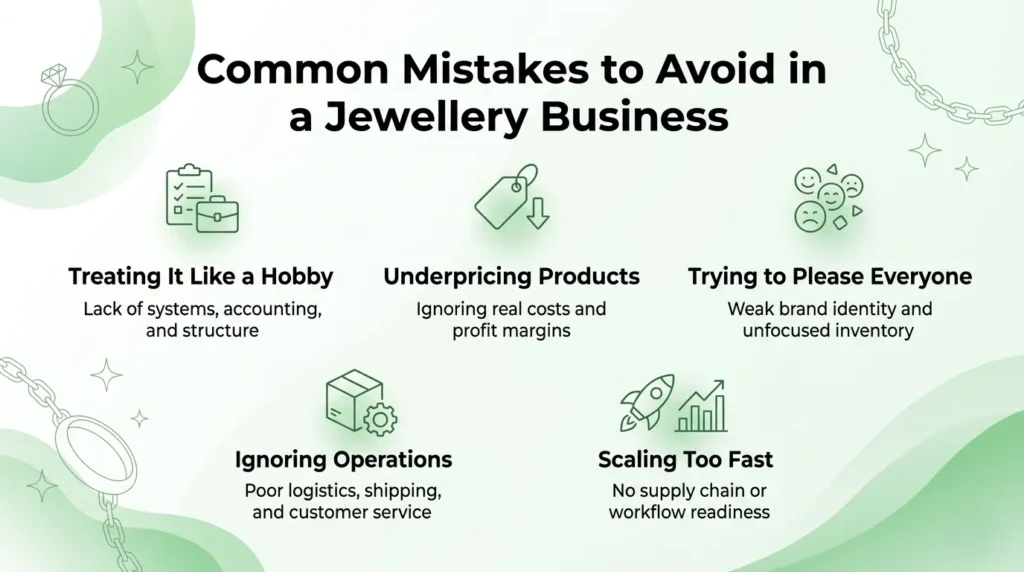
Transitioning from a jewelry lover to a business owner is a steep learning curve. While passion is the driving force behind your brand, it is the operational reality that actually keeps the lights on. Many new entrepreneurs stumble not because their designs are flawed, but because they overlook the daily mechanics of running a retail company. Here are the most frequent pitfalls that sink new jewelry businesses and how you can sidestep them:
- Treating it like a hobby instead of a business: When you make your first few sales, it is easy to just go with the flow. But failing to set up proper accounting, track your inventory, or establish a clear return policy will catch up to you. You need to transition out of the “making” mindset and into the “managing” mindset early on to prevent burnout and organizational chaos.
- Pricing out of fear: One of the quickest ways to kill your margins is underpricing your inventory because you are afraid customers will not pay what it is worth. New sellers frequently forget to factor in hidden expenses like payment gateway fees, shipping mailers, advertising spend, and the actual value of their own labor. Price for long-term sustainability, not just to beat the cheapest competitor.
- Trying to please everyone: If a customer asks for a delicate silver necklace but your brand is known for chunky, gold statement pieces, it is perfectly fine to turn them down. Trying to cater to every single stylistic request dilutes your brand identity and leaves you with a massive, disjointed inventory of unsold materials. Stick aggressively to your defined niche.
- Ignoring the unsexy operations: Packing boxes, calculating sales tax, and managing returns are not the glamorous parts of the industry, but they are the most critical. Many businesses fail because their fulfillment process breaks down as they grow. A single delayed shipment or an ignored customer service message can permanently damage your online reputation and cost you repeat buyers.
- Scaling without a solid foundation: A viral social media video might bring in hundreds of orders overnight, but if you do not have the supply chain in place to handle that volume, it can destroy your brand. Before you pour money into aggressive marketing campaigns, make sure your wholesale suppliers are reliable and your workflow can actually handle a sudden, massive spike in demand.
Conclusion
In conclusion, starting a jewelry brand from scratch might feel intimidating, but the truth is, the barrier to entry has never been lower. If you understand how to start a jewellery business, you will realize that you don’t need a massive budget, a brick-and-mortar store, or decades of metalsmithing experience to succeed today. Whether you want to handcraft bespoke pieces, curate a specific aesthetic, or explore various trading business ideas by sourcing wholesale items, the key is to just begin. Start by nailing down exactly who your customer is, order a small batch of samples to verify the quality, and focus on building a brand identity that truly stands out.
Once your foundation is set, consistency is what will actually drive your growth. Treat your new venture like a real business from day one: price your items to protect your profit margins, keep your back-end operations organized, and use social media to visually showcase what makes your pieces unique. The market is constantly evolving, and there is always space for a brand that knows how to connect with its audience. Trust your vision, put your products out there, and turn that initial idea into a profitable reality.
FAQs
1. Is Starting A Jewellery Business Actually Profitable?
Yes, exceptionally so. Jewelry enjoys some of the highest profit margins in the retail sector, often ranging from 50% to over 100% depending on your model. Because the items are small and lightweight, shipping and storage costs eat up very little of your revenue compared to selling larger physical goods like clothing or electronics.
2. Do I Need To Know How To Make Jewellery To Start A Brand?
Not at all. Many successful founders have never touched a pair of pliers. You can easily adopt a trading model where you source finished wholesale pieces, or use a private label service to curate a collection under your own brand name. In these models, your primary role becomes marketing and curation rather than physical manufacturing.
3. Where Can I Find Reliable Suppliers For My Inventory?
If you are looking for bulk finished pieces, online B2B marketplaces like Alibaba, Faire, and IndiaMart are great starting points. Always order samples first. If you prefer to deal with raw materials or fine jewelry manufacturing, visiting local jewelry districts (such as Zaveri Bazaar in Mumbai) allows you to verify the quality in person and negotiate better rates directly with vendors.
4. Can I Sell Jewellery Online Without A GST Number in India?
If you are selling exclusively through your own website to customers within your home state, and your annual turnover is below ₹40 lakh, you can technically operate without it. However, if you plan to ship across state borders or list your products on major marketplaces like Amazon, Flipkart, or Myntra, a GST registration is legally mandatory from day one.
5. How Much Inventory Should I Buy For My Launch?
Always start small. A very common beginner mistake is buying hundreds of units of a single design before knowing if your target audience even likes it. Order 10 to 20 pieces of a few different styles to test the waters. Once you have data showing which designs sell out quickly, you can confidently place larger bulk orders for those specific winning items.
6. What Is The Fastest Way To Get My First Sale?
Leverage short-form video. Instead of relying solely on static photos, post Instagram Reels, TikToks, or YouTube Shorts showing the jewelry catching the light, demonstrating how to style it, or even filming yourself packing a mock order. Visual proof builds customer trust faster than any other method, and social media algorithms heavily push this type of content to new buyers.