

Growing a digital marketing agency isn’t simply about increasing your number of clients; it’s also about building systems to ensure you grow your income as well. Successful agencies in 2026 leverage niche positioning, automation, data-driven decision-making, recurring revenue models, and advanced Digital Marketing Tools to scale efficiently.
Rather than hoping that this means having founders do all the work, scalable companies define repeatable processes, assign execution, and utilize technology to ensure consistent results. It leads to consistent growth, better profits, and a healthy bottom line.
Scaling involves a mindset shift from ‘doing work’ to ‘creating smart systems,’ whether you’re looking to create a small boutique agency or a growing team. This blueprint will guide you through what it truly means to scale, when you’re ready, the common pitfalls to avoid, and the exact steps you can take to grow sustainably in 2026 and beyond.
What Does ‘Scaling’ a Digital Marketing Agency Mean?
Scaling a digital marketing agency means increasing revenue without proportionally increasing costs, effort, or stress. However, when it comes to scaling, it is more about efficiency, systems, and leverage than simple growth. A scalable agency can scale up prospects, have a stable output, and stay profitable without the founder putting in longer hours.
Services and processes are documented, the right tools are automated, and the structure of the team is right. Scaling also involves us creating reliable client acquisition and retention strategies, thereby making the revenue predictable instead of up-and-down. Scaling in 2026 is not about any more mere hustle but about persisting in a sustainable business strategy based on data, AI, and recurring models.
Growth vs. Scaling: What’s the Real Difference?
Growth is when revenue goes up when you work harder, work more, get more clients, and have more pressure. When revenue goes up because the systems improve, it is called scaling. Growth accounts for an increase in costs and workload as well as increased income. When scaling, revenue increases at a rate quicker than costs. For instance, if they hire employees to manage more customers, an increase in employees is growth.
Scaling is creating a standardized service that can be automated and uses templates that can be reused. There is growth, and there is scaling, and growth is often short-term and exhausting, and scaling is long-term and beneficial. This difference is essential to grasp because many agencies are assuming they’re scaling when they’re really just getting busier and tired.
Signs Your Agency Is Ready to Scale
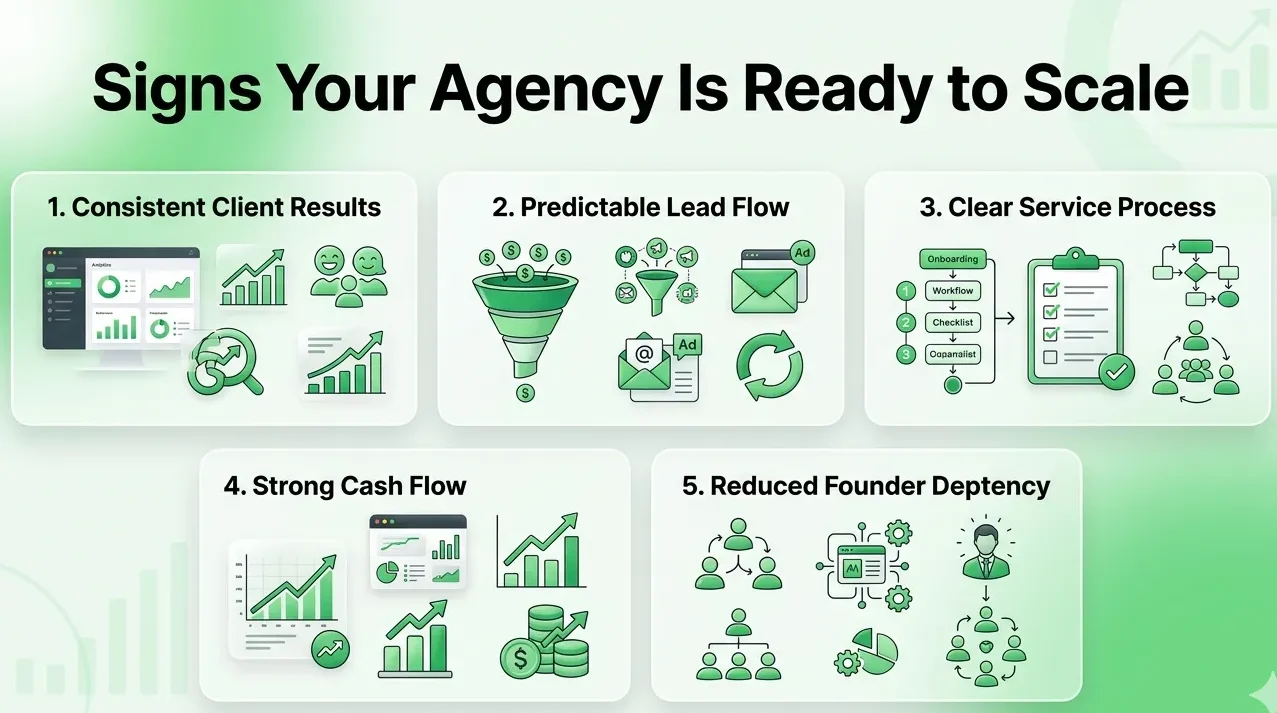
Scaling an agency successfully requires more than just getting additional clients. Before expanding, your business needs strong systems, predictable revenue, and operational stability to support long-term growth. Here are some key signs that show your agency is truly ready to scale.
- Consistent Client Results: Your agency has a proven track record of delivering repeatable results for clients. Campaigns run smoothly, expectations are clear, and your services can handle more clients without sacrificing quality.
- Steady Lead Flow: Your agency consistently attracts qualified leads through inbound, outbound, referrals, or paid marketing. Client acquisition has become predictable, creating a stable path for future revenue growth.
- Clear Service Offerings: Your services are well-defined, productized, and easy for clients to understand. Delivery processes are structured, onboarding is efficient, and your team can execute work consistently without reinventing the process each time.
- Healthy Cash Flow: Your business generates stable monthly revenue and maintains positive cash flow. You can comfortably cover expenses while investing in hiring, automation, tools, and business growth opportunities.
- Founder Bottleneck Awareness: You have realized that being involved in every task limits your agency’s growth. You are ready to delegate responsibilities, trust systems and processes, and focus more on leadership and strategic scaling.
Common Mistakes Agencies Make When Scaling Too Early
Many agencies attempt to scale too quickly without building the right foundation first. This often leads to operational chaos, declining service quality, and financial instability. Avoiding these common mistakes can help your agency grow sustainably and maintain long-term success.
- No Clear Niche: Trying to serve everyone weakens your agency’s positioning and messaging. Without a defined niche, marketing becomes generic, conversions decrease, and attracting high-paying ideal clients becomes much more difficult.
- Hiring Too Fast: Rapid hiring without proper systems and processes increases operational costs and creates confusion within the team. Productivity drops, communication becomes unclear, and founders spend more time managing people instead of focusing on business growth.
- Customizing Everything: Providing completely custom solutions for every client slows down delivery and creates operational inefficiencies. It increases workload, stretches timelines, and makes scaling difficult without overwhelming your team.
- Ignoring Financial Metrics: Failing to track important metrics like profit margins, client acquisition costs, and churn rates can create hidden financial problems. Revenue may grow, but profitability and long-term sustainability can suffer significantly.
- Founder-Centric Operations: When all decisions, client communication, and service delivery depend on the founder, growth becomes limited. This creates bottlenecks, increases stress, and prevents the agency from scaling efficiently.
How to Scale Your Digital Marketing Agency: A Proven $150K/Month Blueprint
Step 1: Define a Clear Niche and Agency Positioning
Decide on a niche, an audience, or the specific problem your agency excels at solving. Positioning can save you from ineffective messaging, poor lead quality, too-long sales cycles, and low prices. Your agency will be more likely to stand out from the rest and can scale a lot more effectively by specializing.
Step 2: Build a Scalable Service Model and Pricing Structure
Take a service and package it up as a product with clear deliverables and outcomes. Keep away from too much tailoring and switch to retainers or value-based pricing. A scalable pricing structure levels the revenue, supports forecasting, and helps to maintain profitability as the number of clients increases.
Step 3: Utilize Outsourcing for Paid Advertising
Smart outsourcing turns fixed marketing expenses into flexible costs. You can scale services based on what you need, which is far more efficient than keeping a full-time team year-round. This way, you have the marketing power exactly when it is needed.
The US BPO market reached $85,445.90 million in 2024-26, showing how common this approach has become. Many agencies partner with providers like The White Label Agency to access services such as white label Google Ads, allowing them to deliver expert campaign management under their own brand.
With this model, agencies gain advanced knowledge, proven systems, and innovative tools without overextending their budget.
Step 4: Build Systems and Standardize Your Delivery Process
Document workflows, establish SOPs, and rely on templates and automation for consistent execution. Standardized delivery guarantees precision, reduces lag time for getting new hires up and running, and makes it simple to offer assignments. If your agency is operating at a high speed and volume, your systems must continue to provide a high level of quality.
Step 5: Hire and Build a High-Performance Team
Ed: Form a team with well-defined roles and responsibilities. Employ specialists or trustworthy contractors who are compatible with your processes and culture. Emphasize accountability, performance measures, and communication to ensure productivity and quality, even in a growing team size.
Step 6: Create a Predictable Client Acquisition System
Create consistent channels of lead generation like content marketing, paid advertising, partnerships, or outbound outreach. Monitor conversion rates and tweak the successful strategies. Knowing what to expect from acquisitions eliminates the risk of revenue volatility, enabling clients to make informed and confident scaling decisions.
Step 7: Master Client Retention and Reduce Churn
Providing to a new client is improved by a good welcome, check-in communications, clear reporting, and measurable results. Customer retention translates to greater lifetime value, provides more predictable revenue, and decreases the strain on sales, which all lead to faster and more profitable growth.
Step 8: Leverage AI and Technology to Scale Faster in 2026
Leverage artificial intelligence tools to analyze, report, create content, and automate workflows. By utilizing technology, you’ll boost production without adding anyone to your agency staff, help with quicker, better decision-making, and ultimately use your resources to process more clients at the same time.
Step 9: Track the Right Metrics to Measure Agency Scale
Track important indicators such as churn rate, the monthly recurring revenue, margin profitability, cost of acquisition, and team utilization. Your data-driven insights can now tell you where your problems are, how you can improve, and which way you can go for scaling with confidence and profitability in mind.
The Road Ahead for Your Agency
Scaling a digital marketing agency is never a matter of luck. It is the result of vision, structure, and the courage to put the right systems in place. When you define your agency’s direction, build a model that can expand, invest in a motivated team, nurture strong client relationships, and manage high-performing Digital Marketing Projects efficiently, growth becomes a natural outcome rather than a constant struggle.
Every agency will encounter challenges, but the difference between those that stall and those that thrive is found in preparation. The framework outlined here gives you the tools to move beyond short-term wins and create a business that can sustain both revenue and impact for years to come.
The question is no longer if you can scale, but how quickly you are ready to put these steps into practice.
Conclusion
In a digital world, scaling is not about being in a hurry; it’s about being smartly designed. Successful agencies are all about being clear, having systems, and leveraging instead of working harder to scale. And with a clear niche, standardized services, a consistent distribution network, and the use of AI-driven tools, you can grow revenues without fatigue.
The trick is the timing; scale it when the foundation is set. When done correctly, scaling moves your agency from a daunting task to a successful, profitable enterprise. Follow this blueprint step by step, track the right metrics, and commit to building systems that support long-term growth rather than short-term wins.