
Running a small business these days is more challenging than ever in 2026. Founders face fast change, distributed teams, investor pressure, customer demands, and tough competition—sometimes all in one day. Many startups fail within their first few years due to weak financial controls, poor planning, and ineffective team management. Founders invest tremendous effort in the product but often struggle with execution, decision-making, and growth.
Running a small business these days is more challenging than ever in 2026. Founders face fast change, distributed teams, investor pressure, customer demands, and tough competition—sometimes all in one day. Insights from an Ecommerce industry report 2026 show that businesses adopting data-driven decision-making, strong financial planning, and scalable technology are better positioned for long-term growth and profitability. A leading business intelligence platforms for Indian companies like TOFLER, provides valuable market insights and company intelligence that help entrepreneurs make informed strategic decisions. Many startups fail within their first few years due to weak financial controls, poor planning, and ineffective team management.
This guide is intended to reduce that overwhelm. If you want to learn how to manage your startup effectively, this step-by-step guide covers everything from setting goals and building a business plan to managing finances, hiring the right people, selecting useful tools, and handling legal compliance.
With the right approach, smart planning, and helpful resources like USgrants, you can keep your startup organized, focused, and growing in the right direction. Building strong systems early, staying adaptable, and making data-driven decisions can help your business scale more efficiently while avoiding costly mistakes.
This guide will help you manage your startup more efficiently, avoid common mistakes, and build a business designed for long-term sustainability.
What Does “Managing a Startup” Actually Mean?
Managing a startup involves far more than handling daily operations. Rather than running a startup, it’s about managing the people, process, and growth in sync. Startup management is about making decisions, prioritizing, and being flexible in a world of uncertainty.
There are three cornerstones. People consist of hiring, culture, leadership, and communication. Operations include workflows, finances, tools, and legal compliance. Growth is all about finding customers, product-market fit, and scaling. It’s a balancing act that successful entrepreneurs continue to strive for.
Startups, different from a standard business, should move fast, test ideas, and have to pivot quickly. Understanding this difference helps new founders avoid burnout and build systems that support sustainable growth.
Step-by-Step Guide on How to Manage Your Startup
Step 1 — Set Clear Goals and Define Your Vision
Every successful startup begins with clarity. Without a clear vision and realistic goals, founders often waste time, lose focus, and struggle to make consistent decisions. Defining your vision gives your startup direction, while setting goals creates a roadmap for achieving growth.
At the early stage, startups face constant uncertainty. Markets change quickly, customer needs evolve, and resources are limited. Clear goals help founders prioritize what matters most and prevent distractions from slowing progress. A strong vision also keeps teams aligned and motivated during difficult phases.
Your startup vision should explain:
- What problem your business solves
- Who your target audience is
- What impact you want to create
- Where you want the company to be in the future
1. How to Set SMART Goals for a Startup
SMART goals are specific, measurable, achievable, relevant, and time-bound. Don’t set “grow revenue” without setting a specific goal like “increase MRR by 20% in six months.” Having SMART goals can help align teams, ensure accountability, and track progress, which is essential for early-stage startups.
2. Short-Term vs. Long-Term Startup Goals
Short-term goals are those that involve actions that will be taken next, including the launch of an MVP and the first customers. Long-term goals are what the startup will be like after 3-5 years. Both provide balance and continuity to enable day-to-day efforts to advance towards the broader goal.
3. How to Track Progress (KPIs for Startups)
Measuring progress involves choosing a handful of relevant KPIs that are related to growth and sustainability. Founders can use metrics like customer acquisition cost, retention rate, and monthly burn rate to identify issues at an early stage and pivot accordingly before matters get too big.
Step 2 — Build a Solid Business Plan
A strong business plan gives your startup structure, direction, and clarity. While many founders focus heavily on building products, a business plan helps turn ideas into a sustainable business model. It outlines how your startup will operate, generate revenue, compete in the market, and grow over time.
For early-stage startups, a business plan is more than a document for investors. It acts as a roadmap that helps founders make informed decisions, set priorities, and reduce uncertainty during growth.
1. The elements of a business plan for a startup
A startup business plan should cover a problem statement, solution, target market, revenue model, competitive analysis, go-to-market strategy, and financial projections. It serves as a guide for founders and a confidence booster for investors.
2. Lean Business Plan vs. Traditional Business Plan
Lean plans are built around assumptions, experiments, and quick iterations and are perfect for early startups. Traditional plans are more in-depth and suitable for industries with regulation or fundraising. A large number of ventures will lean out and then grow as time goes on.
3. Free Tools to Create a Business Plan
The business model canvas, pitch template, and planning software are tools that can help founders quickly structure their ideas, all of which are free. These resources are useful for stakeholders to confirm their own assumptions without shouldering a heavy burden of consultants.
Step 3 — Manage Your Startup Finances Like a Pro
Strong financial management is one of the most important parts of running a successful startup. Many startups fail not because of bad ideas, but because they run out of money, overspend, or fail to manage cash flow properly. Understanding your finances early helps you make smarter decisions, reduce risk, and build a sustainable business.
Startup founders should treat financial planning as an ongoing process rather than a one-time task. Every business decision — hiring, marketing, product development, or expansion — directly affects cash flow and long-term growth.
1. How to Create a Startup Budget?
A startup budget details the expected revenues and costs, such as salary, marketing, software, and office space. For example, allocating 40% to product development and 20% to marketing helps founders control spending and avoid cash shortages.
2. How to Track Cash Flow and Burn Rate?
Cash flow indicates the movement of cash, and burn rate is how long the money will last. Having a weekly analysis is also good for founders to make decisions on timely cost-cutting or funding.
3. Funding Options for Startups in 2026 (Grants, VC, Bootstrapping)
Government grants, angel investors, venture capital, crowdfunding, and bootstrapping are all options for startup funding in 2026. Each choice has some advantages/disadvantages in terms of control, risk, and rate of growth.
4. When to Bootstrap vs. Raise Funding
Bootstrapping is effective with consistent growth in sales and stable costs. It is a good idea to raise funds for startups that need lots of capital or are rapidly growing. Racing or stopping too early or too late can impact long-term success.
Step 4 — Hire and Build the Right Team
A startup’s success depends heavily on the people behind it. Even the best business ideas can fail without the right team to execute them. In the early stages, every hire has a major impact on company culture, productivity, and long-term growth. That is why founders must focus on building a team that is skilled, adaptable, and aligned with the startup’s vision.
The first step is finding the right co-founders and early employees. Strong co-founders should complement your strengths rather than duplicate them. For example, a technical founder may benefit from partnering with someone experienced in sales, operations, or marketing.
1. How to Find Co-founders and Early Employees?
You have great co-founders who are able to share your vision with you and complement your skills. In addition to being adaptable and mission-oriented, early hires should also be equipped to face uncertainty. Become more successful with networks, startup communities, and/or referrals than mass hiring.
2. Equity Split and Vesting Schedules Explained
Equity equals contribution and risk. Vesting schedules are one way to safeguard a startup by helping founders and employees accrue equity over time to limit the chances of fighting and hold them longer.
3. How to Build a Remote Startup Team in 2026
Remote and hybrid work models have become standard in 2026. They have remote teams working for them. Clear documentation, async communication, and outcome-based performance tracking help distributed teams stay productive and aligned.
4. How to Develop a Strong Culture for a Startup?
Culture forms early. Leadership actions, communication norms, and recognition, particularly in remote-first settings, should promote transparency, ownership, and trust.
Step 5 — Choose the Best Tools to Manage Your Startup Efficiently
The right tools can significantly improve how a startup operates. From project management and communication to accounting and customer support, software tools help founders save time, reduce manual work, and improve team productivity. In fast-moving startup environments, efficient systems are essential for staying organized and scaling operations smoothly.
However, many startups make the mistake of using too many tools too early. Instead of increasing productivity, excessive software can create confusion, duplicate work, and unnecessary expenses. The goal is not to use every available platform but to choose tools that solve real operational problems.
One of the most important categories is project management software. These tools help startups organize tasks, assign responsibilities, monitor progress, and manage deadlines.
1. Project Management Tools (Trello, Asana, Notion)
Tools like Trello, Asana, and Notion help startups organize tasks, track progress, and collaborate efficiently. Choosing one primary tool prevents confusion and improves accountability.
2. Communication Tools for Startup Teams
Communication tools are equally important, especially for remote and hybrid teams. Fast and clear communication helps startups make decisions quickly and avoid misunderstandings.
- Slack for team messaging
- Zoom for video meetings
- Google Meet for collaboration
- Microsoft Teams for larger organizations
Many startups also rely on async communication to reduce meeting overload and improve productivity across different time zones.
3. Financial Management Tools for Startups
Financial management tools help founders track expenses, monitor cash flow, manage invoices, and maintain accurate records. Proper financial tracking is essential for budgeting, fundraising, and long-term planning.
Financial tools like
- QuickBooks
- Xero
- FreshBooks
- Wave
- Zoho Books
These platforms simplify bookkeeping and provide financial insights that help founders make smarter business decisions.
Startups also benefit from customer relationship management tools that organize customer data, sales pipelines, and communication history.
4. Best Free Tools for Bootstrapped Startups
For bootstrapped startups, free and low-cost tools can reduce operational costs during the early stages. Many platforms offer free plans that provide enough functionality for small teams.
Useful free tools include:
- Canva for design
- Google Workspace for collaboration
- Mailchimp for email marketing
- Figma for UI/UX design
- Google Analytics for website tracking
- Buffer for social media scheduling
The best startup tools are the ones that simplify workflows and support growth without adding unnecessary complexity.
As the company grows, founders should regularly review their software stack to remove unused tools and improve operational efficiency. Building a streamlined system early allows startups to scale faster while keeping teams productive and organized.
Step 6 — Validate Your Product and Understand Your Customers
Many startups fail because they build products people do not actually need. Founders often spend months developing features without confirming whether customers are willing to use or pay for the solution. Product validation helps reduce this risk by ensuring there is real market demand before investing significant time and money.
The goal of validation is to understand your customers, test assumptions, and improve the product based on real feedback. Instead of relying on opinions or guesses, successful startups make decisions using customer insights and market data.
1. What Is Product-Market Fit and How to Achieve It
One of the most important concepts in startup growth is product-market fit. Product-market fit happens when a product successfully solves a meaningful problem for a specific audience and customers actively continue using it.
2. How to Collect Customer Feedback (Surveys, Interviews)
Develop your understanding of customers’ buying journeys through surveys, interviews, and usability tests. Startups will benefit by continuous feedback loops, which will reduce wasted development and improve startup results.
3. How to Build and Test an MVP in 2026
An MVP should answer a single problem with the fewest amount of features. By 2026, no-code tools and AI accelerators will enable founders to experiment with business ideas without producing extensive engineering.
Step 7 — Create a Marketing Strategy That Actually Works
Even the best products struggle to grow without effective marketing. Many startups focus heavily on product development but underestimate the importance of building awareness, attracting customers, and creating consistent demand. A strong marketing strategy helps startups reach the right audience, generate trust, and grow sustainably over time.
Startup marketing is different from traditional marketing because early-stage companies often operate with limited budgets and smaller teams. Instead of trying to compete with large brands through expensive advertising, startups should focus on targeted, cost-effective growth strategies.
1. Startup Marketing on a Zero Budget
Everything culminates in a strategy used by early-stage startups to get going without paid ads organic channels such as partnerships, referrals, and communities.
2. Content Marketing and SEO for Startups
Long-term traffic and trust are created through SEO blogs, case studies, and guides. It’s the consistency and value, not volume, that counts.
3. Social Media Strategy for Startups in 2026
Consider whether you want to target one or two platforms where you think your audience can be found. Promotional content is less effective than short-form video, authenticity, and community engagement.
4. How to Use Email Marketing to Grow Your Startup
Email remains a high-ROI tool. Connect with your customers and drive retention and upsells with onboarding, product announcements, and education.
Step 8 — Assess Performance Using Data and KPIs
Successful startups make decisions based on data rather than assumptions. While intuition and creativity are important, long-term growth depends on understanding what is working, what is failing, and where improvements are needed. Tracking performance through data and key performance indicators (KPIs) helps founders measure progress, identify problems early, and make smarter strategic decisions.
Many startups collect large amounts of data but fail to focus on the metrics that truly matter. Instead of tracking everything, founders should concentrate on KPIs directly connected to business growth, customer behavior, financial health, and operational efficiency.
1. Most Important KPIs for Startup Management
Startups should focus on a few meaningful KPIs connected to growth, customer behavior, financial health, and operational efficiency. Some of the most important startup metrics include customer acquisition cost (CAC), customer lifetime value (LTV), monthly recurring revenue (MRR), churn rate, burn rate, revenue growth, and customer retention. For example, CAC shows how much it costs to acquire a new customer, while churn rate measures how many customers stop using the product over time. Monitoring these metrics regularly helps founders understand whether the business is growing sustainably.
2. How to Set Up a Simple Startup Dashboard
To simplify performance tracking, startups should create a dashboard that combines financial, marketing, and product data in one place. Tools like Google Analytics, Looker Studio, Mixpanel, HubSpot, and Notion dashboards make it easier to monitor trends and evaluate performance. Even a simple spreadsheet can work effectively during the early stages. A well-organized dashboard allows founders to quickly identify issues such as rising customer acquisition costs, declining retention rates, or increasing burn rates before they become major challenges.
3. How to Make Data-Driven Decisions
Data-driven decision-making also helps startups improve marketing, product development, and operational strategies. Founders can use customer feedback, sales reports, website analytics, and A/B testing to validate assumptions and optimize business performance. Instead of relying on opinions, successful startups continuously test ideas, analyze results, and adjust strategies based on evidence. By building a data-focused culture early, startups can reduce uncertainty, improve efficiency, and create a stronger foundation for sustainable long-term growth.
Step 9 — Stay Legally Compliant and Protect Your Business
Legal and compliance issues are often overlooked during the early stages of a startup, but ignoring them can create serious financial and operational risks later. From choosing the right business structure to protecting intellectual property and managing contracts, legal planning plays a major role in building a stable and scalable company. A legally protected startup is better prepared to attract investors, avoid disputes, and operate confidently in competitive markets.
1. Legal Structure — LLC vs. Corporation vs. Sole Proprietorship
The structure will impact taxes, liability, and fundraising. Corporations are beneficial to startup companies that are backed by investment capital, while LLCs are flexible for small groups.
2. How to Register Your Startup
Registration includes name selection, filing of incorporation documents, and tax ID acquisition. This will help avoid problems with the law in the future.
3. Contracts, IP Protection, and Compliance in 2026
Clear contracts, IP ownership clauses, and data protection compliance safeguard your startup from disputes and regulatory risks.
Step 10 — Scale Your Startup Without Losing Control
Scaling a startup is one of the most exciting yet challenging stages of growth. Expanding too slowly can limit opportunities, while scaling too quickly can create operational chaos, financial pressure, and declining customer satisfaction. Successful startups scale strategically by building systems, strengthening operations, and maintaining control as the business grows.
Before scaling, founders should ensure the startup has achieved a strong product-market fit, stable revenue, and reliable operational processes. Growth becomes far more sustainable when the business already has consistent customer demand, healthy cash flow, and a proven business model. Scaling without these foundations often leads to wasted resources and unnecessary risk.
1. When Is the Right Time to Scale?
Ideally, scaling occurs when businesses can pinpoint product-market fit, stable cash flow, and consistent revenue. Before you invest in growth and expansion, your operations, customer service, and team should be able to meet existing demand without effort.
2. How to Build Repeatable Systems and Processes?
Systems need to operate without continual founder engagement to work for scaling. Track documents, establish standards for making decisions, streamline repetitive processes, and rely on reliable tools. Repeatable processes allow for quality, minimize error, and onboard new members of the team as the startup grows without compromising on efficiency.
Common Mistakes Startups Make When Scaling
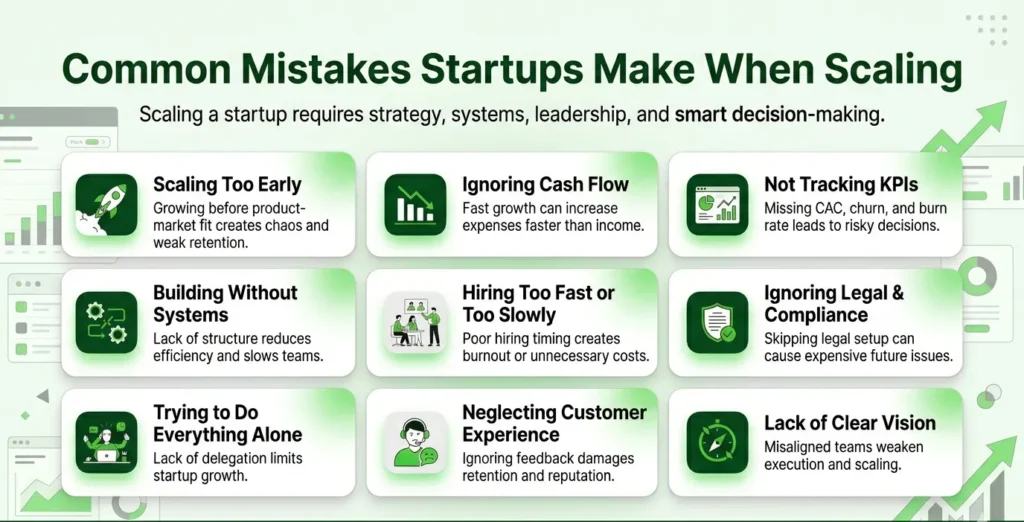
Scaling a startup requires more than rapid growth and increased revenue. Without the right strategy, systems, and leadership, startups can face challenges that slow progress and impact long-term success.
- Scaling Too Early: Breaking the rules of growth before reaching product-market fit results in loss of investment, poor retention, and operational chaos.
- Ignoring Cash Flow: Faster growth can make expenses grow quicker than revenues. Even startups with high revenue can suffer from a shortfall in cash flow.
- Not Tracking the Right KPIs: Scaling without data results in guesswork. If important metrics, such as burn rate, CAC, and churn, are missing, then there are serious dangers.
- Building Without Systems: Relying on ad-hoc processes causes inefficiency. Not having documentation slows teams and raises the dependency on the founders.
- Hiring Too Fast or Too Slowly: You can’t afford to overhire, and you can’t have enough employees to overwork them. Important in scale-up phases will be to clarify timing and roles.
- Avoid legal and compliance setup: In skipping contracts and IP protection and/or regulatory requirements, one can find oneself in costly disputes and legal setbacks at a later stage.
- Trying to Do Everything Alone: Those founders who do not delegate stifle growth. Scaling goes beyond the technical; it needs trust, leadership, and the empowerment of the right people.
- Neglecting Customer Experience: Growth can take a reactive approach and turn inward. Without addressing customer feedback during scaling, this can cause churn and reputation issues.
- Lack of Clear Vision During Expansion: Misaligned scaling leads to conflicting team dynamics that compromise execution and long-term strategy.
Real-World Examples of Well-Managed Startups
1. Airbnb
Airbnb started as a small platform that allowed people to rent out spare rooms to travelers. The company focused heavily on customer experience, trust, and technology to scale globally.
One of Airbnb’s biggest strengths was its ability to adapt quickly. During difficult periods, the company improved its platform, expanded into new markets, and built systems that could support millions of users worldwide. Its focus on branding, operational efficiency, and user trust made it one of the most successful startup scaling stories.
2. Slack
Slack transformed workplace communication by creating a simple and user-friendly collaboration platform. Instead of targeting everyone at once, Slack focused on solving communication problems for teams and businesses.
The company grew rapidly because it listened closely to customer feedback and continuously improved the product. Slack also invested in strong onboarding experiences and scalable infrastructure, helping it maintain performance while growing its user base globally.
3. Canva
Canva became one of the world’s leading design platforms by making graphic design accessible to non-designers. The startup identified a major market gap and simplified complex design processes into an easy drag-and-drop experience.
Canva’s management strategy focused on product innovation, global scalability, and community engagement. The company consistently introduced new features while maintaining a simple user experience, allowing it to scale across individuals, businesses, and educational institutions.
4. Zoom
Zoom gained massive popularity because of its reliable video communication platform. While many competitors struggled with performance issues, Zoom focused on speed, simplicity, and stable connectivity.
The company’s management handled rapid growth effectively during the global shift to remote work. Zoom scaled its infrastructure quickly, maintained service quality, and responded rapidly to security concerns, which helped strengthen customer trust and long-term adoption.
5. Shopify
Shopify built a scalable eCommerce ecosystem that enabled small businesses to create online stores easily. Instead of competing directly with large retailers, Shopify focused on empowering entrepreneurs and small brands.
The company succeeded by continuously improving its platform, offering integrated tools, and building a strong support ecosystem for merchants. Shopify’s ability to scale technology, operations, and partnerships made it one of the most successful startup management examples in the eCommerce industry.
Conclusion
When running a startup in 2026, there has to be clarity, discipline, and adaptability. Understanding how to Manage Your Startup effectively is essential for making better decisions, improving operations, and building a sustainable business.
Every decision and every minute spent—from setting up objectives to handling finances, hiring the right people, and using smart tools—is significant. The most successful founders view management as an ongoing activity and not as a one-off task.
By following this step-by-step guide on Manage Your Startup, you can minimize risks, enhance decision-making, and grow a startup for long-term success. Get started, maintain focus, and continue improving as your business evolves.