Today’s best fundraising CRM platforms with AI features provide real-time insights, personalized communication tools, and predictive analytics that directly strengthen donor relationships.
Artificial intelligence is transforming nonprofit fundraising. CRMs that integrate AI enable organizations to better understand their donors, predict giving patterns, and automate everyday tasks. This makes teams more efficient and campaigns more effective.
Here are three of the top CRM platforms with AI that nonprofits are using to raise more funds and manage supporters more effectively.
List of 3 Best Fundraising CRM Platforms
1. ascend fundraising CRM by Kindsight
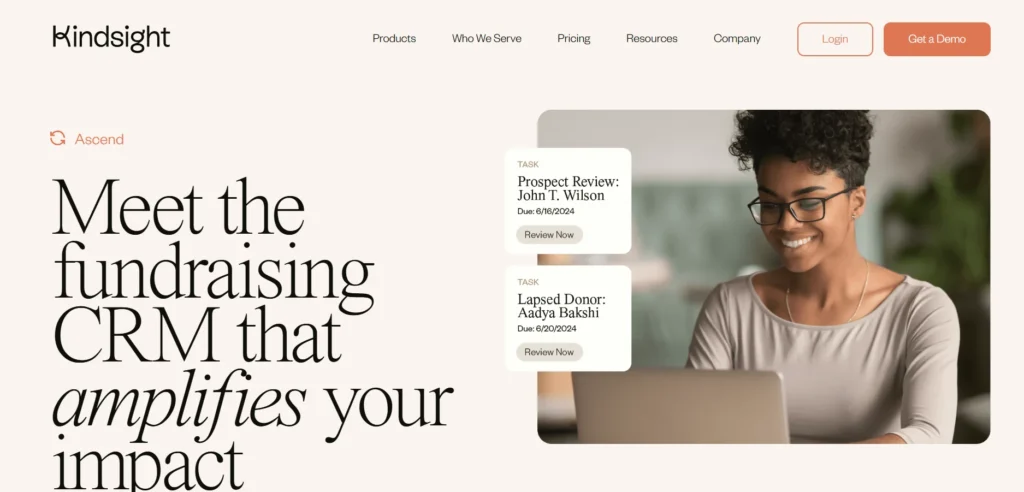
The ascend fundraising CRM by Kindsight is the best AI-native constituent relationship management platform, with powerful AI features built into its core system. It leverages big data, automation, and advanced analytics to provide nonprofit professionals with the insights they need to foster lasting donor relationships and drive revenue growth.
Key features include:
- AI-driven prospect research: Identify high-value prospects with predictive modeling, drawing on 1.5 billion up-to-date wealth and philanthropic records.
- Automated workflows: Save time by automating acknowledgment letters, reminders, and follow-ups.
- Real-time dashboards: Gain immediate visibility into campaigns, pipelines, and donor engagement.
- Salesforce foundation: Built on Salesforce, ascend allows for seamless integration and scalability. Research shows that the adoption of Salesforce increases sales productivity by as much as 34%. This also translates to greater effectiveness when used in fundraising applications.
ascend provides a powerful platform for managing all constituent activities in one place. Its AI-powered capabilities help nonprofits anticipate donor behavior, prioritize outreach, and run campaigns more efficiently. With its data-driven design and intelligent automation, ascend empowers fundraising teams to strengthen donor connections and achieve far greater impact.
2. GoldMine CRM
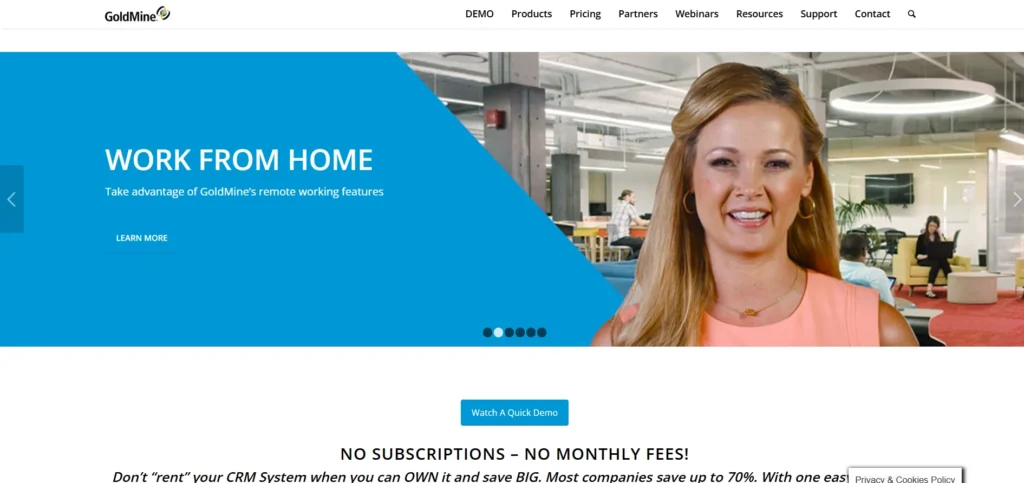
GoldMine CRM is a long-standing customer relationship management solution designed to help small and mid-sized teams organize contacts, track activities, and manage sales pipelines. It offers very basic native AI features like email automation, with additional AI features available via integrations.
Key features include:
- Contact and activity management: Centralize customer data, link emails and documents, and schedule follow-ups in one place.
- Sales tracking and forecasting: Manage opportunities, monitor donor pipelines, and generate performance reports.
- Email and marketing integration: Connects with tools like Microsoft Outlook and QuickBooks for streamlined communication and data management.
- AI and automation capabilities: While GoldMine does not have deeply integrated native AI tools, it supports AI functionality through third-party integrations. Users can connect external platforms such as Microsoft Power BI or Zapier-based automation systems to enable predictive analytics, lead scoring, and AI-driven workflow triggers. GoldMine also offers optional add-ons for automated email responses, intelligent task reminders, and natural language search within contacts and communications—features that approximate AI assistance within its legacy framework.
GoldMine is best suited for small teams—typically between 5 and 25 users—who prefer to host their own system rather than rely on the cloud. However, it’s more of an advanced contact manager than a full-featured, AI-driven CRM platform. The software’s traditional design and limited built-in automation make it feel dated compared to newer cloud-based CRMs that feature robust, native AI capabilities.
3. Twenty CRM
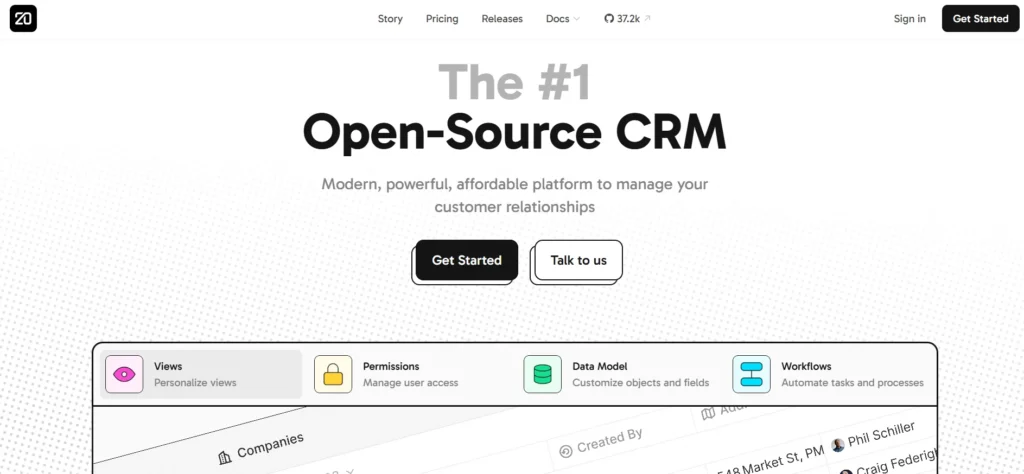
Twenty CRM is a modern, open-source CRM platform designed to provide businesses with full control over their customer data, workflows, and integrations, with AI features to increase efficiency. It emphasizes developer-friendliness, customization, and data ownership rather than a “one-size-fits-all” SaaS model.
Key features include:
- Customizable objects & data model: Define your own fields, relationships, and data structures so the CRM reflects your unique business processes.
- Flexible workflows & automation: Automate tasks and processes via APIs and webhooks to connect Twenty to your other tools and systems.
- Multiple views & navigation shortcuts: Includes Kanban boards, table views, and a command palette (⌘ K), which helps users move through contacts, deals, and tasks efficiently.
- Emerging AI-enabled features: While Twenty’s AI capabilities may not yet be fully mature, integrations show AI templates and automation being applied to extract data and insights from communications and trigger workflows. For example, a “Praiz” integration mentions “Advanced AI Templates” to extract insights from calls and then push them to Twenty CRM.
Twenty CRM offers a compelling platform for technically capable teams that want control, customization, and the ability to integrate AI-driven workflows. That said, users have voiced real concerns. One paying customer called the platform “incomplete” and noted that support can take days to respond. As a young, open-source product, some features are still in development, and support is less refined than that of mature CRMs.
Why Nonprofits Need AI in Fundraising CRMs
AI in fundraising CRMs is shaping how nonprofits build donor trust, manage data, and increase giving.
- Predictive donor insights: Identify the best prospects and time outreach effectively.
- Automation of repetitive tasks: Free staff from manual processes so they can focus on relationships.
- Improved donor retention: Personalized communications foster loyalty and long-term engagement.
- Smarter reporting: Real-time dashboards and forecasts replace guesswork with data-driven clarity.
For nonprofits facing limited resources and high expectations, these features directly improve impact and efficiency.
Choosing the Right Fundraising CRM With AI
When selecting a platform, nonprofits should consider:
- Integration needs: Will the CRM work with existing tools and databases?
- Ease of use: Staff adoption depends on intuitive interfaces and clear workflows.
- Scalability: The platform should grow with the organization’s fundraising needs.
- Support and training: Strong customer service and onboarding resources are critical.
- Budget: Costs should align with the organization’s size and capacity without sacrificing features.
By focusing on these factors, nonprofits will select a CRM that strengthens fundraising while remaining manageable for staff.
The Future of Fundraising Is Intelligent
The best fundraising CRM platforms with AI features are helping nonprofits modernize their donor engagement strategies through automation, insight, and data-driven decision-making.
1. ascendfundraising CRM: stands out for its Salesforce-powered architecture and AI-driven intelligence that helps organizations anticipate donor behavior, automate outreach, and measure impact in real time.
2. GoldMine CRM: remains a trusted option for smaller teams that prefer on-premise control, offering solid contact and pipeline management tools—even if its legacy design limits automation compared to cloud-based solutions.
3. Twenty CRM: provides a flexible, open-source alternative for technically skilled teams that value customization and emerging AI-enabled workflows. While still in development, it provides users with the freedom to tailor their CRM environment.
Each of these platforms offers a distinct path toward smarter fundraising operations. Whether your organization values advanced automation, simplicity, or open-source flexibility, the next generation of fundraising success will be built on intelligent systems that deepen donor relationships and enhance the effectiveness of every campaign.