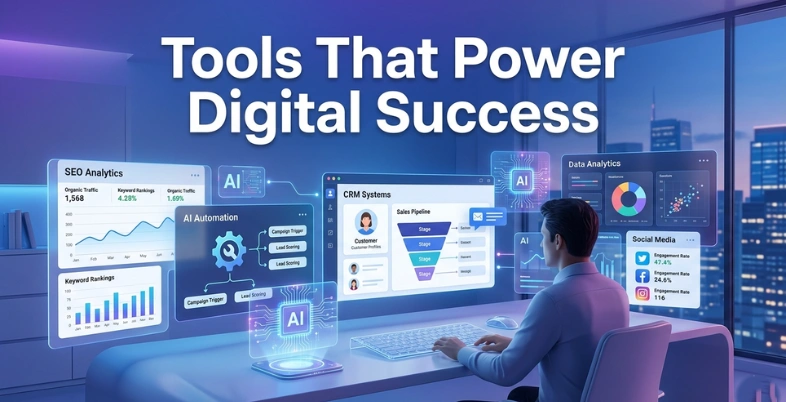
In 2026, digital success will be more than just ranking on search engines and displaying advertisements; it will be about creating visible, trusted, and AI-recognized brands on platforms. AI-powered discovery, automation, and data-driven decisions are defining success in the online landscape, and the Tools That Power Digital Success are the key to competitive advantage.
This guide is especially crafted for marketers, startup founders, startups, and agencies looking for the best digital marketing tools in a in a saturated tech landscape. You will discover some of the tools that are relevant to the present time, the transformation of SEO to AI visibility, the evolution of your plate to smarter growth with analytics, and much, much more.
In 2026 digital success isn’t finding more tools; it’s finding the right sets of tools. Let’s get to know platforms that drive modern digital performances and use them strategically.
What Does Digital Success Mean?
Digital success used to be about traffic; now it’s about influence, engagement, and AI trust. Conventional search optimizations and modern SEO optimization strategies are no longer sufficient—brands need to start appearing in AI answers, voice, and generative search.
Keystones for Digital Success
- SEO → AI Visibility + Brand Authority: Being ranked doesn’t necessarily get you growth. AI systems must acknowledge, quote, and rely on brand names.
- Rise of GEO (Generative Engine Optimization): Crafting content to be optimized for AI understanding, summarizing, and recommending.
Performance Metrics That Matter in 2026
- Time on task, depth, and interactions.
- Converted leads, sales, or user signups
- AI citations (citation as part of AI-generated answers)
This is a move away from chasing algorithms toward thought leadership, structured content, and credibility.
GEO in 2026: Optimizing Content for AI Search and Generative Engines
Generative Engine Optimization (GEO) is becoming a major digital marketing strategy in 2026 as AI-powered search engines and conversational assistants change how users discover information online. Unlike traditional SEO, which focuses on ranking webpages in search engine results, GEO focuses on helping AI systems understand, trust, and reference your content in AI-generated answers.
As users increasingly rely on tools like ChatGPT, Google AI Overviews, Perplexity, voice assistants, and conversational search interfaces, businesses must optimize their content for AI visibility. In many cases, users now receive direct AI-generated answers instead of browsing multiple websites. GEO helps ensure that your brand, products, and expertise are included in those responses.
GEO focuses on creating:
- Structured and AI-readable content
- Expert-led and trustworthy information
- Semantically clear explanations
- Conversational and intent-focused content
- Strong brand authority across the web
One of the most important aspects of GEO is semantic clarity. AI systems understand context and meaning rather than just keywords, so content must clearly explain topics, answer user intent, and provide complete information in a natural format.
Structured data also plays a critical role in GEO. Using schema markup, FAQs, author information, product details, and organized formatting helps AI systems better interpret and summarize content accurately.
Another key factor is authority and trust. AI search systems are more likely to reference content from recognized brands, experienced authors, and credible sources. Businesses that consistently publish high-quality and accurate content are more likely to appear in AI-generated recommendations and summaries.
In 2026, GEO is especially important for:
- AI-generated search results
- Voice search optimization
- Conversational AI interfaces
- Smart assistants and chatbots
- Personalized search experiences
Companies investing in GEO can improve brand visibility, increase authority, and future-proof their digital marketing strategy as search behavior continues shifting toward AI-driven experiences.
How GEO Differs From Traditional SEO
Although GEO and SEO work together, they are not the same.
| Traditional SEO | GEO (Generative Engine Optimization) |
| Focuses on ranking webpages | Focuses on AI-generated mentions |
| Optimizes for search engines | Optimizes for AI systems |
| Relies heavily on keywords | Relies on semantic meaning and clarity |
| Measures clicks and rankings | Measures AI citations and visibility |
| Targets search result pages | Targets conversational answers |
SEO & Visibility Tools — Get Found Before Competitors
Keyword Research Tools
1. Ahrefs

Website: https://ahrefs.com/
Ahrefs is a powerful SEO suite known for its massive backlink index and advanced keyword research capabilities, making it one of the most trusted SEO tools for businesses and marketers.
Key Features:
- Keyword difficulty analysis
- Competitor keyword tracking
- Backlink research
- Content gap analysis
- SERP history insights
2. SEMrush

Website: https://www.semrush.com/
SEMrush offers an all-in-one digital marketing toolkit covering SEO, PPC, content, and competitive research, making it one of the most popular keyword research tools for marketers.. It’s ideal for teams managing multi-channel visibility strategies.
Key Features:
- Keyword research & clustering
- Competitive analysis
- PPC insights
- Content optimization tools
- Rank tracking
Technical SEO & Site Audit Tools
3. Screaming Frog
Website: https://www.screamingfrog.co.uk/seo-spider/
Screaming Frog is a website crawler that identifies technical SEO issues affecting performance and indexability. It’s widely used for deep audits of large and complex websites.
Key Features:
- Broken link detection
- Page title & meta analysis
- Crawl depth insights
- Duplicate content checks
- XML sitemap generation
4. Sitebulb

Website: https://sitebulb.com/
Sitebulb combines technical auditing with visual reporting, making SEO insights easier to understand and communicate. It’s ideal for agencies and in-house teams.
Key Features:
- Visual SEO reports
- Core Web Vitals analysis
- Internal linking insights
- JavaScript SEO checks
- Actionable recommendations
Analytics & Data Tools — Turn Insights into Growth
Website Analytics
5. Google Analytics 4
Website: https://analytics.google.com/
GA4 tracks user behavior across websites and apps using an event-based model. It provides predictive insights essential for modern, privacy-first analytics.
Key Features:
- Event-based tracking
- Cross-device analytics
- Predictive metrics
- Custom reports
- Privacy-focused measurement
6. Mixpanel
Website:https://mixpanel.com/home/
Mixpanel focuses on product and user behavior analytics, helping teams understand how users interact with digital experiences in real time.
Key Features:
- User journey tracking
- Funnel analysis
- Retention reports
- Real-time insights
- Behavioral segmentation
Heatmaps & Behavior Tools
7. Hotjar

Website:https://www.hotjar.com/
Hotjar visualizes user behavior through heatmaps and session recordings, helping identify friction points and UX improvement opportunities.
Key Features:
- Click & scroll heatmaps
- Session recordings
- Feedback widgets
- Conversion funnels
- User surveys
8. Microsoft Clarity

Website https://clarity.microsoft.com/copilot
Microsoft Clarity offers free behavioral analytics with deep session insights, making it accessible for startups and small businesses.
Key Features:
- Session replays
- Rage click detection
- Heatmaps
- Performance insights
- Free unlimited usage
AI-Powered Content & Automation Tools
AI Content Creation
9. Jasper

Website: https://www.jasper.ai/
Jasper is an AI-powered content creation platform built for marketers and teams, making it one of the most useful AI tools for small businesses in 2026. It helps generate high-quality blogs, ad copy, emails, and brand-aligned content at scale while maintaining tone, consistency, and speed.
Key Features:
- Brand voice customization
- Long-form content generation
- SEO-focused writing workflows
- Team collaboration tools
- AI-powered content templates
10. Copy.ai

Website: https://www.copy.ai/
Copy.ai focuses on fast, conversion-driven copy creation for marketing, sales, and social media. It’s ideal for teams looking to automate repetitive writing tasks without sacrificing creativity.
Key Features:
- Marketing & sales copy generation
- Workflow automation
- Multilingual content support
- Idea brainstorming tools
- CRM-friendly integrations
Marketing Automation
11. HubSpot
Website: https://www.hubspot.com/
HubSpot is an all-in-one marketing automation platform combining CRM software, email marketing, lead nurturing, and analytics. It helps businesses automate customer journeys while keeping data centralized.
Key Features:
- Email & workflow automation
- Built-in CRM
- Lead scoring & nurturing
- Marketing analytics
- AI-powered insights
12. ActiveCampaign
Website: https://www.activecampaign.com/
ActiveCampaign specializes in customer experience automation, enabling personalized email, SMS, and lifecycle marketing based on user behavior and data signals.
Key Features:
- Advanced email automation
- Behavioral segmentation
- Predictive sending
- CRM integration
- Multi-channel campaigns
Social Media Management Tools
Scheduling & Publishing
13. Hootsuite
Website: https://www.hootsuite.com/
Hootsuite enables businesses to manage, schedule, and monitor social media content across multiple platforms from a single dashboard, making large-scale social management easier.
Key Features:
- Multi-platform scheduling
- Social listening tools
- Analytics & reporting
- Team collaboration
- Content calendar
14. Buffer

Website:https://buffer.com/
Buffer is a simple and intuitive social media scheduling tool designed for creators, startups, and small teams focused on consistent posting and engagement.
Key Features:
- Easy post scheduling
- Platform-specific previews
- Engagement tracking
- Analytics dashboard
- Browser & mobile apps
Social Commerce
15. Sprout Social
Website: https://sproutsocial.com/
Sprout Social combines social media management with social commerce insights, helping brands manage conversations, track customer intent, and support direct selling on social platforms.
Key Features:
- Unified social inbox
- Social commerce analytics
- Customer engagement tools
- Influencer insights
- Advanced reporting
16. Shopify
Website: https://www.shopify.com/
Shopify enables seamless social commerce by integrating online stores with Instagram, Facebook, and TikTok, allowing brands to sell directly through social channels.
Key Features:
- Social media storefronts
- Integrated checkout
- Inventory synchronization
- Analytics & reporting
- App ecosystem
Paid Advertising Tools
Google Ads
In 2026, Google Ads continues to play a crucial role in high-intent marketing, particularly for users deeply intent on finding a specific product or service. Its AI-driven smart bidding, predictive audience targeting, and Performance Max campaigns allow brands to appear across Search, YouTube, Display, and AI-powered discovery surfaces seamlessly.
Example:
An interior company is leveraging Google Ads to reach the audience searching for “modular kitchen near me,” running search ads and video ads on YouTube while using automated bidding and real-time optimization to convert qualified leads and bookings.
Meta Ads
With Meta Ads, advertisers can create brand and performance campaigns on Facebook, Instagram, and Messenger. With advanced audience targeting, AI-based creative testing, and social commerce features, it excels at influencing discovery-driven buyers and nurturing them toward conversion.
Example:
A fashion e-commerce company goes pro with Instagram Reels ads in Meta Ads by targeting lookalikes and retargeting website traffic, achieving improved engagement, impulse buying, and robust ROI with polished creatives and placements.
How to Build Your Digital Marketing Stack
The key to creating a digital marketing stack in 2026 is not about the chaos of tools but about focusing on automation tools and platforms those that help the business grow, automate, and make it visible through AI.
- Start with Clear Goals: Set your visibility goals, conversion goals, retention goals, or goals for building your AI authority. With clear goals, you don’t spend too much time repeating the same set of tools with more workflows.
- Integrate Core + AI Tools: Build SEO, analytics, and UX skills and use foundational tools on top of AI-driven tools for content, automation, and predictive insights. Through integration, processes are more streamlined, and information is more accurate.
- Scale with Integration in Mind: Opt for tools that integrate seamlessly with CRMs, advertisement platforms, and AI systems. The benefit of a well-integrated stack is that it saves time, minimizes errors, and is future-proofed for scalability.
Conclusion
Digital success for 2026 will be shaped by strategy and technology as well as intelligence. Routine is not enough, and how tools are connected will make a difference. Whether it’s visibility, credibility, or conversion, the right stack puts brands in front of humans and AI to drive effective outcomes.
Search and decision-making capabilities are transforming with AI, and marketers and companies are steering beyond individual tools to full-fledged ecosystems. The winners will be those who invest wisely, quickly adapt, and concentrate on developing authority (not traffic). The future belongs to brands that understand the Tools That Power Digital Success and use them strategically behind every campaign and decision.