

Why Legal Marketing Is No Longer Optional
Law firms have always grown on referrals and reputation. That model still works, but it no longer works alone. Industry data shows AI use among legal professionals jumped from 19% in 2023 to 79% in 2024, and that 96% of people seeking legal help start with a search engine. The firms winning new clients in 2026 are not simply better lawyers, they are better marketers who have adopted the right AI marketing platforms at the right stage of their practice.
This roundup evaluates ten AI marketing platforms that address the full spectrum of legal client acquisition: search visibility, reputation management, intake automation, content creation, and multilingual client reach.
Each platform is assessed on its core function, what type of law firm benefits most, and the one differentiating capability that sets it apart. A comparison table follows for quick reference.
List of Top AI-Powered Legal Marketing Platforms
1. Clio
Full-practice management with built-in marketing and intake
Clio is the most widely adopted legal practice management platform globally, used by attorneys across more than 100 countries. Its marketing value sits in Clio Grow, the client intake and CRM component that captures leads, automates follow-ups, and tracks referral sources. For a firm trying to connect marketing spend to actual client conversions, Clio provides the data layer that most standalone CRMs do not.
Among the full range of law practice management software available to law firms, Clio’s combination of case management and marketing automation makes it the natural starting point for growth-focused practices.
Best for: Small to mid-size firms building a systematic intake and client tracking workflow.
2. Semrush
SEO and competitive intelligence for legal search visibility
Legal keywords are among the most expensive in paid search, which makes organic search performance critical. Semrush gives law firm marketing teams the keyword research, competitor gap analysis, and content audit capabilities to build topical authority over time. Its legal-specific position tracking helps firms understand where they rank for high-intent queries like ‘immigration attorney near me’ or ‘corporate contract lawyer [city]’. According to RevenueMemo’s 2026 analysis of legal marketing benchmarks, the 3-year ROI for law firm SEO investment reaches approximately 526%, the highest return of any digital channel measured.
Best for: Firms with a dedicated content or marketing team looking to build long-term search authority.
3. Birdeye
Automated review management and online reputation
In legal services, trust precedes conversion. Research from PracticeProof shows that 75% of potential clients visit between two and five law firm websites before making contact. Birdeye centralizes review collection, response, and monitoring across Google, Avvo, and other directories, automating post-matter review requests and flagging negative feedback for immediate attention. For personal injury, family law, or any practice area where client decisions are emotion-driven, reputation management is a direct revenue lever.
Best for: Consumer-facing practices (PI, family, immigration) where online reviews influence first contact.
4. ChatGPT (OpenAI)
Versatile AI for content drafts, intake bots, and FAQ generation
ChatGPT has become a default starting point for law firm marketing teams producing blog content, email sequences, and social posts at scale. It also powers client-facing intake chatbots that qualify leads outside business hours, reducing the response delay that accounts for a significant share of lost contacts. The caveat: like any single-model AI system, ChatGPT’s outputs require review before publication, particularly for practice-area content where accuracy carries professional risk.
Best for: Firms that need high content volume across multiple formats and have staff to review outputs.
5. Eye2.AI
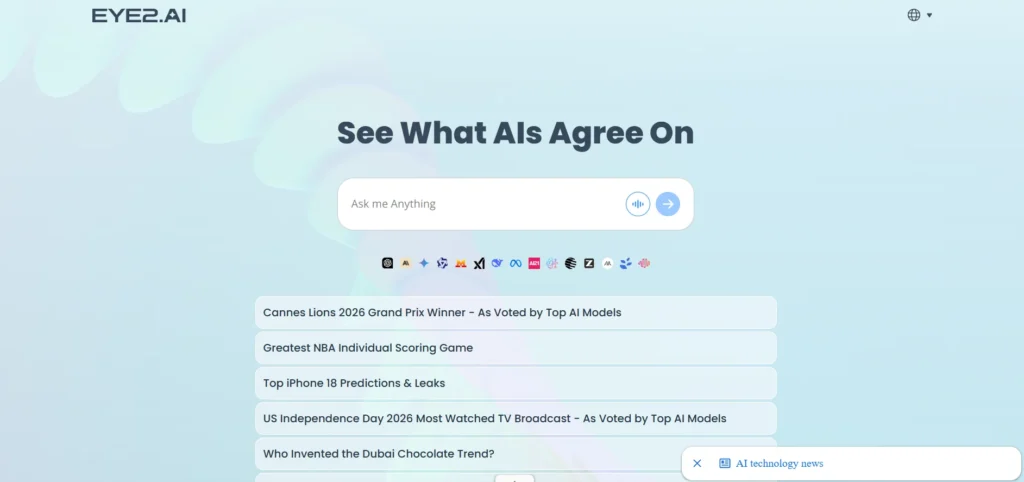
Multi-model AI consensus for research and fact-checking
Eye2.AI takes a different approach to AI reliability: instead of returning one model’s answer, it runs a query through multiple leading AI systems simultaneously and surfaces what they agree on. For legal marketing teams producing thought leadership, regulatory updates, or practice area explainers, Eye2.AI provides a cross-check layer that reduces the risk of publishing inaccurate AI-generated content. The platform compares responses from ChatGPT, Claude, Gemini, Grok, DeepSeek, Mistral, and others, making disagreement visible rather than hidden.
Best for: Marketing teams producing legally sensitive content who want AI consensus before publishing.
6. Lawmatics
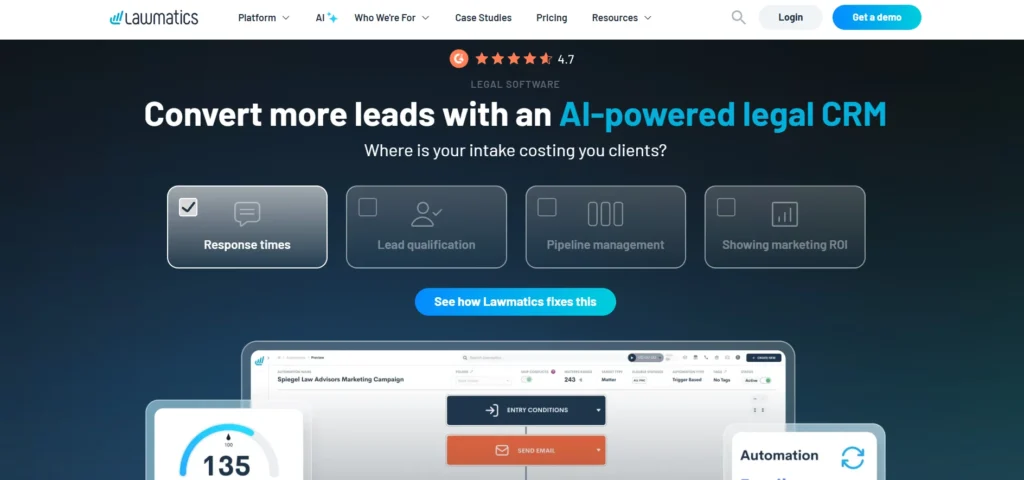
Legal-specific CRM with intake automation and pipeline management
Lawmatics fills the gap between initial enquiry and signed engagement letter, the stage where most law firms leak the most prospective clients. Its legal-specific CRM automates email sequences triggered by intake form submissions, schedules consultation reminders, and tracks each prospect through the pipeline to conversion. Marketing teams can attribute specific campaigns to signed matters, giving partners the revenue-linked reporting they increasingly require from marketing budgets.
For firms also exploring contract lifecycle management platforms, Lawmatics pairs well with document automation tools that handle the post-conversion workflow.
Best for: Mid-size firms with active marketing campaigns and an intake volume that outpaces manual follow-up.
7. Ahrefs
Backlink analysis and off-page authority building
Organic search authority is built on two pillars: content and backlinks. Ahrefs gives legal marketing teams the data to pursue both, identifying which competitor firms are earning links from legal directories, bar association pages, and industry publications, then surfacing the gap opportunities to replicate. For firms competing in high-intent local markets, the ability to analyze where a top-ranked competitor earns its domain authority is a practical competitive advantage.
Best for: Firms with an SEO strategy in place that are ready to invest in systematic off-page link building.
8. Podium
Client messaging, reviews, and multi-channel communication hub
Client communication in legal services is often fragmented: calls, emails, text messages, portal messages, and web chat operating on separate systems. Podium consolidates them into a single inbox, enabling law firm staff to respond to every enquiry channel from one interface. Its integrated payment and review request features make it particularly effective for practices that handle high volumes of shorter-matter work, such as estate planning, immigration document services, or business formations.
Best for: Volume-driven practices that need efficient multi-channel client communication and automated review collection.
9. Copy.ai
AI copywriting for law firm websites, ads, and social content
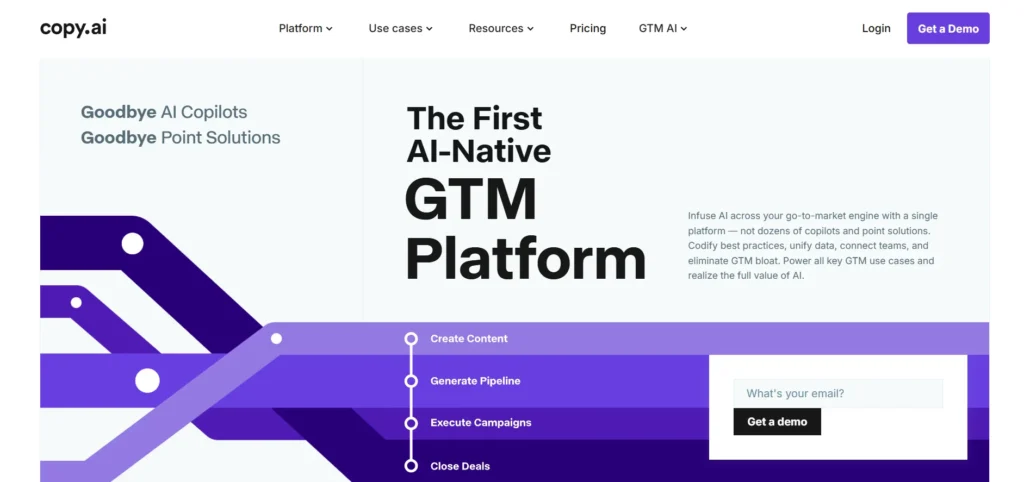
Copy.ai supports multi-model AI writing, drawing on GPT-4 and Anthropic models to generate website copy, PPC ad variations, LinkedIn posts, and email subject lines. For law firms updating service page copy or producing ad creative at scale, it reduces the production cycle significantly. Its workflow templates for legal audiences, including attorney bio rewrites and practice area descriptions, address the specific copy categories that most general AI tools handle poorly.
Best for: Boutique firms or solo practitioners who produce their own marketing content and need to scale output without hiring.
10. MachineTranslation.com
AI translation consensus for multilingual client reach and document accuracy
Law firms serving multilingual client populations face a translation problem that standard AI tools do not adequately address. A mistranslation in a client intake form, a retainer agreement, or a court-filing notice is not a content error, it is a liability. Research on multilingual legal communication highlights that breakdowns commonly occur before formal legal work begins, at the intake and engagement stages where language accuracy matters most.
The reliability gap in AI translation is documented. Individual large language models hallucinate or introduce errors in translation tasks between 10% and 18% of the time, according to data synthesized from Intento’s State of Translation Automation 2025 and WMT24 benchmark findings. For a law firm sending a translated court notice, that error rate is not acceptable.
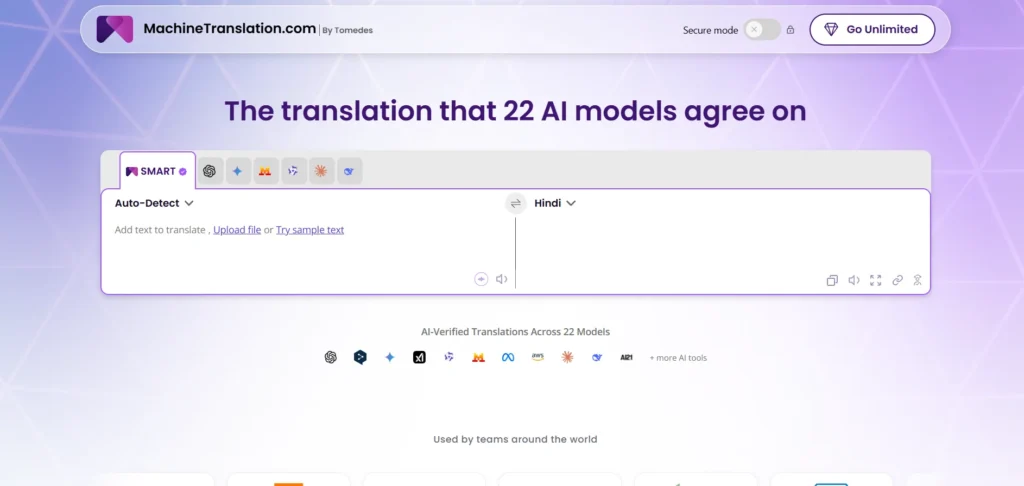
MachineTranslation.com addresses this through its SMART mechanism, which runs every translation through 22 AI models simultaneously, including ChatGPT, Claude, Gemini, DeepL, DeepSeek, and 17 others, and delivers the translation the majority agree on. Internal benchmarks show this consensus approach reduces critical translation errors to under 2%, a 90% reduction in error risk compared to relying on a single model. With 1.5 million registered users and more than 1 billion words translated, the platform’s dataset reflects real-world legal, business, and compliance translation at scale, not lab conditions.
For firms with bilingual practice areas, international business clients, or U.S.-based clients whose primary language is not English, MachineTranslation.com provides the AI translation certainty that single-model tools cannot. Human verification is also available within the platform for documents where 100% accuracy is required before submission.
Best for: Law firms serving multilingual clients, cross-border commercial practices, and any firm translating legal documents for submission to authorities.
Quick Reference: 10 AI Platforms for Legal Marketing
The table below summarises each platform’s primary function, optimal use case, and key differentiating capability:
| Platform | Primary Function | Best For | Key Differentiator |
|---|---|---|---|
| Clio | Practice management & CRM | Case + client management | Full-practice platform with intake |
| Semrush | SEO & content marketing | Search visibility & rankings | Legal keyword research & competitor audit |
| Birdeye | Review management & reputation | Client trust-building | Review automation + response workflows |
| ChatGPT (OpenAI) | AI content & chatbot | Content drafts & intake bots | Versatile LLM for multiple tasks |
| Eye2.AI | Multi-model AI consensus | Research & fact-checking | Surfaces what multiple AI models agree on |
| MachineTranslation.com | AI translation (consensus) | Multilingual client comms | 22 AI models reach consensus; 90% error reduction |
| Lawmatics | Client intake & CRM automation | Lead nurturing & onboarding | Legal-specific CRM with automation |
| Ahrefs | Backlink & SEO analysis | Off-page authority building | Competitor backlink gap analysis |
| Podium | Messaging & client engagement | Client communication & reviews | Multi-channel messaging hub |
| Copy.ai | AI copywriting | Website copy & ad content | Multi-model writing with templates |
How AI Consensus Works in Legal Marketing Contexts
[Infographic placeholder: Two-column visual. Left column: ‘Single AI Model’ with an error rate bar showing 10-18% hallucination risk, single arrow output. Right column: ’22 AI Models + Consensus (SMART)’ with 22 parallel model arrows converging to one agreed output, error rate bar showing under 2%. Source: Intento State of Translation Automation 2025 and MachineTranslation.com internal benchmarks. Suggested placement: directly below the MachineTranslation.com entry, before the comparison table.]
Choosing the Right Stack for Your Firm’s Growth Stage
No single platform covers the full legal marketing lifecycle. The firms growing most efficiently in 2026 are combining platforms strategically: a practice management system like Clio for intake and conversion tracking, an SEO platform like Semrush or Ahrefs for search visibility, a reputation layer like Birdeye or Podium for client trust, AI writing platforms for content velocity, and specialist AI platforms for the tasks where accuracy carries professional risk.
The last category is where the distinction between general-purpose AI and purpose-built AI matters most. A tool that is efficient for writing a blog post is not necessarily suitable for translating a contract. A tool that produces plausible-sounding content is not necessarily one you would stake your firm’s reputation on. In the platforms listed here, the ones designed for legal contexts, whether intake automation, consensus-based AI research, or multi-model translation, earn their place in the stack because they reduce the professional risk that every law firm carries every time it communicates with a client.