Can a single borrowed ₹8,000 investment truly transform a roadside tea stall into a multi-crore business empire? In the high-stakes world of modern Indian entrepreneurship, viral fame and raw financial success frequently collide. MBA Chaiwala net worth is estimated at ₹22 crore to ₹25 crore ($3 million), reflecting the remarkable journey of founder Prafull Billore.
Prafull Billore built his career by transforming a humble tea stall into a nationwide quick-service restaurant (QSR) brand. While his bold promotional strategy brought widespread media attention, viral popularity, and lucrative speaking invitations, his personal net worth stands as a distinct metric from his company’s overall operational revenue. The following sections explore his background, reported net worth, corporate turnover, franchise business model, and practical takeaways for modern entrepreneurs.
Who Is MBA Chaiwala?

To understand MBA Chaiwala, you first have to reframe the question: it is not about who MBA Chaiwala is, but rather what. MBA Chaiwala is a commercial brand name, not an individual person. Prafull Billore is the entrepreneur who founded the business. Registered legally under entities such as MBA Chai Wala Private Limited, the corporate business structure functions separately from the founder.
Prafull Billore was born and raised in Dhar, Madhya Pradesh, India. Like many young students, he initially prepared for the Common Admission Test (CAT) to pursue an MBA at a top business school. After failing to secure admission through multiple attempts, he chose to enter the workforce directly.
Moving to Ahmedabad, Gujarat, he secured a job at a local McDonald’s outlet, earning around ₹200 per hour. Working across cleaning, kitchen support, and customer service taught him operational discipline and standardized processes.
Driven to build his own business, he borrowed ₹8,000 from his father under the pretext of funding an educational course. He used this money to buy basic cooking utensils, milk, tea leaves, and paper cups, launching a small roadside stall in Ahmedabad in July 2017. Through direct customer engagement, he turned the stall into a visible local hangout spot.
Why Is MBA Chaiwala Called MBA?
The letters “MBA” in the brand name do not indicate a Master of Business Administration degree. Instead, “MBA” stands for Mr. Billore Ahmedabad Chaiwala.
When Billore began selling tea, roadside vending carried a social stigma in many communities. Recognizing this perception, he crafted a name that contrasted a prestigious academic title with a basic street trade. This name served specific marketing goals:
- Brand Distinction: It set his business apart from ordinary local chai tapris.
- Storytelling Anchor: It turned his dropped MBA aspirations into a conversational narrative.
- Curiosity Marketing: It prompted passersby and online users to ask questions, creating organic word of mouth.
While the name helped build public attention, it functions as a marketing nickname rather than an academic credential.
What Is The History Of MBA Chaiwala?
The enterprise evolved from a single street stall into a national brand through distinct operational phases.
- 2017: Street-Side Origins In July 2017, the venture launched in Ahmedabad with minimal capital. Billore differentiated his stall by speaking fluent English, serving tea with toast, and engaging customers in informal discussions.
- 2018: Viral Expansion A Valentine’s Day campaign offering “Free Tea for Singles” went viral on social media. This stunt drove local media coverage and substantial footfall.
- 2020: Corporate Scaling Capitalizing on digital visibility, Billore expanded into event catering and leveraged social platforms. In August 2020, the business incorporated as MBA Chai Wala Private Limited and launched a franchise network.
- 2022-2023: Operational Friction Rapid scaling triggered challenges. Between 2022 and 2023, several franchise owners reported financial losses, citing high rent and fees that outpaced sales. Public complaints arose in Indore and Lucknow, while Billore attributed disputes to standard business risks.
This trajectory proves a core principle: generating social media buzz is very different from building a stable franchise network.
What Is MBA Chaiwala Net Worth and Annual Turnover?
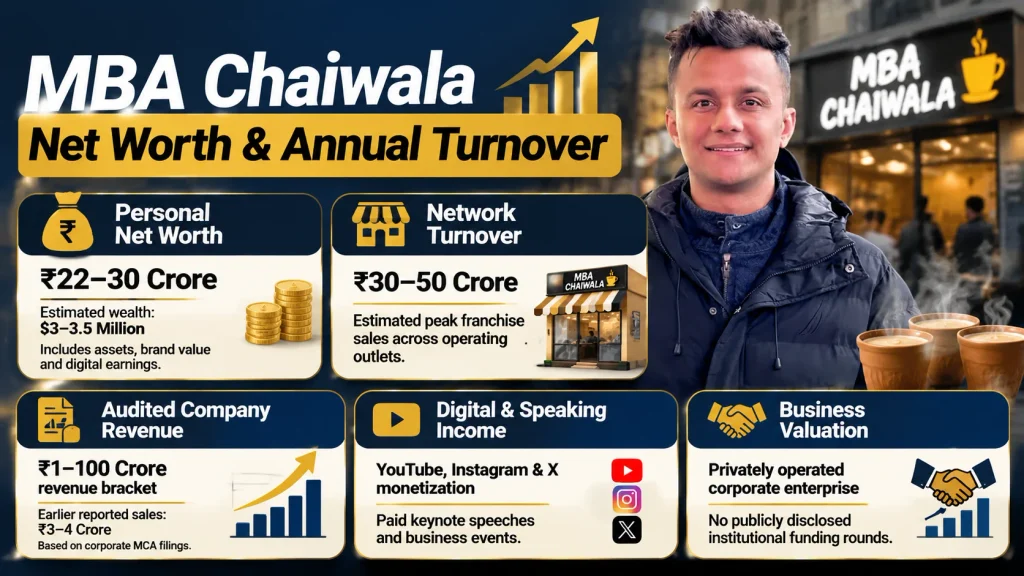
Understanding the true financial scale of a viral brand requires looking beyond media headlines and examining actual business metrics. Prafull Billore has successfully transformed public visibility into a multifaceted commercial enterprise spanning tea franchising, digital content, and public speaking. Financial estimates and business performance data for Prafull Billore and his enterprise break down into distinct categories:
- Personal Net Worth: Estimated by online financial media between ₹22 crore and ₹30 crore ($3 million to $3.5 million), derived from brand equity, accumulated assets, and digital monetization streams.
- Network Turnover: Peak franchise years generated an aggregate estimated retail sales volume between ₹30 crore and ₹50 crore across all operating franchise stores.
- Audited Entity Revenue: Regulatory filings via corporate MCA data place the operating revenue bracket of the parent company between ₹1 crore and ₹100 crore. Earlier milestones recorded corporate sales around ₹3 crore to ₹4 crore.
- Digital & Speaking Income: Ongoing revenue streams generated through monetized digital channels like YouTube, Instagram, and X, alongside high-fee keynote speaking engagements.
- Business Valuation: The enterprise functions as a private corporate structure operating without public institutional funding rounds.
How Does The MBA Chaiwala Business Model Work?
The MBA Chaiwala business structure relies on a franchise-led quick-service restaurant framework. The company monetizes its brand across several revenue channels:
- Franchise License Fees: The business charges upfront fees to grant third-party operators the right to trade under the MBA Chaiwala name. These fees cover licensing, store layout guidance, and initial staff orientation.
- Centralized Supply Chain: Franchise outlets purchase proprietary ingredients, spices, branded paper cups, and uniforms directly from headquarters. This maintains brand consistency across locations while creating a recurring wholesale supply revenue stream for the franchisor.
- Direct Retail Sales: In select locations operated directly by the parent company, sales of tea, snacks, and merchandise generate retail profit margins.
- Media and Speaking Engagements: Billore earns separate income by speaking at universities, business summits, and corporate events, as well as through digital content promotions.
Operational Challenges And Unit Economics
Franchising allows rapid geographical expansion without funding every store launch directly. However, it introduces operational risks:
- Quality Control: Ensuring identical taste and service standards across independent locations requires ongoing monitoring.
- Location Footfall: Online brand fame does not guarantee customer footfall if a store is located in an area with low pedestrian traffic.
- Fixed Costs: Local franchisees face fixed expenses like rent, utilities, and labor. If daily cup sales drop below the breakeven threshold, individual stores run at a loss.
What Can Entrepreneurs Learn From MBA Chaiwala’s Journey?
The story of MBA Chaiwala offers practical lessons and opportunities to work for small business owners, tea stall operators, and local cafe startups.
- Differentiate Everyday Products Through Positioning: Tea is widely available across India. Billore built visibility not by changing the core product, but by changing how it was presented. Clean packaging, modern stall design, and conversational engagement helped a traditional trade stand out.
- Leverage Storytelling and Social Media: Traditional advertising can be costly. By building a narrative around his personal story and CAT exam attempts, Billore gained press coverage and social media reach without heavy media spend.
- Verify Unit Economics Before Scaling: Expanding quickly can multiply underlying operational errors. Entrepreneurs should verify that a single outlet maintains steady profit margins, positive cash flow, and repeat customers before attempting multi-location scaling.
- Build Repeat Local Demand: Viral marketing generates an initial wave of curious visitors. Long-term viability depends on local customers who return regularly for good food, fast service, and fair pricing.
Explore More Like This:
What Aspiring Entrepreneurs Should Not Copy Blindly
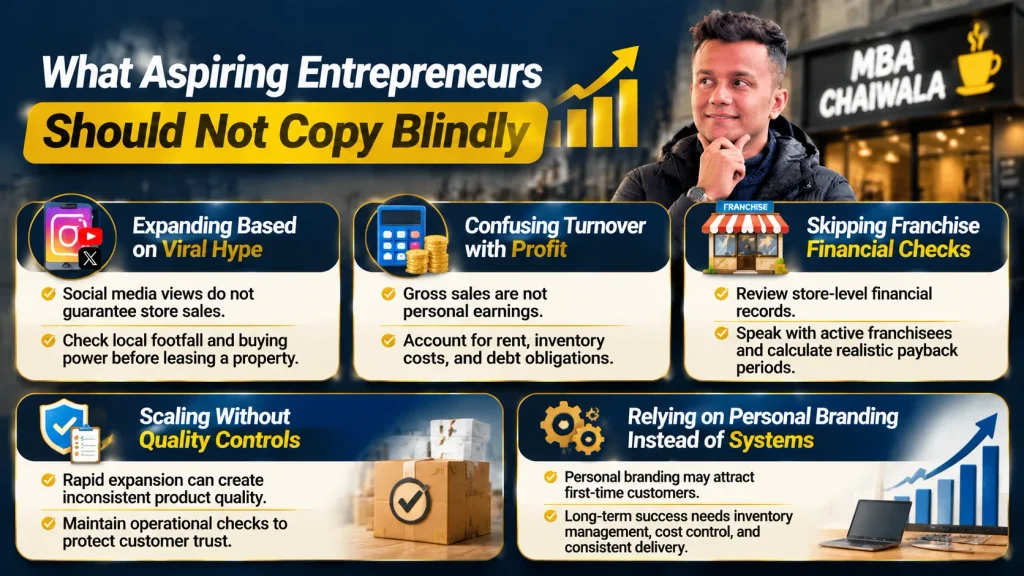
When reviewing public business success stories, new entrepreneurs should watch out for common pitfalls:
- Expanding Based Only on Viral Hype: Do not assume social media views translate into daily store sales. Evaluate neighborhood footfall and local buying power before signing commercial property leases.
- Confusing Turnover with Profit: Never treat gross sales numbers as personal earnings. High sales can be offset by high rent, inventory costs, and debt obligations.
- Buying Franchises Without Financial Checks: Before investing in a franchise, review store-level financial records, talk to active franchisees, and calculate realistic payback schedules.
- Scaling Without Quality Controls: Rapid expansion without strict operational checks leads to uneven product quality, damaging customer trust.
- Relying on Persona Instead of Systems: Personal branding can drive trial visits, but long-term business survival depends on efficient inventory management, cost controls, and consistent delivery.
Conclusion
The journey of MBA Chaiwala offers a clear lesson: viral publicity and high top-line sales do not guarantee long-term profitability.
While media reports estimate Prafull Billore’s personal wealth between ₹22 crore and ₹30 crore ($3 million to $3.5 million), these numbers stem from unverified brand equity and estimated assets. Crucially, a business must distinguish between network-wide turnover, corporate revenue, and the founder’s personal wealth.
Ultimately, lasting enterprise success relies on strong unit economics, consistent product quality, disciplined cost management, and reliable store-level execution rather than media hype.
Frequently Asked Questions
1. What Is the Real Name of MBA Chaiwala?
The founder of the MBA Chaiwala brand is Prafull Billore. MBA Chaiwala is the business name under which his QSR chain and franchise operations trade.
2. Why Is Prafull Billore Called MBA Chaiwala?
The acronym “MBA” stands for “Mr. Billore Ahmedabad Chaiwala”. He created the name after attempting the CAT exam, using the label to differentiate his tea stall from conventional roadside vendors.
3. What Is MBA Chaiwala’s Annual Turnover?
Unverified media reports cite peak network turnover between ₹30 crore and ₹50 crore. Earlier reports cited corporate revenue around ₹4 crore, showing that figures vary depending on reporting methods.
4. How Does MBA Chaiwala Make Money?
The business earns revenue through franchise licensing fees, supply distribution of proprietary tea and packaging to outlets, corporate store sales, public speaking fees, and brand endorsements.
5. Is MBA Chaiwala’s Turnover The Same As His Personal Income?
No. Turnover is total gross sales volume before deducting store expenses, franchisee margins, supply costs, and corporate taxes. Personal income is what the founder draws after business expenses.