When GEO landed on my SEO team, we reported it like rankings: positions, a top-10 count, one monthly snapshot. It reached the CMO with three issues. PR and product marketing owned two fixes nobody asked them to make. The third changed before anyone rechecked. Decide who acts on a finding first, then choose generative engine optimization tools.
Clicks shrink even where rankings hold: Google organic traffic to 2,500+ news sites fell 33% globally in the year to November 2025, though AI Overviews’ share is unclear.
This list is for a Head of SEO and three to eight specialists at a B2B company with 1,000+ employees and several country sites, whose objectives gained a GEO line. They run an enterprise SEO suite and Search Console. Content, brand, PR, and product marketing own most fixes, in other reporting lines. It’s not for agencies, single-site brands, or dedicated AI search functions.
What an In-house SEO Team Needs from GEO Software:
- Answer-level evidence: response, sources, engine, market, date
- Trends across runs, not snapshots
- Evidence other owners open without a walkthrough
- Third-party sources and non-Google engines
- Data joining SEO reporting: API, Looker Studio, exports
How I picked: in October 2026 I scored 12 generative engine optimization tools on these five needs from vendor pages; six meet four or more.
Problem 1: Reading AI Answers Like a Rankings Report
SEO teams instinctively read generative engine optimization tools like rank trackers. AI answers draw on pages outside the top 10 and change between runs, so a rankings-style report misstates what the answer says and how stable it is.
A 2025 study from Ruhr University Bochum and the Max Planck Institute for Software Systems found that, on average, 53% of the domains AI Overviews consult sit outside the organic top 10. Between runs, AI Overviews kept 18% of the same links, against 45% for organic results.
Search Console’s generative AI performance report, rolled out worldwide as of August 31, 2026, counts AI Overviews and AI Mode impressions by page, country, device, and date. We bolted it onto our rankings report. It covers Google’s AI features and link impressions; geo tools add answer text and other engines.
Problem 2: The Fix Sits in Another Reporting Line
Most findings from generative engine optimization tools get fixed outside the SEO team: a product page by product marketing, a press mention by PR, a comparison article by content. A finding reaching those owners as a bare score stalls in someone else’s queue. Ours did for a quarter.
In SEJ’s State of SEO 2026 survey, cross-department collaboration had the lowest impact (9%), yet 37% of companies plan to increase it; 26% of teams struggle with leadership support.
Forrester analyst Nikhil Lai writes: “Because answer engines prioritize what others say about a brand over what a brand says about itself, brands need to cultivate authority off their owned and operated properties.” My reading: a geo strategy written inside SEO leaves that work unowned.
Who owns it: the SEO team holds the metric definition, the collection, and the read; product marketing, PR, content, and brand each fix what sits in their channel; the CMO settles priority at the monthly review.
Problem 3: The Team Optimizes Only the Half it Controls
The SEO team controls the site, and Google says that work still counts: its AI features are “rooted in our core Search ranking and quality systems.” The other half of each answer is what third-party sites, reviews, and forums say, and what non-Google engines do with it. On-page work doesn’t change that half.
On Google’s surfaces, the team’s equity carries over: a study of AI Mode citations found very-low-traffic sites averaged about 3.6 citations, against about 6.5 for high-traffic leaders (a correlation, AI Mode only).
Our early GEO audit covered only the site and missed the review pages engines quoted. Test LLM optimization tools on one question: do they show which outside pages each engine cites?
What Actually Fixes These Three Problems
Once findings have owners, the platform test narrows: choose generative engine optimization tools that store each answer with its sources, show movement across runs, and hand that evidence to the owning function. The table compares six platforms on that test; prices as published October 2026.
| # | Platform | Fixes problem | Engines named | Evidence the owning team gets | Into SEO reporting | Starting price |
| 1 | SE Visible by SE Ranking | 1, 2, 3 | ChatGPT, Gemini, AI Mode, AI Overviews | Unedited answer, sources, market, date | Looker Studio, API, exports | Trial; plans listed on site |
| 2 | Botify | 1, 3 | Five, incl. Perplexity | Visibility beside GSC, logs | Inside Botify | Quote only |
| 3 | seoClarity ArcAI | 1, 3 | Nine, incl. Claude | Hallucination flags | API, MCP | Quote only |
| 4 | Conductor | 2 | Seven, incl. AI Mode | Gaps routed to writers | Data API, MCP | Usage credits; 3-week trial |
| 5 | Semrush Enterprise AIO | 1 | ChatGPT, Gemini, Claude, Perplexity | Prioritized content recommendations | API, GA4 context | Quote only |
| 6 | AthenaHQ | 2 | 11 on Starter | Sources, proposed actions | CSV export | Free tier; Starter $295/mo |
Problem numbers match the three sections above; hold other generative engine optimization tools or geo software to them.
List of The 6 Best Generative Engine Optimization Tools for In-house SEO Teams
Six platforms, ranked for an in-house SEO team that carries a GEO line. SE Visible covers all three problems; Botify and seoClarity ArcAI fix Problems 1 and 3; Conductor and AthenaHQ fix Problem 2; Semrush Enterprise AIO fixes Problem 1.
1. SE Visible
Problem it solves: Problems 1, 2, and 3.
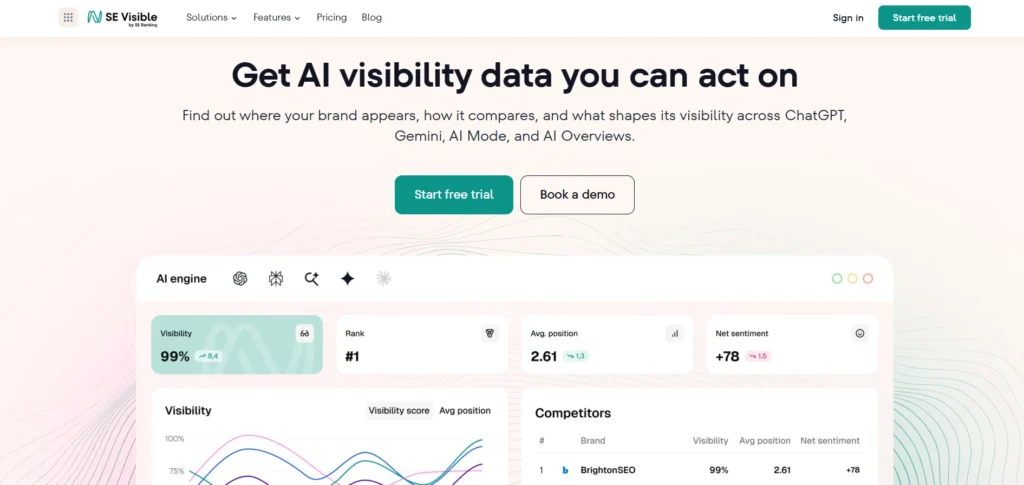
Copying AI answers into a findings doc by hand loses the date, the market, and the page each answer cited. SE Visible by SE Ranking captures what ChatGPT, Gemini, Google AI Mode, and Google AI Overviews answer about your brand; it’s an AI visibility platform.
Why it works for in-house SEO teams: When a finding needs a fix from product marketing or PR, that owner opens the exact answer, the page it cited, its market, and the date. The evidence travels with the finding. The same data feeds Looker Studio through the connector or API.
Standout feature: For every engine, the Sources view shows which domains and URLs the answers lean on, grouped as media, blogs, and forums. It’s the view that tells PR and content which outside pages to work on.
Pros:
- All plans cover all tracked engines, with no engine add-ons
- Keeps the unedited answer, engine, market, and date behind each metric
- Benchmarks share of voice, visibility score, net sentiment, and average position against competitors
- Checks prompts daily by default, adjustable per project
Cons:
- AI visibility only; rank tracking and site audits live in SE Ranking
- Each project covers one market; several markets per project are planned
- Still growing: Claude support and custom access control are planned
- The in-app report builder is still maturing
Pricing: Current plans sit on SE Visible’s site; all include the tracked engines and API access; a free trial is available.
The handover check: If you’re comparing generative engine optimization tools on whether findings reach other teams with proof attached, start here. Test how SE Visible maps the sources behind each answer on your own prompts. For classic search, SE Ranking handles the SEO half.
2. Botify
Problem it solves: Problems 1 and 3.
Botify places AI visibility beside data your team trusts: Search Console rankings, site structure, and logs.
Why it works for in-house SEO teams: Crawl access and structure are fixes no other function picks up, so evidence and change stay in one platform, one reporting line.
Standout feature: Every metric is grounded in rankings, structure, and logs. Share of voice splits by topic, category, top GSC keywords, and engine, and auto-discovery surfaces “hidden” competitors.
Pros:
- Tracks ChatGPT, Gemini, Perplexity, AI Mode, and AI Overviews
- Drills into prompts by intent and sentiment
- Ships site changes through PageWorkers
Cons:
- Data refreshes weekly, per Botify’s FAQ
- Pricing and market or language handling aren’t published
Pricing: Quote only, via demo.
The handover check: Of the ai search optimization tools here, pick Botify when the site is the first suspect. Weekly data looked slow to us at first, but for structural fixes it matched our release cycle.
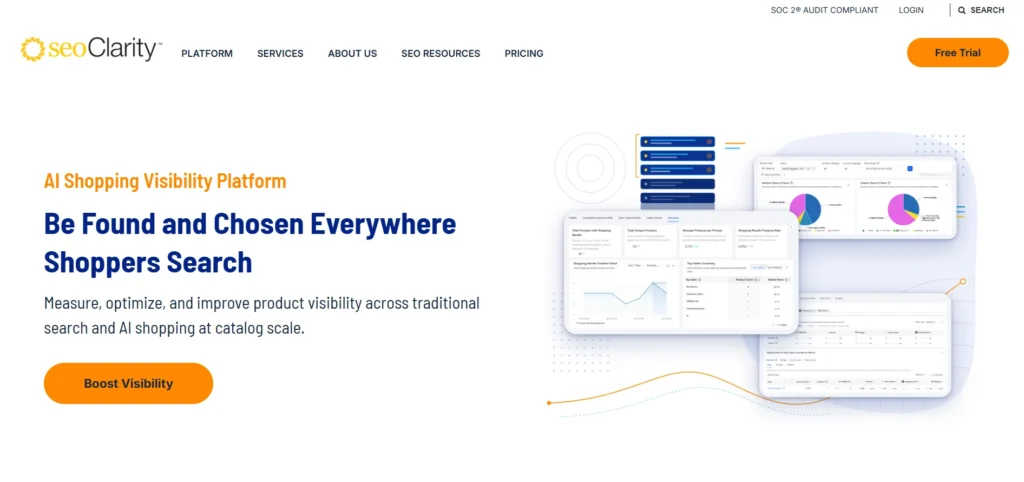
3. seoClarity ArcAI
Problem it solves: Problems 1 and 3.
ArcAI is seoClarity’s AI search package for teams whose enterprise SEO tools already include seoClarity.
Why it works for in-house SEO teams: It tracks nine engines, Claude and Copilot included, so the off-site half shows beyond Google. Teams already on seoClarity add no new vendor.
Standout feature: Accuracy monitoring flags hallucinations and factual errors in AI answers, turning “it looks wrong” into specific errors you can route to product marketing or PR.
Pros:
- Pipes mentions and citations out via API
- Serves the data to ChatGPT or Claude via MCP
- Adds managed services in the Accuracy package
Cons:
- AI bot tracking and brand protection come only in add-on packages, per the vendor
- Prices aren’t published
Pricing: Quote only; prompt queries start at 500.
The handover check: Of these generative engine optimization tools, it’s the fit for seoClarity users fighting factual errors. Name an owner for flagged errors before the trial: ours sat in a shared inbox for a month.
4. Conductor
Problem it solves: Problem 2 (fixes owned elsewhere).
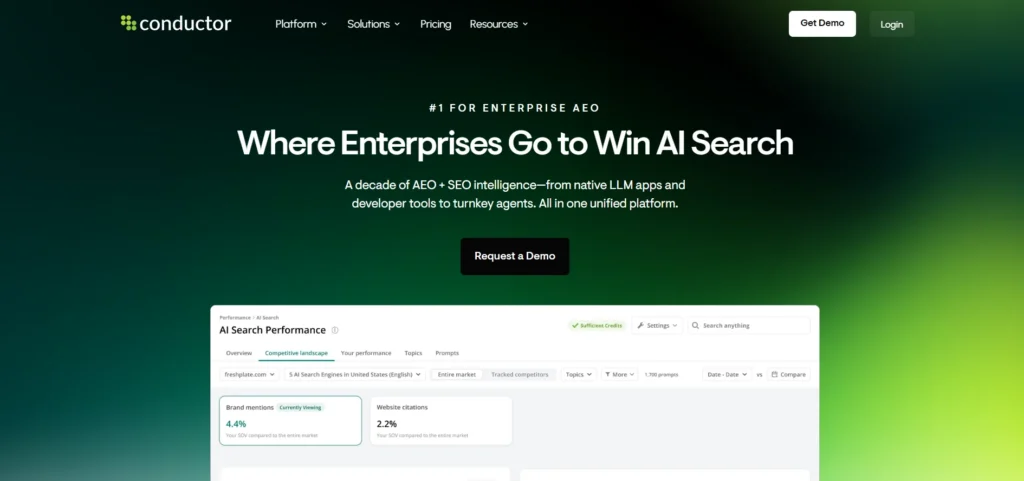
Conductor is an SEO and content suite that tracks seven AI models and routes visibility gaps to writers.
Why it works for in-house SEO teams: Gaps land in Conductor’s Writing Assistant and Creator workflow, so content owners act in the tool they already use.
Standout feature: Sentiment is tied to the sources each answer cites, across Google AI Mode, Google AI Overviews, ChatGPT, Claude, Copilot, Gemini, and Perplexity. A negative read arrives with its source page.
Pros:
- Scores drafts with AI Content Score
- Configures tracking by brand, region, and domain
- Feeds BI tools through a Data API and MCP
Cons:
- No AI search volume data, per the vendor
- Price isn’t published; credits scale with the engines you pick
Pricing: Not published; usage-based credits, 3-week free trial.
The handover check: Ask your content lead whether briefs get written in Conductor. If yes, findings reach writers untranslated. Ours didn’t, which settled it.
5. Semrush Enterprise AIO
Problem it solves: Problem 1 (the rankings lens).
Enterprise AIO, separate from Semrush’s self-serve AI Visibility Toolkit, serves organizations standardized on Semrush Enterprise.
Why it works for in-house SEO teams: AI answer data arrives under a contract your specialists use daily, with GA4 or Adobe Analytics traffic beside it, so the read moves past positions.
Standout feature: Semrush describes detail by brand, market, city, and product, dozens of languages, and a database of 289M+ prompts. That’s the split multi-country reporting needs.
Pros:
- Reads ChatGPT, Gemini, Claude, and Perplexity answers
- Adds prioritized content recommendations and audits
- Pushes AIO data into other systems via API
Cons:
- No published price list
- SSO and roles aren’t listed on product pages
Pricing: Quote only, after a demo.
The handover check: This one suits teams already on Semrush. Our mistake was judging it on prompt volume; scope the demo around the markets and cities your country leads actually review.
6. AthenaHQ
Problem it solves: Problem 2 (the fix sits elsewhere).
AthenaHQ tracks your brand in AI answers and pairs each visibility gap with suggested fixes on your site and beyond it.
Why it works for in-house SEO teams: Unlimited seats with role-based access on paid plans give PR, content, and product marketing their own logins. Enterprise adds views by team or region.
Standout feature: Findings arrive with a next step: citation intelligence shows which sources an answer used, and a content optimization agent handles the page work.
Pros:
- Monitors 11 models on Starter
- Joins GA4 and Search Console data
- Offers CSV export from Starter
Cons:
- Starter is single-region; multiple regions need Enterprise
- SAML SSO is Enterprise-only
Pricing: Free tier (300 credits); Starter $295/month (3,600 credits); Enterprise custom.
The handover check: Our early findings died as forwarded screenshots. Here each owning team gets a seat and a proposed action. Multi-region programs land on Enterprise, so count credits per market (one per AI response) before the demo.
Which GEO Platform Should an In-house SEO Team Start With?
Start with the problem that costs you most today. For our team that was Problem 2, findings stalling in another reporting line, so trial generative engine optimization tools whose evidence travels without a walkthrough.
- If findings stall because PR, content, or product marketing can’t see the answer: SE Visible.
- If crawl access or structure is the likely suspect: Botify.
- If you run seoClarity and need factual errors flagged: seoClarity ArcAI.
- If content already works in Conductor: Conductor.
- If you’re standardized on Semrush Enterprise: Semrush Enterprise AIO.
- If each acting team needs seats and roles: AthenaHQ.
We learned this late: generative engine optimization tools don’t settle who acts. Name an owner per finding type in your geo strategy before the trial starts. Then test SE Visible against that list.
FAQs: GEO Tools For In-House SEO Teams
Has GEO Replaced SEO For In-House Teams?
No. Google says its AI features rest on core ranking and quality systems, so your SEO team’s site work feeds AI Overviews and AI Mode. GEO adds what third-party sources and other engines say, which PR and content teams own.
Does Google Search Console Show AI Overviews And AI Mode Data Now?
Yes. Since August 31, 2026, Search Console’s generative AI performance report is live for all sites, showing AI Overviews and AI Mode impressions by page, country, device, and date. It counts link impressions; for the answer text itself, you need ai search optimization tools that store responses.
Can An Enterprise SEO Suite Cover GEO, Or Do You Need A Separate Platform?
Partly. Suites with AI modules give your SEO team a first read inside its existing stack. Dedicated generative engine optimization tools add stored answers, sources, and cross-engine coverage. The deciding question: must findings reach content, PR, or product marketing with evidence?