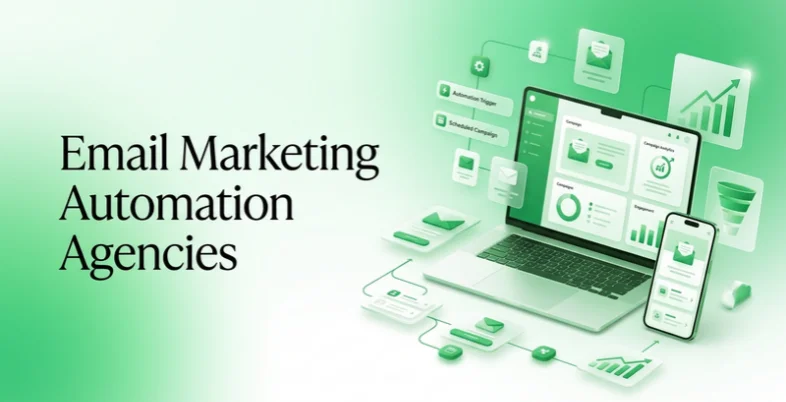
Automation drives outsized revenue: Omnisend’s latest benchmark shows automated emails make up only 2 percent of sends yet produce 30 percent of revenue. Let those flows sit idle, and the upside slips away.
Gmail now warns any domain with a spam-complaint rate above 0.3 percent, and recommends staying under 0.1 percent. If you’re not monitoring deliverability daily, revenue leaks fast.
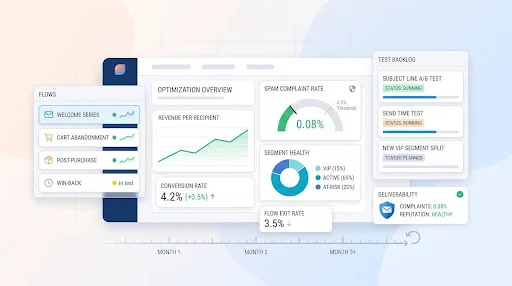
That’s why we rated partners on what happens after the welcome, cart-abandon, and win-back flows go live: ongoing tests, segment upkeep, and inbox placement, not just pretty templates.
How We Ranked the Agencies
Choosing an email partner risks real revenue, so we scored candidates the same way you’d screen a hire: skills first, résumé second.
Inclusion bar
- Must manage lifecycle automations (welcome, abandonment, win-back, etc.) and optimize them after launch.
- Must publish verifiable proof: a service page, named case study, or directory review.
- Pure software vendors, one-off flow builders, and cold-outreach shops were excluded.
If a firm couldn’t show both craftsmanship and ongoing ownership, it never reached the scoring table.
The Eight Weighted Factors
| Criterion | Weight |
| Ongoing optimization cadence | 20% |
| Results quality (named, quantified proof) | 20% |
| ESP and technical breadth | 15% |
| Deliverability governance | 12% |
| Lifecycle sophistication | 12% |
| Account model (senior access, stability) | 8% |
| Industry & scale fit | 6% |
| Commercial flexibility | 7% |
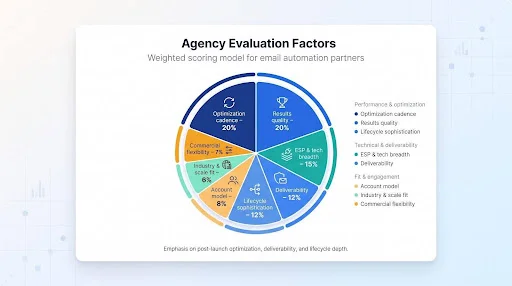
We track what moves revenue after launch: test backlogs, segment upkeep, and inbox placement, not vanity metrics like raw open rate. The final composite score reflects incremental, evidence-backed impact.
List of Best Email Marketing Automation Agencies
1. InboxArmy: Best for Multi-ESP, Multi-Industry Programs
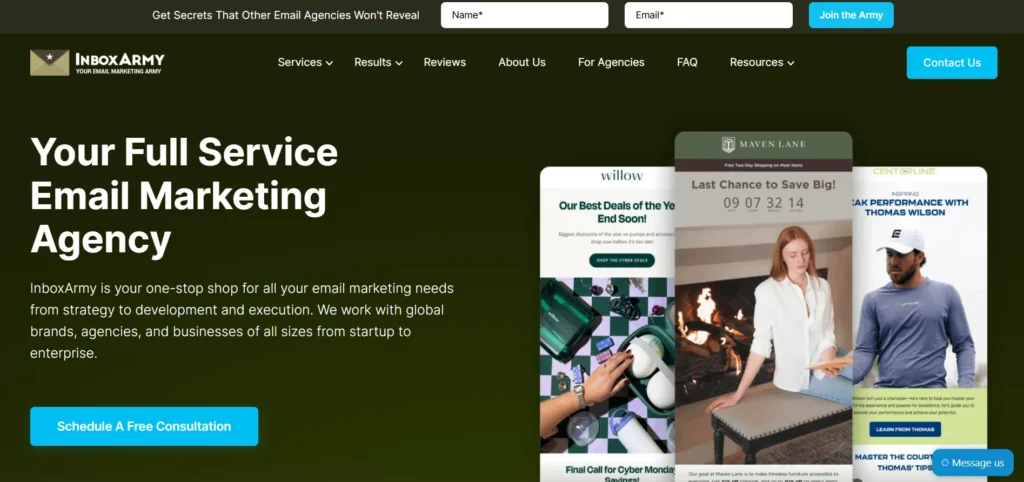
InboxArmy email marketing automation services suit brands that juggle multiple business lines, mixed ESPs, and strict deliverability rules. The team works across 40+ platforms, from Klaviyo to Salesforce Marketing Cloud, so future migrations won’t slow you.
An engagement starts with a 4-week onboarding sprint and shifts to weekly check-ins where a dedicated team tracks revenue, segment health, and sender reputation. That cadence shows in published case studies such as a 1,100 percent email revenue lift for London Store in nine months and a 700,000-dollar-plus result in six months for Maven Lane.
InboxArmy also offers white-label production, giving other agencies extra email capacity without adding headcount.
Pros:
- Broadest ESP coverage and migration expertise
- Senior strategists stay on the account
- White-label option for partner agencies
Cons:
- Pricing isn’t published, so budgeting starts from scratch
- Formal A/B-testing cadence not disclosed; confirm before signing
2. Chronos Agency: Best for High-Growth DTC Retention
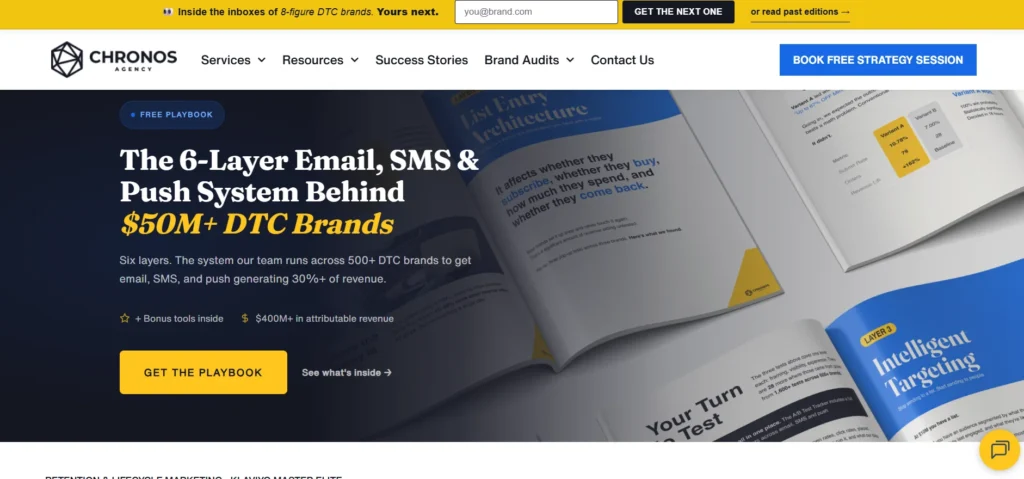
Chronos grew up during the Shopify-plus-Klaviyo surge, so its culture focuses on squeezing more lifetime value from every buyer. If your growth team expects double-digit revenue gains month over month, Chronos is built for that pressure.
The team values speed: expect a testing roadmap early and regular calls that review lift, segment drift, and creative fatigue. Email, SMS, and push run as one funnel, so a cart-abandon text can trigger a follow-up email without crossed wires.
Chronos reports working with more than 500 brands and attributing over 400 million dollars in revenue (agency-published aggregates; request a vertical-specific case study). Klaviyo is home base, yet the crew also manages HubSpot and Mailchimp for brands still climbing toward a full retention stack, useful if a platform jump is on the horizon.
Pros:
- Retention-first process with an early testing roadmap
- Email, SMS, and push managed as one growth engine
- Global team can schedule promotions outside North American business hours
Cons:
- Pricing is not published, so early-stage stores should confirm the entry retainer first
- Ecommerce focus means B2B SaaS and nonprofit brands usually look elsewhere
3. Flowium: Best for Klaviyo-First Ecommerce Programs
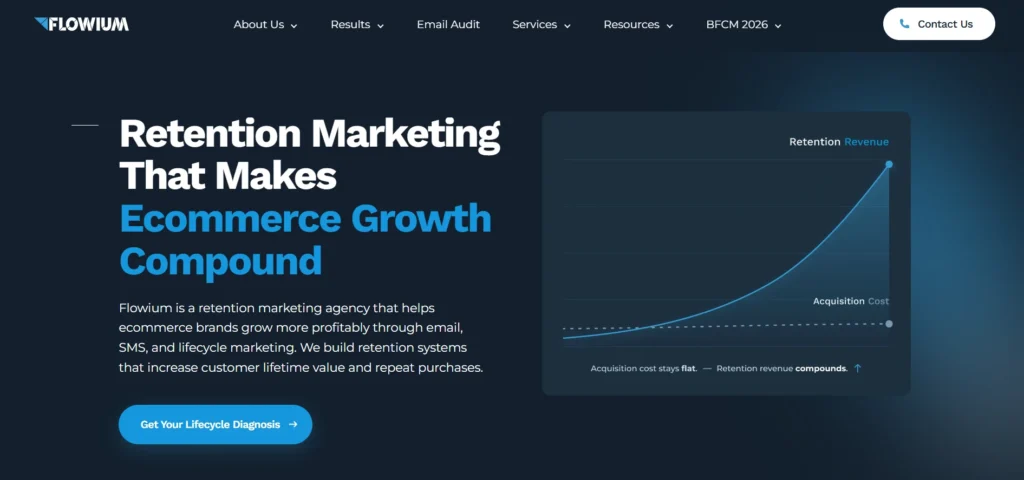
If Klaviyo already powers your store and you want to refine rather than rebuild, Flowium is the specialist to call. The team lives and breathes lifecycle fundamentals: welcome, browse, cart, post-purchase, and win-back flows, all optimized for revenue per recipient, not vanity opens.
Every new client moves through a five-phase Diagnose, Map, Build, Optimize, Scale system. Weekly specialist calls keep the roadmap honest, while monthly reports track revenue lift, deliverability, and list health.
Flowium’s published case studies cite repeat-customer revenue increases of 164 percent and 215 percent. Treat those figures as directional; ask for a vertical-specific case study because beauty differs from pet supplies.
Pricing is quoted after a call, but Clutch lists Flowium’s email marketing packages starting at 6,000 dollars a month with a 1,000-dollar project minimum, and the agency advertises a two-year price lock.
Pros:
- Documented, repeatable process tailored to Klaviyo’s feature set
- Clear A/B-testing and deliverability playbooks
- Two-year price lock on signed scopes
Cons:
- Klaviyo focus limits usefulness for brands on Braze or Salesforce Marketing Cloud
- Heavy ecommerce DNA means B2B or content-led funnels may feel underserved
4. Alchemy Worx: Best for Enterprise-Level Experimentation
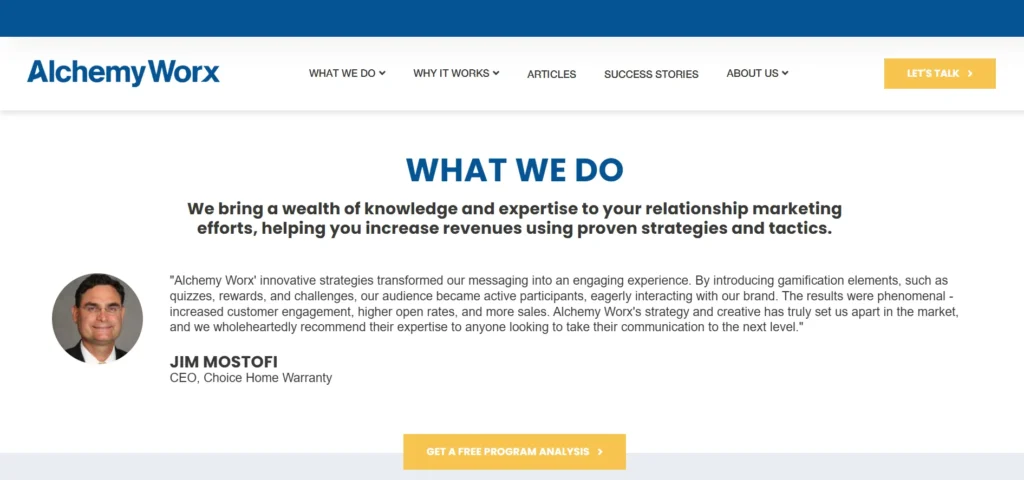
When your list tops 1,000,000 subscribers, a tiny tweak can swing six-figure revenue. Alchemy Worx has worked at that scale for more than two decades, across over 115 brands.
Every send is a test. The team runs a documented test-and-learn practice with pre-set winner criteria, so stakeholders sign off on strategy instead of debating mock-ups. That discipline tames the legal and brand bottleneck most enterprises dread.
Alchemy Worx specializes in behavioral email at scale: browse triggers that feed dynamic offers, multi-variant subject-line tests, and incremental-lift reporting proven by statistical significance. The depth pairs best with platforms such as Salesforce Marketing Cloud, Listrak, or Blueshift.
Pricing is custom, and meaningful send volume is required. Ask for an anonymized results deck to see how incremental gains compound on a large base (request agency-published evidence).
Pros:
- Rigorous experimentation framework built for large datasets
- Long track record with enterprise ESPs
- Processes reduce internal approval delays
Cons:
- Limited fit for smaller lists or emerging brands
- Public pricing and full platform roster require direct confirmation
5. RPE Origin: Best Vendor-Agnostic Enterprise Option
Most agencies claim platform neutrality, then steer you toward a favorite tool. RPE Origin is comfortable running Braze on Monday and Salesforce Marketing Cloud on Tuesday, so tech migrations or multi-brand portfolios won’t derail progress.
Engagement starts with an intro and scoping call, then a proposal and onboarding that audit current flows, data hygiene, and reporting depth before a roadmap is set.
Because the firm serves enterprise and agency clients across categories, it focuses on strategy, segmentation, and deliverability first, plugging into whichever ESP or CDP fits your stack. Public case metrics are limited; ask for an anonymized QBR deck before signing to gauge lift potential.
Pros:
- True multi-platform expertise for complex stacks
- Roadmap and QBR cadence simplify executive alignment
- Strategic depth extends beyond ecommerce
Cons:
- Few public case studies mean more diligence for buyers
- Custom pricing can stretch smaller budgets
6. MH Digital: Best Boutique Lifecycle Partner
Sometimes you don’t need a big agency machine; you need senior operators who can tweak a flow and push it live before the coffee cools. That’s MH Digital. The Denver-based team keeps headcount intentionally lean, so every client works with seasoned strategists rather than a rotating junior crew.
The firm specializes in full-funnel lifecycle work for SaaS and high-AOV ecommerce. Braze and Klaviyo lead the stack, but the team will handle HubSpot or Iterable when data pipelines require it. Because they straddle SaaS and retail, they optimize beyond checkout: free-to-paid conversion, churn reduction, and expansion revenue guide each test.
Engagements begin with a diagnostic sprint that covers copy critique, segmentation gaps, and a deliverability pulse check, then roll into a monthly retainer. Clutch lists MH Digital’s email marketing packages starting at 2,000 dollars a month, giving mid-market brands senior brainpower without enterprise overhead. Ask for a recent, named case study to see revenue impact on an account similar to yours.
Pros:
- Direct access to lead strategists (no account-manager buffer)
- Cross-pollination of SaaS and ecommerce best practices
- Strong Braze and Klaviyo expertise
Cons:
- Limited capacity can mean waitlists during peak seasons
- Public case metrics are scarce; request proof before signing
7. Andzen: Best for APAC Ecommerce Retention
Running campaigns from Brisbane while your biggest sales days follow U.S. clocks can be brutal. Andzen solves that time-zone headache for Asia-Pacific brands by pairing local support with a global retention mindset.
The team focuses on end-to-end customer journeys (acquisition, activation, and loyalty) rather than isolated automations. Flows cover email, SMS, and CRM triggers, all anchored in its Klaviyo Master Elite partner status and deep Shopify Plus integrations (Okendo, Gatsby, and more).
A client testimonial credits Andzen with roughly 200 percent revenue growth over two years, pointing to long-game optimization over quick-hit promos. Project work starts around 1,000 dollars, then scales with list size, keeping the service within reach for growth-stage stores that can’t fund a six-figure retention pod.
Pros:
- Regional proximity for Asia-Pacific merchants
- Journey-first strategy linking email, SMS, and loyalty apps
- Klaviyo Master Elite expertise plus rich Shopify ecosystem knowledge
Cons:
- Heavy ecommerce focus; B2B or SaaS brands may look elsewhere
- Public proof leans on testimonials; request a quantified case study in your niche
8. Rejoiner: Best for Managed Predictive Retention
Rejoiner pairs a proprietary platform with an in-house agency to deliver a done-for-you retention engine that learns as it runs. If your list is large, purchase cycles long, and internal bandwidth thin, this managed model lifts the day-to-day burden.
Engagement starts with data ingestion. The platform pulls customer, product, and order data, then surfaces predictive segments such as high-value buyers at churn risk and one-time purchasers likely to repeat. The agency team turns those insights into automated email, SMS, and even direct-mail touchpoints, tracking lifetime value rather than click bursts.
Client reports are promising: outdoor-furniture retailer AuthenTEAK reports a 22 percent revenue jump to more than 2 million dollars, and Triumph Motorcycles cites a 40 percent year-over-year increase in email revenue (agency-published). Ask to see the underlying dashboards; they show how predictive scoring guides cadence and creative.
Because the tech stack is proprietary, confirm asset portability and data-export options before signing. For brands that need a turnkey solution, the exchange is often worth it.
Pros:
- Predictive segmentation and LTV reporting baked in
- Full-service execution across email, SMS, and direct mail
- Demonstrated impact on high-ticket, long-cycle products
Cons:
- Proprietary platform can complicate future migrations
- Engagements skew toward larger databases and budgets
9. Scalero: Best Under-the-Radar Lifecycle Studio
Scalero stays off most “top Klaviyo agency” lists because its work happens inside SaaS dashboards and customer-data platforms, not in flashy ecommerce templates. If your retention plan relies on product events, in-app milestones, or subscription renewals, their engineers and strategists already think like part of your dev team.
Engagement starts with a data-flow audit that reveals what’s syncing, what’s lagging, and which triggers are missing. From there, Scalero builds automations that align marketing goals with engineering realities, then tracks success in retained MRR or active-user lift rather than revenue per send.
Because the studio iterates on behavioral journeys, creative runs in parallel. Copywriters craft modular blocks the tech team can drop into new branches without rewrites, so velocity stays high even as the roadmap changes.
Pricing is flexible. Directory benchmarks show a 1,000-dollar project minimum and hourly support around 100 dollars (directory-reported). That lets product-led teams validate a proof of concept before committing to a full retainer.
Pros:
- Deep lifecycle and CDP-integration expertise for SaaS and digital products
- Modular creative approach supports rapid iteration
- Accessible entry pricing for proof-of-concept projects
Cons:
- Public case studies feature few hard numbers; request a quantified SaaS win
- Limited brand recognition may require extra internal buy-in
10. CodeCrew: Best for Technical Execution and Deliverability
CodeCrew lives where design, code, and inbox placement meet. If you’ve watched creatives and deliverability specialists argue over who broke a template, you’ll value having all that expertise in one Slack channel.
Data-driven strategists sit next to developers who can debug HTML, AMP, or Salesforce Marketing Cloud scripting on the fly. That technical muscle fixes rendering bugs, merge-tag mishaps, and authentication errors before the meeting ends.
Deliverability is non-negotiable: the team tracks complaint trends, domain reputation, and blocklist status daily. For senders stuck in spam folders, that vigilance often recovers revenue faster than creative tweaks.
Platform versatility seals the deal. CodeCrew runs Klaviyo for DTC brands, Braze for apps, and Salesforce Marketing Cloud or Attentive for enterprise portfolios, sometimes all in the same week.
The agency cites an average client ROI above 1,300 percent (agency-published aggregate; ask for list-size-specific proof). Directory listings place the project minimum near 5,000 dollars, reflecting the senior talent deployed.
Pros:
- Deep technical skill set across code, ESP APIs, and deliverability
- One team owns strategy through production, reducing hand-offs
- Works across modern ESPs, a plus for multibrand operators
Cons:
- Aggregate ROI stats need client-specific context
- Ecommerce focus may require tweaks for pure B2B funnels
What Ongoing flow Optimization Should Include
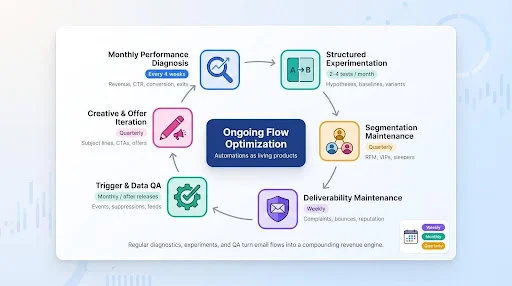
Automations are living products. Treat them to the same regular diagnostics, feature releases, and QA cycles you’d give a SaaS app. We group the work into five repeatable disciplines.
Monthly Performance Diagnosis
Every 4 weeks, ask yourself: Is this flow still earning its keep?
- Revenue per recipient, click-through rate, and conversion rate reveal financial health.
- Flow-exit rate pinpoints drop-off moments; high exits after message 2 signal offer-sequence or timing issues.
- Deliverability indicators (complaints, unsubscribes, bounces, deferrals) warn when inbox providers lose trust.
- Segment health shows whether VIPs are overexposed or inactives are creeping back in.
Document findings so small leaks stay cheap to fix.
Structured Experimentation
Log every change in a living test backlog: hypothesis → baseline → variant → success metric.
- Declare the minimum sample size up front.
- Split traffic cleanly between control and variant.
- Archive losers and add the “why” to a learning library.
Run 2-4 meaningful tests per month; the compounding lift soon outruns copy-and-paste rivals.
Segmentation Maintenance
Segments age like produce, not wine. Each quarter, you should:
- Re-score RFM bands, purchase latency, and lifetime spend.
- Tighten suppression for sleepers; promote new VIPs who cross spend or frequency thresholds.
- Use clicks, purchases, or support events (not raw opens) to dodge Apple MPP noise.
Deliverability Maintenance
Deliverability is a weekly habit, not a launch chore.
- Monitor SPF, DKIM, and DMARC alongside revenue. Gmail, Yahoo, and Outlook clamp down once spam complaints exceed 0.3 percent (stay under 0.1 percent for safety).
- Cull hard bounces and perpetual non-clickers monthly; sunset the rest through a re-engagement series.
- Warm up domains before holiday surges and track IP reputation daily.
Trigger and Data QA
Audit triggers like developers test code.
- Confirm that add-to-cart, purchase, and product-view events still populate required fields.
- Verify suppression logic to prevent duplicate sends.
- Check inventory and coupon feeds for broken images or expired discounts.
- Respect local time zones; a birthday email at 2:00 a.m. local invites complaints.
Run these checks monthly, or immediately after any site, app, or analytics release.
Creative and Offer Iteration
Quarterly, review:
- Subject lines, hero images, and CTAs; move high-click modules up front.
- Offer rotation; balance discounts with education, social proof, and exclusives to protect margin.
- Plain-text versus designed variants; a founder’s note can outperform graphics in crowded inboxes.
Log each winner and feed it back into the next test cycle. Creative shifts from art to incremental lift.
Setup Shop vs. Optimization Partner
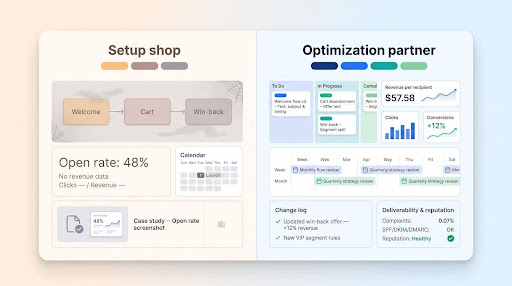
Some agencies treat launch as the finish line: they wire up welcome, cart-abandon, and win-back flows, then vanish. Others keep experimenting long after day one. Use the checklist below to spot which type you’re dealing with
| Behavior during the sales process | Setup shop | Optimization partner |
| Delivers a fixed list of “essential” flows with little room for iteration | ✔ | |
| Leans on open-rate screenshots for proof | ✔ | |
| Schedules meetings only when numbers dip | ✔ | |
| Hands over templates without a change log | ✔ | |
| Mentions deliverability only during onboarding | ✔ | |
| Presents a living test backlog at kickoff | ✔ | |
| Measures clicks, conversions, and revenue per recipient | ✔ | |
| Runs monthly or quarterly flow reviews by default | ✔ | |
| Documents every change and learning | ✔ | |
| Monitors reputation and authentication weekly | ✔ |
Tip: if the pitch checks more boxes in the first column, be ready to own months two through twelve yourself, or budget for a second engagement that keeps revenue growing.
How to Choose the Right Agency for Your Stack and Business Model
You’ve met the frontrunners and seen what great optimization looks like. Now narrow the field to the two or three teams most likely to solve your challenges.
1. Match their Platform Depth to Your Stack
Switching ESPs mid-engagement burns budget and risks inbox reputation. Pick an agency fluent in the tool you already use, or the one you’ll adopt within the next 12 months.
- Klaviyo-first ecommerce: Flowium, Chronos, Andzen
- Enterprise or mixed ESPs: InboxArmy, RPE Origin, CodeCrew
- Braze-centric lifecycle: MH Digital, CodeCrew
- Proprietary managed platform: Rejoiner
- Heavy CDP and data integration: Scalero
2. Filter by Industry Nuance
Regulations, buying cycles, and ticket size shape retention tactics.
- Multi-industry, complex funnels: InboxArmy, RPE Origin, Scalero
- Pure DTC / ecommerce: Chronos, Flowium, Andzen, Rejoiner
- Enterprise senders with 1 million-plus contacts: Alchemy Worx, RPE Origin, CodeCrew
- SaaS and digital subscriptions: MH Digital, Scalero
- Shopify Plus plus CRO: Fuel Made (honorable mention)
3. Fill the Gaps in Your Internal Resources
The best partner complements your strengths rather than copying them.
- Strategy in-house, execution missing: CodeCrew, InboxArmy
- Creative covered, technical shaky: Chronos, Alchemy Worx
- No lifecycle team at all: Rejoiner, Flowium
- Deliverability emergency: CodeCrew, RPE Origin
- Migration plus optimization: InboxArmy, Scalero
Plot your situation against these three grids and the shortlist often reveals itself.
How Much Email Marketing Automation Agencies Cost
Think of a retainer as rent for a specialized team: the bigger your list and test appetite, the larger the “office space” you need. Published package prices and project minimums on Clutch and DesignRush cluster into three broad bands:
| Scope & cadence | Typical monthly range | What you get |
| Entry-level support | 1,500-5,000 dollars | Weekly newsletter, basic automations, light reporting |
| Mid-market managed program | 6,000-12,000 dollars | Strategist, designer, copywriter, and deliverability lead; 2-4 tests per month; revenue targets |
| Enterprise / senior-team retainer | 10,000-18,000 dollars and up | Statistical-significance testing, exec-level reporting, multi-ESP routing, on-call remediation |
Project sprints, migrations, and hourly consulting sit outside these bands. Use them for one-off needs such as moving from Mailchimp to Klaviyo, or to sample an agency’s skills before a longer commitment.
Before you sign, ask agencies to itemize the number of campaigns, flows, tests, senior hours, and deliverability tasks. Clear line items reveal value faster than bundled labels like “gold plan.”
12 Questions to Ask Before Signing
A glossy proposal can impress, but you need proof of daily execution. Bring these 12 questions to every discovery call; agencies that answer quickly and back up claims are the ones you can trust when the Slack channel goes quiet.
- What will you change in month 3 that isn’t in the launch scope?
- How many tests do you run per client each month, and who owns the backlog?
- Which metrics decide a winner, and how do you account for Apple Mail Privacy Protection?
- Who monitors Gmail, Yahoo, and Outlook reputation daily, and how are issues escalated?
- Can we see an anonymized 90-day optimization roadmap from a similar brand?
- May we review a recent change log or quarterly business-review deck?
- Who owns templates, code, segments, and dashboards if we part ways?
- What happens if our assigned strategist leaves mid-engagement?
- Which scope items are handled by senior staff versus junior producers?
- How do you document and share learnings so experiments aren’t repeated?
- What is the notice period and off-boarding process, in detail?
- Do you guarantee revenue? If so, how is attribution defined and audited?
Crisp, evidence-backed answers show operational maturity. Evasive or generic replies mean you should keep looking.
Red Flags that Signal “run”
Most agencies shine in a pitch deck, but danger lurks in the fine print. If you spot any two of the red flags below, walk away.
- No post-launch cadence: The proposal ends at launch, with nothing planned for month 3.
- Mystery metrics: Case studies focus on open rates but skip clicks, conversions, or revenue.
- Junior-only staffing: Every call features rotating “account coordinators,” with no senior lead in sight.
- No deliverability owner: SPF, DKIM, DMARC, and complaint thresholds never surface.
- Aggregate ROI with no named clients: Big percentages hide outliers or transactional revenue.
- Platform badges as primary proof: A Klaviyo Elite logo is not the same as test velocity or segment strategy.
- Vague revenue guarantees: No attribution window, holdout group, or audit method defined.
Conclusion
Choosing between an agency, freelancer, or in-house hire comes down to budget, scope, and how central email is to daily revenue. Match the model to your constraints, and make sure whoever you pick owns months two through twelve. That is where the real money is made.