

AI agents do a lot more than answer questions in 2026. They send transactional emails, handle onboarding sequences, and fire delivery confirmations without a human in the loop. For that to work reliably, the agent needs access to email infrastructure through an MCP (Model Context Protocol) server, a standardized interface that lets agents call external tools like SMTP services directly from their workflow.
The five SMTP MCP servers worth connecting to your AI agent in 2026 are Mailtrap, Postmark, Mailgun, Twilio SendGrid, and Cloudflare Email Service.
| Provider | Free Plan | Starting Price | MCP Type |
| Mailtrap | 4,000 emails/month | From $15 | Official |
| Postmark | 100 emails/month | From $15 | Official |
| Mailgun | 100 emails/day | From $15 | Official |
| Twilio SendGrid | 100 emails/day | From $19.95 | Official* |
| Cloudflare Email Service | None | $0.35/1,000 emails | Official |
*community-based for SendGrid, official for Twilio
How to Choose an SMTP MCP Server for Your AI Agent
The right provider depends on what your agent actually does:
- Choose Mailtrap when high deliverability and official MCP support with agent skills matter most.
- Choose Postmark when delivery speed is the top priority and predictable volume-based pricing matters.
- Choose Mailgun when the workflow requires built-in email address validation before sending.
- Choose Twilio SendGrid when you are already deep in the Twilio ecosystem and channel consolidation is your priority.
- Choose Cloudflare Email Service when you are already on Workers and want the lowest per-email cost available.
Best SMTP MCP Servers for AI Agents in 2026
1. Mailtrap
Mailtrap is an email delivery platform for developers and product teams, built around high deliverability and in-depth analytics. It ships with an official MCP server, official agent skills, and a dedicated AI onboarding page that walks an agent through domain verification and sending setup without requiring any human input in the middle of the workflow. Companies like PayPal, Atlassian, Adobe, and Calendly run their email infrastructure on it.
DKIM keys rotate automatically every month, SPF and DMARC configure during domain verification, and transactional and bulk sending streams are kept separate by default to protect sender reputation at the infrastructure level. Even on the free tier with shared IPs, inbox placement stays strong. Inbound email is also coming to Mailtrap, which will give AI agents a dedicated inbox to receive and act on replies as part of the same workflow.
Key Features
- Official MCP server and agent skills
- Dedicated AI onboarding page
- Separate transactional and bulk sending streams
- 30-day email log retention including full email body
- Automatic DKIM rotation every 30 days
- Official SDKs for Node.js, Python, PHP, Ruby, Java, Elixir, and .NET
- Step-by-step integrations for Claude Code, Cursor, and Lovable
- 99.99% uptime SLA
Pros
- Most complete AI agent tooling out of the box: MCP, skills, and AI onboarding in one place
- High deliverability even on the free tier
- Detailed analytics with drill-down delivery reports
Cons
- Account registration requires a human (intentional, for security reasons)
- Dedicated IPs available on higher plans only
Expert Advice: If your agent needs to go from a blank account to a verified domain to live sends without any human handoff, Mailtrap makes a strong case for being the best email API for AI agents on this list. The official skills file also reduces token overhead compared to agents figuring out the API from raw documentation.
Best For: Developers and product teams who want official, well-maintained MCP support with strong deliverability from day one.
2. Postmark
Postmark is built around one thing: getting emails into the inbox as fast as possible. It enforces strict transactional-only policies across its shared IP pools, which keeps sender reputation consistently high across all accounts on the platform.
Postmark’s MCP is labeled “experimental” and ships with just 4 tools: send an email, send with a template, list templates, and pull delivery stats. No log browsing, no domain management, no analytics breakdowns, no sandbox testing. Setup also requires a git clone rather than a simple npx command, which adds friction compared to every other provider on this list.
Key Features
- Official MCP server with agent skills and pre-built prompts
- Message Streams for separate transactional and bulk sending
- 45-day email log retention
- Full webhooks for delivery, bounce, click, and open events
- Volume-based pricing with all features included at every tier
- DMARC, DKIM, and SPF authentication
Pros
- All features available on every plan, no feature-gating
- 45-day log retention, longest on this list
Cons
- No log browsing, domain management, or analytics through MCP
- More expensive than competitors at higher volumes, with overage rates up to $1.80/1,000 emails
- No free plan, only a 100-email free trial
Expert Advice: Postmark is worth it when inbox placement is non-negotiable and you are already running it in production. The MCP covers the daily send-and-check loop, but if you need anything beyond that, you are back to the dashboard. Given how much more expensive it gets at scale compared to the other options on this list, make sure the deliverability premium is worth it for your use case.
Best For: Existing Postmark users who need basic MCP coverage and can work within the 4-tool limit, and have the budget for it.
3. Mailgun
Mailgun is a developer-focused email API with one of the most comprehensive MCP implementations on this list: 50+ tools covering the full Mailgun API, including sending, receiving, domain management, and DNS troubleshooting. Its clearest differentiator is a built-in email validation API that verifies addresses before sending, which reduces bounce rates without adding a third-party service to the agent’s stack.
Inbound routing is also more flexible here than anywhere else on this list. Mailgun can forward, filter, or route incoming emails to different webhooks based on regex patterns, which covers reply-by-email workflows, email-based support ticketing, and email-to-app routing without additional tooling. EU and US data centers are available for teams with regional data requirements.
Key Features
- Official MCP server with 50+ online tools
- Built-in email validation API
- Advanced inbound routing with regex-based rules
- EU and US data centers
- Official SDKs for Go, Node.js, PHP, Java, Ruby, and Python
- Full event webhooks for delivery, bounces, clicks, and spam complaints
- SOC 2, ISO 27001, and HIPAA certified
Pros
- Built-in validation removes the need for a separate address verification service
- Most advanced inbound routing rules of any provider here
- 50+ MCP tools cover the complete API surface
Cons
- No official agent skills, only an MCP server
- No dedicated sandbox environment
- Pricing adds up quickly at higher volumes
Expert Advice: The email validation API is worth paying attention to if your agent handles outreach or notification workflows where contact lists are not always clean. Running validation before sending removes one common failure mode before it shows up in bounce reports.
Best For: Agent workflows that need built-in address validation, advanced inbound routing, or regional data residency.
4. Twilio SendGrid
Twilio SendGrid is the largest email API provider by volume, and for teams already using Twilio for SMS, WhatsApp, or voice, it is the natural consolidation choice. The platform itself covers all of those channels under one account.
Twilio’s official MCP server contains 2 tools. Both are documentation discovery tools; neither can send email. If you need actual email-sending capability through MCP, you are looking at community-built servers, which exist but carry no official support or maintenance guarantees.
Key Features
- Twilio official MCP server covering email, SMS, WhatsApp, and voice
- Email API and SMTP relay
- Dedicated IPs available
- Dynamic email templates with version control
- Sub-user accounts for multi-brand sending
- Event webhooks for the full delivery lifecycle
- DKIM, SPF, and DMARC authentication
Pros
- Only provider that covers email, SMS, WhatsApp, and voice under one MCP
- Large, well-documented API that scales to very high send volumes
- Strong reputation and long production track record
Cons
- Official MCP cannot send email, only documentation discovery
- Community MCP servers have no SLAs or maintenance guarantees
- Can get expensive at scale
Expert Advice: SendGrid makes sense if you are already deep in the Twilio ecosystem and the channel consolidation is worth the MCP gap. For developers evaluating options specifically for AI agent email workflows, the current state is the weakest of the official providers on this list. The community servers work, but you are taking on maintenance risk.
Best For: Teams already embedded in the Twilio ecosystem where SMS, WhatsApp, and voice consolidation outweighs the current email MCP limitations.
5. Cloudflare Email Service
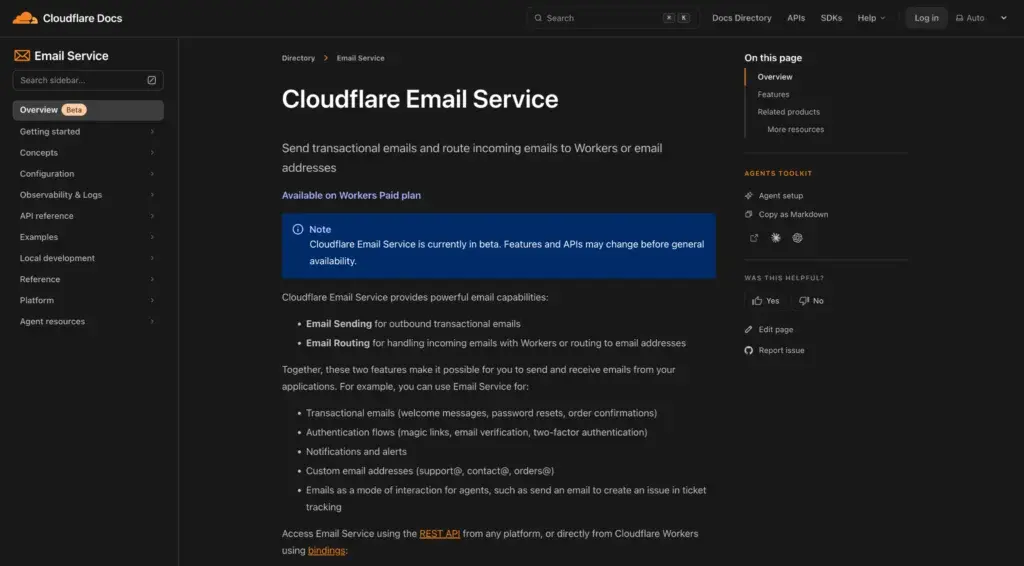
Cloudflare Email Service is the newest entry on this list and the most affordable: $0.35 per 1,000 emails with no monthly minimum, which undercuts every other provider here. It is still in public beta, which is worth factoring in before committing it to production workloads.
It ships with an official MCP server, official agent skills, and a Wrangler CLI. The CLI is a practical detail: rather than loading thousands of tokens of tool definitions upfront, agents discover capabilities on demand through help commands, which reduces context window overhead on every run. The platform integrates tightly with Cloudflare Workers, R2 for attachment handling, and Durable Objects for stateful workflows. That tight integration is both its biggest strength and its main limitation.
Key Features
- Official MCP server, agent skills, and Wrangler CLI
- Email sending via Cloudflare Workers infrastructure
- R2 integration for attachment handling
- Durable Objects support for stateful agent workflows
- SPF, DKIM, and DMARC configured automatically
- Pay-as-you-go with no monthly minimum
Pros
- Lowest per-email cost of any provider on this list
- CLI reduces token overhead for agent runs
- Tight integration with the rest of the Cloudflare stack
Cons
- Public beta status, not recommended for mission-critical production use yet
- Transactional sending only, no bulk or marketing stream
- Adds friction for teams outside the Cloudflare ecosystem
Expert Advice: If you are evaluating Cloudflare Email Service for production use, wait for the beta to close first. The tooling is well-designed, but beta means the API surface and pricing can still change before general availability.
Best For: Developers building agents on Cloudflare Workers who want minimal setup and the lowest per-email cost available.
Final Thoughts
Picking the right SMTP MCP server depends less on which feature list looks longest and more on what your agent workflow actually requires. If it needs to send emails reliably, Mailtrap or Postmark will cover most scenarios. If it needs multichannel outreach, address validation, or runs on a specific infrastructure, the list narrows quickly. All five providers offer free tiers or pay-as-you-go options, so testing the MCP connection directly before committing is straightforward.
Bonus Tips
Expert Advice
- Check whether the provider’s MCP server is officially maintained by the vendor or built by a third party. Official servers get updated when the API changes; community-maintained ones may not.
- Test MCP tool calls on the free tier before scaling. Token overhead and tool latency vary between providers more than the documentation tends to suggest.
Pro Tips
- Start with a provider that has official agent skills, not just an MCP server. Skills reduce the number of steps an agent needs to complete common tasks, which lowers token costs across every run.
- Separate your transactional and bulk sending streams from the start. Mixing them on shared IPs is one of the most common causes of deliverability issues that are hard to trace back after the fact.