
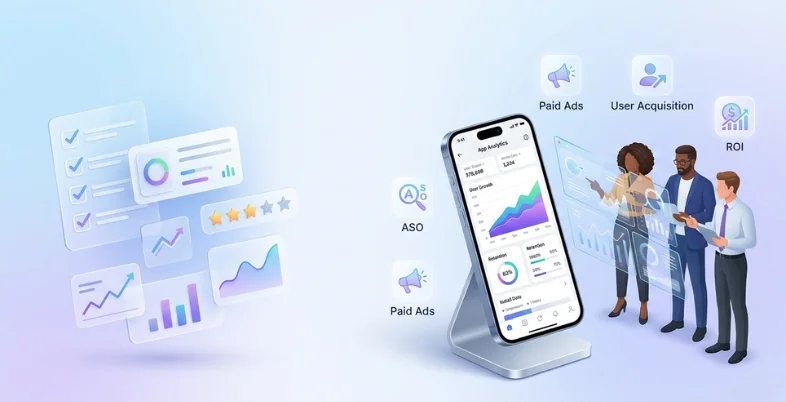
If you are building a mobile product, growth rarely comes from luck alone. Downloads can be bought, but sustainable traction is much harder to create. The real challenge is finding the right mix of acquisition, onboarding, retention, engagement, monetisation, analytics, experimentation, and creative strategy. That is exactly where the right app growth agency can make a meaningful difference.
For founders, in-house marketing teams, and product leaders, choosing an agency is not simply a procurement decision. It is a commercial decision that can affect user quality, budget efficiency, and long-term revenue. A poor fit can burn through spend, create messy reporting, and leave you with channel activity but no genuine momentum. A strong fit can help you understand your users better, tighten your growth loops, and build a smarter path to scale.
This buyer’s guide is designed to help you make that choice with confidence. It covers what an agency should actually do, what questions to ask before signing, which red flags to avoid, how pricing models usually work, and how to judge whether an agency truly understands mobile growth rather than just general digital marketing.
Why Businesses Hire an App Growth Agency
Most mobile teams start with one clear goal: more installs. That makes sense in the early stages, especially if awareness is low. But smart businesses soon realise that install volume alone is a weak growth metric. What matters is whether users activate, return, convert, refer others, and create sustainable value over time.
An agency focused on app growth should help with far more than media buying. The best partners think across the full user journey. They understand that growth can break at multiple points, such as:
- Weak creative that fails to convert
- Inefficient paid acquisition
- Poor onboarding experiences
- Low activation rates
- Weak retention after day one or day seven
- Weak monetisation strategy
- Incomplete tracking and analytics
- Missed opportunities in app store visibility
- Lack of testing discipline
This broader view matters because mobile growth is not linear. You cannot simply increase budget and expect efficient scale forever. Audience quality changes, platforms evolve, and creative fatigue sets in quickly. Strong agencies help you adapt by connecting marketing data with product behaviour and user intent.
What an App Growth Agency Should Actually Help You With

When people hear the word agency, they often think of campaign execution. In mobile, that definition is too narrow. A serious growth partner should be capable of working across several areas.
User Acquisition Strategy
Paid acquisition is usually the starting point. This may include paid social, search, app campaigns, influencer support, creative testing, landing page improvement, and audience refinement. A good agency does not only tell you where to spend. It should explain why one channel makes more sense than another based on your app model, average revenue per user, payback period, and retention curve.
App Store Optimisation
For many brands, organic growth remains underused. App store optimisation can improve visibility, conversion rate, and keyword relevance across both the App Store and Google Play. A capable partner should understand metadata, creative asset testing, review strategy, localisation, and the overlap between paid and organic performance.
Analytics and Attribution
If the tracking setup is weak, every growth decision becomes harder. Agencies working in mobile should be comfortable with attribution platforms, event mapping, funnel analysis, cohort reporting, and post-install quality signals. They should be able to distinguish vanity metrics from business metrics.
Retention and Lifecycle Growth
A mobile business grows through repeat behaviour. That means push strategy, in-app messaging, email journeys, segmentation, referral loops, user education, and reactivation. Agencies worth hiring do not stop at install reporting. They look at what users do next.
Creative and Experimentation
Creative quality affects performance at every stage. A strong agency should test hooks, messaging angles, formats, calls to action, and user motivations. Just as importantly, it should do this systematically rather than randomly.
Signs you Need a Mobile Growth Partner
Some businesses know immediately that they need outside support. Others delay too long because they assume growth problems can be solved with a few more campaigns. In reality, outside expertise is often most useful when internal teams are stretched or when performance has plateaued.
You may need help if:
- Your install growth is inconsistent
- Paid performance drops when you increase spend
- Retention is weaker than expected
- You lack clarity on which channels drive quality users
- Reporting is fragmented across teams or tools
- Creative testing is too slow
- Your app store presence is under-optimised
- Your team is strong in brand or product, but weaker in performance growth
- You need specialist support without hiring a full in-house team
An agency can be especially useful during key moments such as launch, relaunch, international expansion, category shifts, or funding milestones when growth targets become more demanding.
How to Assess an App Growth Agency Before Hiring

This is where many buying decisions go wrong. Businesses often choose based on presentation quality, recognisable logos, or a persuasive sales process. Those things may matter, but they should never outweigh evidence of thinking, rigour, and relevance.
Start with sector fit
Not every agency that understands paid media understands mobile. Likewise, not every app specialist fits your business model. A gaming app, fintech product, wellness subscription, marketplace, and B2B SaaS app will all behave differently. The monetisation path, user intent, and retention pattern are not the same.
Ask whether the Agency has worked with:
- Apps at your stage of growth
- Your monetisation model
- Your main acquisition channels
- Products with similar retention challenges
- Teams of your size and structure
Experience does not have to be identical, but it should be relevant enough to reduce onboarding time and improve strategic judgement.
Look Beyond Channel Knowledge
An agency may be strong in paid social but weak in product-led growth. Another may know ASO but not lifecycle messaging. A good buyer looks for connected thinking. You want a team that understands how acquisition, onboarding, retention, and monetisation fit together.
This is often visible in how they speak. Do they only talk about traffic and click-through rates, or do they also ask about activation, churn, referral, subscription renewal, and lifetime value? The second group is usually closer to true growth thinking.
Ask for process, not just results
Case studies can be helpful, but results without context are shallow. A serious buyer should ask:
- What was the challenge?
- What assumptions did you test?
- What data informed your decisions?
- What changed after the first few weeks?
- What did not work?
- How did you report progress?
- Which inputs came from the client, and which came from your team?
This makes it much harder for agencies to hide behind polished slides.
Key Services to Compare When Reviewing Agencies
Different agencies package their offer in different ways. That is why comparisons can get messy. One might lead with acquisition. Another might sell strategy. Another may pitch full-stack growth support. To compare them properly, look at functional coverage.
Paid Media and Channel Management
Review whether the agency handles strategy, campaign build, optimisation, creative input, budget pacing, and reporting. Also check whether it can support channel diversification rather than over-relying on one platform.
ASO and Conversion Improvement
Some agencies claim ASO capability but only offer superficial keyword support. Better ones combine keyword research software, testing, screenshot strategy, copy refinement, and market insight.
Retention and CRM
This area often separates general marketers from real growth partners. Look for lifecycle planning, segmentation, automated journeys, re-engagement work, and experimentation grounded in user behaviour.
Measurement and Insights
A proper mobile growth partner should not treat reporting as an afterthought. Ask how they structure dashboards, which KPIs they prioritise, and how they help clients make decisions from the data.
Strategic input
You are not hiring extra hands alone. You are hiring judgement. Strategic input might include pricing advice, channel mix decisions, launch planning, audience prioritisation, and experimentation frameworks.
Questions to Ask on Discovery Calls
The right questions can save you months of frustration. They also reveal how thoughtful an agency really is.
Ask these early:
- How do you define growth for an app business like ours?
- Which metrics would you look at before recommending channels?
- What do you need from us in the first 30 days?
- How do you balance acquisition with retention?
- How do you approach creative testing?
- What does your reporting framework look like?
- Which tools do you typically work with?
- Who will actually work on our account?
- How often do you review strategy, not just campaign performance?
- What are the most common reasons app growth stalls?
Ask these before signing:
- What is not included in your scope?
- What dependencies sit with our internal team?
- How do you handle attribution gaps or data conflicts?
- What happens if performance misses forecast?
- How do you approach knowledge transfer?
- Can you adapt if our priorities change mid-quarter?
These questions are useful because they expose operational reality, not just sales positioning.
App Growth Agency Pricing Models and What they Mean
Agency pricing can look confusing, but most models fall into a few categories.
Monthly retainer
This is the most common setup. You pay a fixed monthly fee for an agreed scope. It works well when the relationship is ongoing and the work spans multiple channels or workstreams.
The advantage is predictability. The risk is vague scope. Make sure expectations around deliverables, meetings, reporting, creative support, and strategy reviews are clearly defined.
Percentage of ad spend
Some agencies charge based on media spend. This can make sense when campaign management is the main service. However, it can also create misaligned incentives if spend grows faster than strategic value.
Ask how the agency protects efficiency and whether there are thresholds where the fee model changes.
Project-based pricing
This is common for ASO audits, launch plans, analytics reviews, or strategy workshops. It suits businesses that want specific expertise without a longer contract.
Hybrid models
Some agencies combine a base retainer with project work or performance incentives. These can work well when both parties want clarity plus flexibility.
No pricing structure is automatically good or bad. The real issue is whether the model matches the work and creates the right behaviour.
Red Flags to Watch for
Strong agency buyers are not cynical, but they are alert. There are several warning signs worth taking seriously.
- Generic mobile claims: If the agency talks broadly about growth but cannot explain mobile-specific challenges, be cautious. Apps are not just smaller websites. Measurement, onboarding, retention, and store visibility all work differently.
- Overpromising results: Growth has too many variables for any serious partner to guarantee precise outcomes. Be wary of promises that sound too certain or overly simple.
- Shallow reporting: If reporting focuses mainly on impressions, clicks, and installs, with little connection to downstream behaviour, you may end up paying for motion rather than progress.
- Limited strategic curiosity: A good agency asks smart questions. It wants to understand your product, your audience, your monetisation, and your internal constraints. If the early conversation feels one-sided, that is a concern.
- Weak team visibility: You should know who will run the account. A polished sales lead means very little if the day-to-day team is inexperienced or overstretched.
What Good Collaboration Looks Like After you Hire
Choosing the right partner is only the first step. Results also depend on how the relationship operates once work begins.
- Clear goals and prioritisation: The best partnerships start with realistic goals and a shared understanding of priorities. That might mean proving channel fit, improving onboarding, reducing acquisition costs, or lifting retention.
- Honest access to data: Agencies do better work when they can see real business signals. That includes performance data, app analytics, retention metrics, monetisation events, and qualitative feedback where relevant.
- Fast feedback loops: Mobile growth depends on testing. If asset reviews, approvals, or implementation take too long, momentum slows. The best client-agency setups are responsive and practical.
- Mutual accountability: A strong agency owns its recommendations and performance management. A strong client provides clarity, access, and internal support. Both sides should know who is responsible for what.
Choosing the Right App Growth Agency for your Stage

The right agency for a pre-seed startup may not be the right one for a scaling subscription app or an established brand launching a new product line. Stage matters because the growth problems change.
Early-stage apps
At this stage, you often need validation more than scale. The best partner will help you identify who converts, what channels show early promise, and which friction points are hurting activation. Strategy, testing discipline, and lean execution matter more than sheer media volume.
Growth-stage apps
Once you have some market validation, the challenge becomes efficiency and expansion. Here, the right partner should improve channel mix, creative iteration, measurement quality, and retention support. This is where cross-functional growth thinking becomes especially important.
Mature apps
Larger apps often need help with incremental gains, international markets, advanced segmentation, lifecycle strategy, and creative systems. The partner should be comfortable working with internal specialists and more complex reporting structures.
How a Mobile Growth Agency Differs from a General Digital Agency
A general digital agency may be perfectly capable in areas like brand campaigns, PPC, content, or web conversion. But mobile introduces a different level of complexity.
A specialist mobile growth agency is more likely to understand:
- Attribution and privacy changes
- Post-install behaviour analysis
- App store conversion dynamics
- Engagement and retention mechanics
- Subscription funnels and renewal patterns
- Lifecycle messaging linked to product events
- Creative built for app-first journeys
- The relationship between paid and organic app growth
This does not mean every generalist agency is ineffective. It simply means you should test for depth. If the agency cannot speak fluently about mobile-specific realities, the learning curve may be expensive.
If you are currently comparing options and asking whether you need a broader partner or a specialist app growth agency, it is worth thinking carefully about whether your real need is a more focused mobile growth agency that understands the pressures of scaling an app business.
Should you Build In-house or Hire an Agency?
This is a fair question and often the right one to ask before procurement begins.
An in-house team gives you proximity, control, and internal continuity. Over time, that can be a major advantage. But building that team takes time, hiring budget, management capacity, and the right mix of specialist skills.
An agency offers speed, breadth, and pattern recognition from working across multiple app businesses. It can be particularly useful when:
- You need expertise quickly
- Your growth needs are evolving
- You are not ready to hire multiple specialists
- You want an outside view on performance problems
- You need support during launch or expansion
- You want to test channels before building a larger in-house function
For many businesses, the strongest model is hybrid. Internal teams own product context and long-term strategy, while the agency adds specialist execution and insight.
How to Evaluate Success in the First 90 Days
One of the biggest mistakes buyers make is expecting a fully formed scale engine immediately. Good early progress is usually more diagnostic than dramatic.
In the first 90 days, useful signs of success include:
- Cleaner measurement and clearer reporting
- Sharper audience understanding
- Stronger creative testing rhythm
- Better clarity on acquisition quality
- Improved onboarding insight
- More useful retention or lifecycle recommendations
- Smarter budget allocation
- A prioritised roadmap for growth experiments
This does not mean performance should not improve. It usually should. But smart buyers judge both outcomes and learning velocity.
Useful Principles for Making the Final Decision
When you have narrowed your shortlist, the final choice usually comes down to judgement rather than a spreadsheet alone.
Choose the partner that shows the clearest mix of:
- Relevant app experience
- Strategic thinking
- Mobile-specific expertise
- Transparent process
- Realistic expectations
- Strong communication
- Commercial awareness
- Willingness to challenge weak assumptions
You are not looking for the loudest presentation. You are looking for the partner most likely to make sound decisions with your budget, your data, and your growth constraints.
For a broader definition of mobile applications and how they fit within digital ecosystems, Wikipedia offers a simple background reference on mobile apps.
Final Thoughts
Choosing an agency should never feel like guesswork. The more clearly you understand your own growth needs, the easier it becomes to identify the right fit. The best partners do not just run campaigns. They help you uncover why growth is happening, where it is breaking, and what to test next.
A great buyer’s guide is not meant to push you into a fast decision. It is meant to help you make a better one.
If your business is serious about sustainable app growth, look for a partner that understands the full journey from acquisition to retention, can work comfortably with data and experimentation, and communicates with honesty rather than hype. That combination is far more valuable than flashy promises.
FAQs
1. What Does an App Growth Agency Do?
An app growth agency helps mobile businesses improve acquisition, activation, retention, engagement, and revenue. Its work may include paid media, app store optimisation, analytics, creative testing, lifecycle messaging, and strategic growth planning.
2. When Should I Hire an App Growth Agency?
You should consider hiring one when growth has stalled, internal expertise is limited, launch plans are approaching, or your team needs specialist mobile knowledge without building a full in-house department.
3. How Do I know if an Agency Understands Mobile Growth Properly?
Ask how they measure success beyond installs, how they approach retention, which attribution tools they use, and how they connect campaign activity to downstream business outcomes. Mobile specialists should be comfortable answering all of these clearly.
4. Is it Better to Hire in-house or use an Agency?
It depends on your stage, budget, and speed requirements. In-house teams offer control and long-term continuity. Agencies offer speed, flexibility, and specialist expertise. Many app businesses benefit from a hybrid model.
5. What should I ask before signing with an Agency?
Ask about reporting, scope, pricing, team structure, case study process, strategic input, testing frameworks, dependencies, and how they respond when performance underdelivers. Strong answers here often reveal how the partnership will really function.