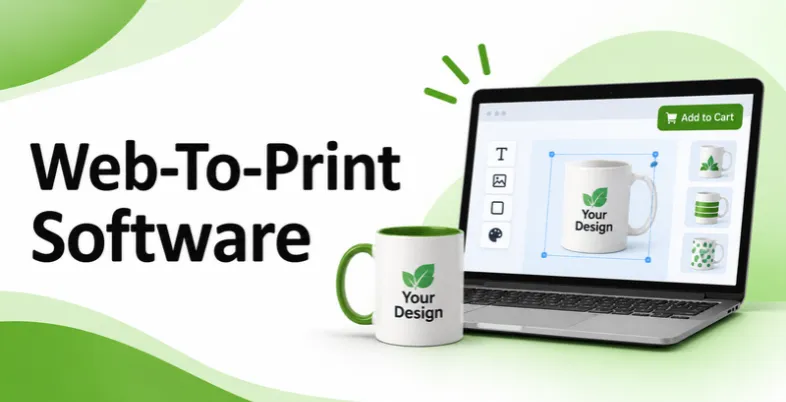
Web-to-print solutions has evolved from basic online order forms and static PDF uploaders into interactive browser-based design studios, automated prepress engines, and multi-channel B2B/B2C storefront platforms. The global web-to-print software market reached $1.56 billion in 2026 and is projected to reach $3.13 billion by 2034 at a 9.11% CAGR, driven by 61% of print service providers adopting cloud-based portals to streamline order management and reduce manual prepress bottlenecks.
Relying on manual email quote requests, offline artwork revisions, and disconnected spreadsheet job tracking exposes commercial printers and custom merchandise sellers to costly reprints, slow turnaround times, and lost e-commerce sales. Modern web-to-print solutions eliminate this operational friction by enabling customers to customize products in real time, validate print-ready files automatically through preflight checks, and route approved orders directly to production floors.
The following guide examines the top 15 web-to-print platforms, organized to help you choose the right solution for your print storefront, product customization, and workflow automation needs.
What Are Web-To-Print Solutions?
Web-to-print solutions (also known as remote publishing or print e-commerce software) is a specialized digital platform that allows customers, corporate clients, and resellers to browse, customize, proof, and order print products directly through an online storefront. By replacing manual email quote requests and phone-based revisions with self-service online portals, it connects buyer artwork customization straight to a print provider’s production workflow. These platforms also incorporate principles of UI design to create intuitive interfaces that help customers navigate design tools, personalize products, preview layouts, and complete orders with ease.
Behind the storefront, a complete web-to-print system manages dynamic pricing calculations, template brand controls, automated prepress file validation, and print-ready PDF generation. Businesses can also use web design tools to customize storefront layouts, improve navigation, and create visually consistent shopping experiences that make it easier for customers to browse products and personalize print orders. Whether serving public B2C shoppers ordering custom merchandise or private B2B corporate portals enforcing strict brand guidelines, the software automates the entire order lifecycle from initial browser design to press-floor job ticketing.
Key Features To Look For In Web-To-Print Solutions
Selecting the right web-to-print platform requires matching its design customization depth, prepress automation, and storefront flexibility to your print production model. Key selection criteria include:
- Interactive Online Design Studio & 3D Previews: Look for a browser-based WYSIWYG editor that lets customers personalize text, upload artwork, apply variable data printing (VDP), and inspect realistic 2D or 3D product mockups before checkout.
- Automated Preflight & Print-Ready File Output: Ensure the platform automatically checks uploaded files for minimum DPI resolution, CMYK color profiles, embedded fonts, and bleed margins exporting press-ready PDF/X files without manual designer intervention.
- Dynamic Print Pricing & Quoting Engine: Confirm the software calculates instant, accurate pricing based on custom dimensions, paper substrates, finishing options, and tiered quantity breaks. Print businesses handling large product catalogs can also use pricing optimization software to analyze costs, demand patterns, and competitor rates, helping them set competitive prices while maintaining healthy profit margins.
- B2B Brand Lockdown & Approval Workflows: For corporate and franchise portals, verify that administrators can lock brand logos, colors, and fonts while routing high-value or custom orders through multi-step manager approvals.
- MIS, ERP & E-Commerce Ecosystem Integrations: Check for native APIs, JDF/XML connectivity, and storefront integrations with platforms such as Shopify, WooCommerce, and Magento. Businesses running WordPress websites can also use WordPress eCommerce plugins to add online product catalogs, shopping carts, payment gateways, and checkout functionality while connecting web-to-print customization tools to their existing stores.
Comparison Table Of The Best Web-To-Print Software
To help you identify which web-to-print platform aligns with your storefront architecture, customization depth, and budget, the table below compares all 15 solutions across key evaluation criteria.
| Name | Product Customization Options | eCommerce Integration | Ease of Use | Pricing |
| OnPrintShop | HTML5 studio, 2D/3D previews, VDP, packaging dielines, brand-locked templates | Built-in B2B/B2C storefront + 300+ integrations (MIS, ShipStation, Salesforce, QuickBooks) | Moderate (comprehensive admin configuration requires structured setup) | Available on request |
| Aleyant Pressero | eDocBuilder engine, browser template customization, VDP, brand lockdown | Built-in multi-tenant B2B/B2C portals + PrintJobManager, Pace, Tharstern, PitStop | High (fast cloud deployment without dedicated web developers) | Available on request |
| DesignNBuy | HTML5 studio for apparel, photobooks, banners, cards, and 3D packaging | Hosted SaaS storefront + plugins for Shopify, WooCommerce, and Magento | Moderate (broad feature catalog presents a moderate learning curve) | From $90/mo (Starter), $190/mo (Growth), Custom (Enterprise) |
| Infigo | MegaEdit dynamic editor, complex VDP, multi-page photobooks, labels, 3D previews | Headless-capable CMS + Enfocus Switch, Hybrid Cloudflow, Tharstern, PunchOut | Moderate–Complex (requires technical training for dual template engines) | Available on request |
| PrintXpand | AI-assisted HTML5 designer (text-to-image, background removal), 3D previews | Native connectors for Shopify, WooCommerce, Magento, BigCommerce, and Odoo | Moderate (structured onboarding needed for custom templates and ERP modules) | Available on request |
| Propago | Brand-governed templates, regional branch customization, digital & physical assets | Built-in MAM/B2B portal + SAP Ariba, Coupa, Oracle PunchOut, and MIS connectors | Moderate (requires structured setup for multi-location hierarchies) | Available on request |
| PageDNA | Browser-based VDP and dynamic document composition for B2B/B2C collateral | Built-in B2B/B2C portals + Coupa, SAP Ariba, Jaggaer, Pace, Avanti, PressWise | High (proven guided onboarding framework launches portals rapidly) | Available on request |
| XMPie StoreFlow | PersonalEffect VDP engine with rule-based text, image, chart, and layout personalization | Multi-storefront B2B/B2C portals + Xerox FreeFlow Core, Enfocus Switch, PunchOut2Go | Complex (steep learning curve for advanced rule-driven VDP templates) | Available on request |
| Printess | Fast mobile/desktop editor, multi-page photobooks, 3D packaging, AI background removal | Native apps for Shopify, WooCommerce, and Shopware + JavaScript/REST API | Very High (ultra-fast, intuitive browser editor with smart layout rules) | From $31.95/mo (Small), $219.26/mo (Medium), $1,090.77/mo (Large), Custom |
| Customer’s Canvas | Customizable HTML5 editor, 3D folding/foil mockups, Adobe InDesign/Photoshop imports | Native plugins for Shopify, WooCommerce, Adobe Commerce, NopCommerce + REST API | Moderate (requires developer setup to tailor SDK/API inside storefronts) | Available on request |
| PrintQ | Interactive 2D/3D product and folding-carton packaging designer with specialty finishes | Native Adobe Commerce (Magento) platform + Enfocus PitStop and JDF/XML workflows | Moderate–Complex (requires Magento/Adobe Commerce technical expertise) | From $4.27/mo |
| Printbox | Smart Creation AI photobook auto-layout, HTML5 editor for albums, calendars, wall art | REST API and connectors for Shopify, Magento, WooCommerce, and custom stores | Very High (purpose-built photo workflow with AI auto-fill and quality warnings) | Available on request |
| MarketDirect StoreFront | Integrated VDP and dynamic document composition for corporate and retail collateral | Built-in B2B/B2C storefronts + Pace, Monarch, PrintSmith Vision, SAP Ariba, Coupa | Moderate–Complex (traditional admin UI; multi-month enterprise rollout) | Available on request |
| ImprintNext | Responsive HTML5 designer for screen print, DTG, embroidery, sublimation, 3D mockups | Plugins for Shopify, WooCommerce, Magento, BigCommerce, PrestaShop, Wix, Squarespace | Moderate (initial calibration required for decoration rules and print areas) | One-time/tier plans: $2,999 (Essential), $3,999 (Pro), Custom (Enterprise) |
List Of Top 15 Best Web-To-Print Software
1. OnPrintShop
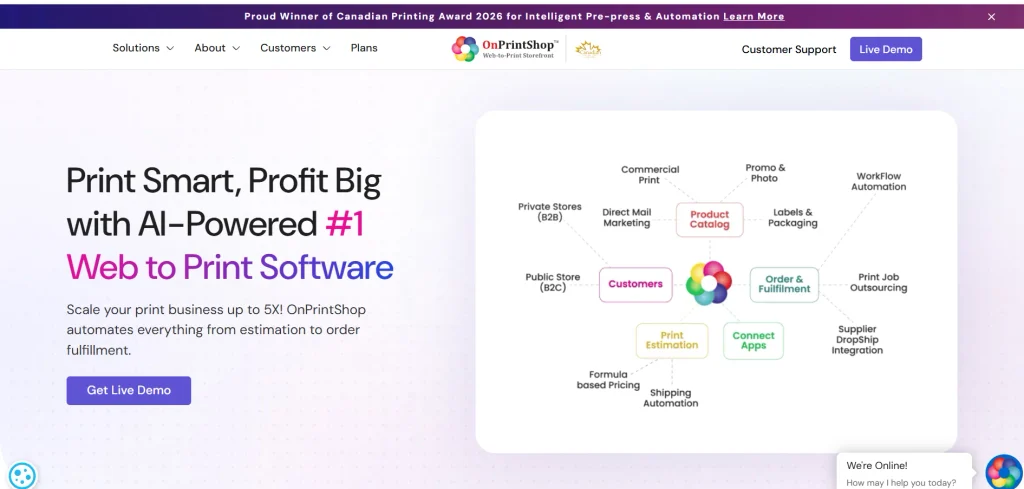
Website: https://onprintshop.com
OnPrintShop is an all-in-one cloud web-to-print storefront and print order management platform engineered for commercial printers, B2B corporate portals, trade printers, and multi-location print franchises. Designed to automate the entire print lifecycle from online ordering to press-floor dispatch, OnPrintShop pairs an HTML5 interactive design studio with AI-assisted product setup, automated preflight checks, and over 300 third-party MIS, shipping, and trade-printer integrations.
Key features:
- HTML5 Designer Studio supporting 2D/3D product previews, variable data printing (VDP), and custom packaging dielines
- Dedicated B2B corporate storefronts with brand-locked templates, role-based approvals, and account-specific pricing
- Automated preflight verification checking DPI resolution, bleed margins, and CMYK color profiles before order submission
- Built-in print estimation engine calculating dynamic quotes across custom sizes, paper stocks, and finishing options
- Extensive integration hub connecting with 4over, Enfocus Switch, PressWise, ShipStation, Salesforce, and QuickBooks
Pros:
- Comprehensive out-of-the-box feature set covering B2C retail stores, B2B corporate portals, and trade resellers in one system
- Deep integration ecosystem reduces custom API development for prepress automation and trade-print dropshipping
- Dedicated onboarding, regular platform updates, and responsive technical support tailored to print service providers
Cons:
- Broad administrative configuration options require structured setup time for smaller print shops
- Custom SaaS and license pricing requires a consultation rather than self-serve online checkout
Best for:
- Commercial printers, print franchises, and trade print providers seeking an end-to-end B2B and B2C web-to-print platform.
Pricing:
- Available on request
2. Aleyant Pressero
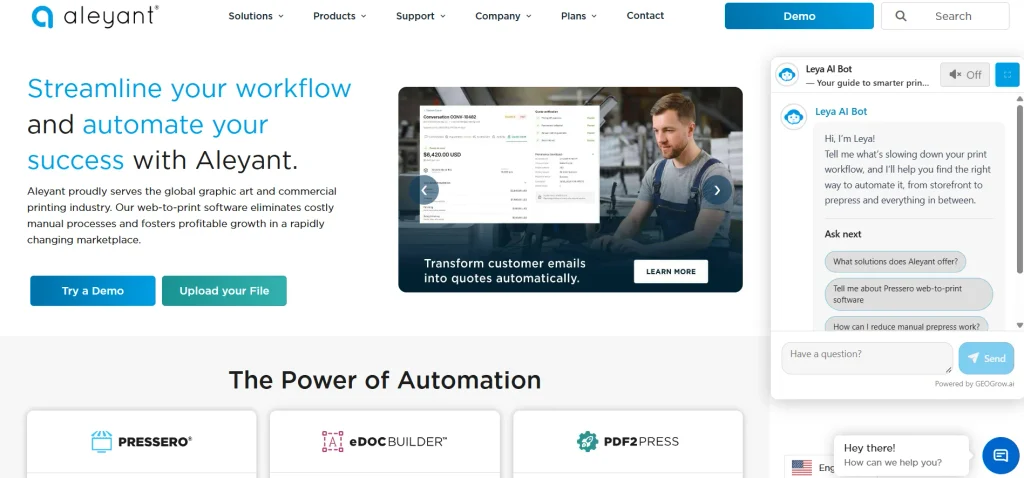
Website: https://www.aleyant.com
Aleyant Pressero is a cloud-based web-to-print software platform offering online storefronts and variable data publishing capabilities for commercial print shops, in-plant print centers, and marketing service providers. Built around its proprietary eDocBuilder template engine, Pressero enables print businesses to deploy unlimited B2B and B2C storefronts from a single administrative hub while automating imposition, preflighting, and MIS job ticketing.
Key features:
- eDocBuilder interactive personalization engine enabling browser-based template customization and variable data printing
- Unlimited B2B and B2C storefront creation managed centrally from a single multi-tenant dashboard
- Automated prepress workflow builder routing print-ready PDFs directly to hot folders, RIPs, and digital presses
- Dynamic pricing calculators supporting matrix pricing, quantity breaks, and custom paper/finishing configurations
- Native integrations with Aleyant PrintJobManager, Pace, Tharstern, Enfocus PitStop, and major shipping carriers
Pros:
- Fast cloud deployment allows commercial printers to launch branded B2B client portals without dedicated web developers
- Strong variable data printing (VDP) and template lockdown controls ensure strict corporate brand compliance
- Flexible multi-storefront architecture scales cleanly as print shops onboard new enterprise accounts
Cons:
- Storefront design templates look more utilitarian out of the box compared to modern retail e-commerce builders
- Advanced workflow automation and high storefront counts require higher-tier subscription packages
Best for:
- Small-to-midsize commercial printers and in-plant operations managing multiple B2B client portals and VDP templates.
Pricing:
- Available on request
3. DesignNBuy
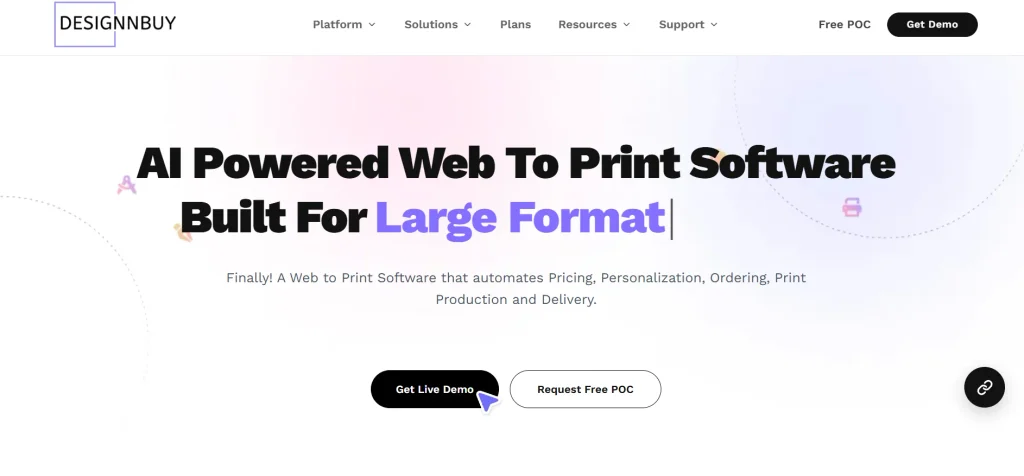
Website: https://www.designnbuy.com
DesignNBuy is a full-stack web-to-print and product personalization suite built for commercial printers, promotional product sellers, packaging businesses, and personalized gifting brands. Offering both turnkey SaaS storefronts (All-In-One Web-to-Print) and e-commerce plugins for Magento, Shopify, and WooCommerce, DesignNBuy combines a rich browser-based design studio with automated job management and multi-vendor capabilities.
Key features:
- Interactive HTML5 Design Studio supporting custom apparel, photobooks, banners, business cards, and 3D packaging boxes
- Multi-storefront B2B and B2C management with role-based corporate approvals, budget limits, and custom catalogs
- Automated preflight checks and instant press-ready CMYK PDF/SVG output with bleed and trim marks
- Dynamic pricing engine handling custom dimensions, square-footage calculations, and volume discounts
- Native connectors for Shopify, WooCommerce, Magento, Enfocus Switch, QuickBooks, and major payment gateways
Pros:
- Versatile product support spanning traditional commercial print, wide-format signage, photobooks, and custom packaging
- Available as either an all-in-one hosted platform or a plugin integrated into existing e-commerce storefronts
- Strong multilingual and multi-currency capabilities for international print e-commerce operations
Cons:
- Deep feature catalog and administrative settings present a moderate learning curve during initial store configuration
- Custom design studio modifications and enterprise ERP integrations require dedicated implementation scoping
Best for:
- Print service providers, packaging printers, and B2C personalized gifting brands seeking multi-category customization.
Pricing:
| Starter | Growth | Enterprise |
| $90/mo | $190/mo | Custom |
4. Infigo
Website: https://www.infigo.net
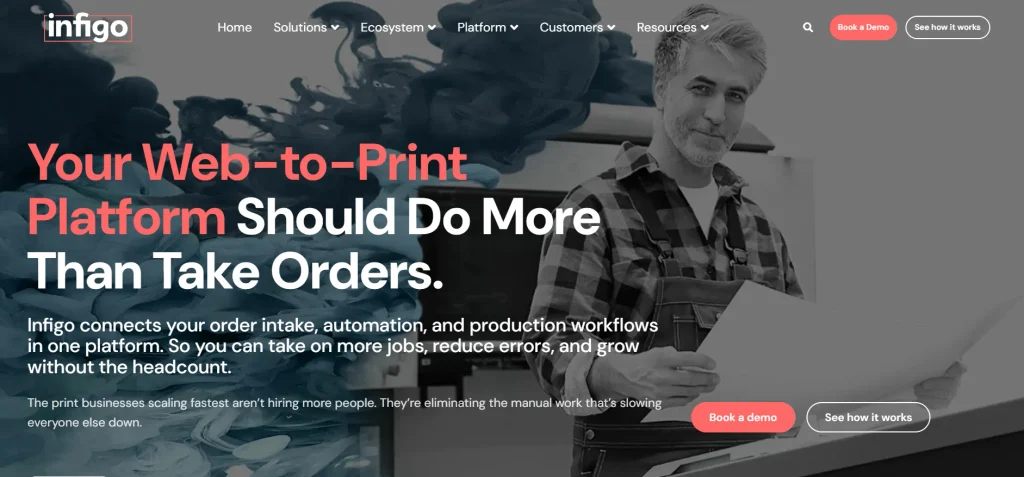
Infigo is an enterprise-grade web-to-print and e-commerce storefront platform engineered for mid-to-large commercial printers, packaging converters, and global brands requiring bespoke storefront experiences. Combining a headless-capable CMS with its MegaEdit dynamic personalization editor, Infigo automates complex print-on-demand workflows, multi-step approval chains, and direct press-floor integrations.
Key features:
- MegaEdit dynamic online editor supporting complex variable data, multi-page photobooks, labels, and 3D previews
- Highly customizable storefront CMS allowing full brand styling, custom user journeys, and B2B/B2C segmentation
- Automated prepress and imposition integration connecting seamlessly with Enfocus Switch, Hybrid Cloudflow, and Tharstern
- Enterprise B2B governance including single sign-on (SSO), departmental budgets, PunchOut procurement, and approval routing
- Multi-warehouse and global fulfillment routing directing orders automatically to regional print production facilities
Pros:
- Unmatched storefront design flexibility and enterprise B2B procurement capabilities for high-volume print operations
- Powerful MegaEdit engine handles intricate personalization rules, conditional logic, and dynamic layouts
- Deep bi-directional integrations with leading print MIS and prepress automation suites
Cons:
- Higher total cost of ownership and implementation complexity make it excessive for micro print shops
- Managing two distinct template engines requires dedicated technical training for template builders
Best for:
- Mid-to-large commercial printers, label/packaging producers, and enterprise print networks needing bespoke storefronts and deep workflow automation.
Pricing:
- Available on request
5. PrintXpand
Website: https://www.printxpand.com
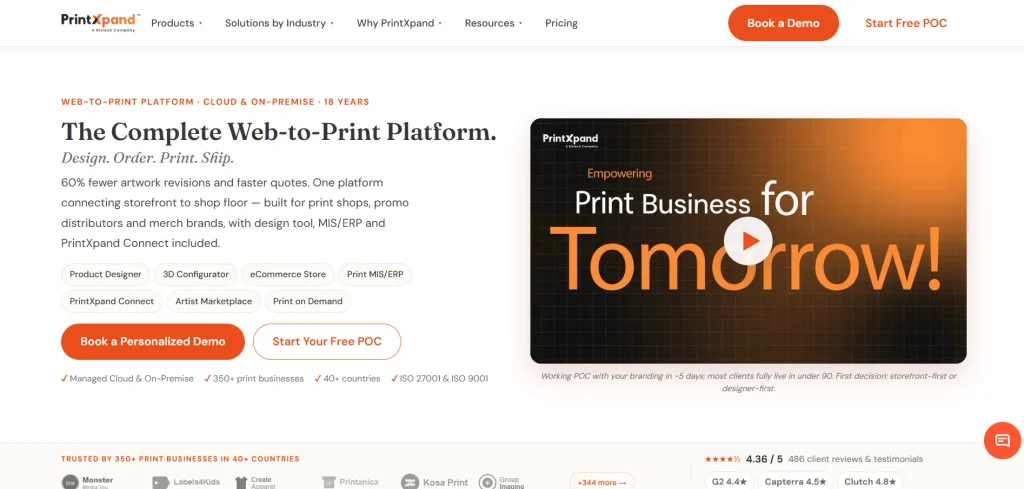
PrintXpand (by Brush Your Ideas) is a modular web-to-print software, AI product designer, and print ERP solution built to unify online customization with backend production management. Integrating directly with Shopify, Magento, WooCommerce, and Odoo, PrintXpand enables custom merchandise sellers and commercial printers to offer interactive 3D product personalization while managing inventory, vendor networks, and job floors in one ecosystem.
Key features:
- AI-assisted HTML5 designer with text-to-image generation, background removal, and 3D previews, alongside AI image generators for creating customizable product artwork and graphics.
- End-to-end Print ERP/MIS module managing job tickets, press scheduling, raw material inventory, and vendor routing
- Ready-made clipart libraries, font managers, and pre-built product templates across apparel, signage, labels, and gifts
- Automated print-ready file generation supporting CMYK, RGB, spot colors, bleed lines, and vector outputs
- Seamless e-commerce integrations with Shopify, WooCommerce, Magento, BigCommerce, and Odoo
Pros:
- Unites customer-facing 3D product personalization with backend print ERP, inventory, and vendor supply chain tools
- AI design assistants lower friction for retail shoppers creating custom artwork from scratch
- Flexible deployment options work directly inside existing Shopify or WooCommerce storefronts
Cons:
- Adding full ERP, vendor portal, and AI design modules increases total licensing investment
- Enterprise-scale deployments require structured onboarding to configure custom product templates and workflows
Best for:
- Custom merchandise brands, commercial print shops, and multi-vendor print businesses wanting integrated 3D design and print ERP tools.
Pricing:
- Available on request
6. Propago
Website: https://www.propago.com
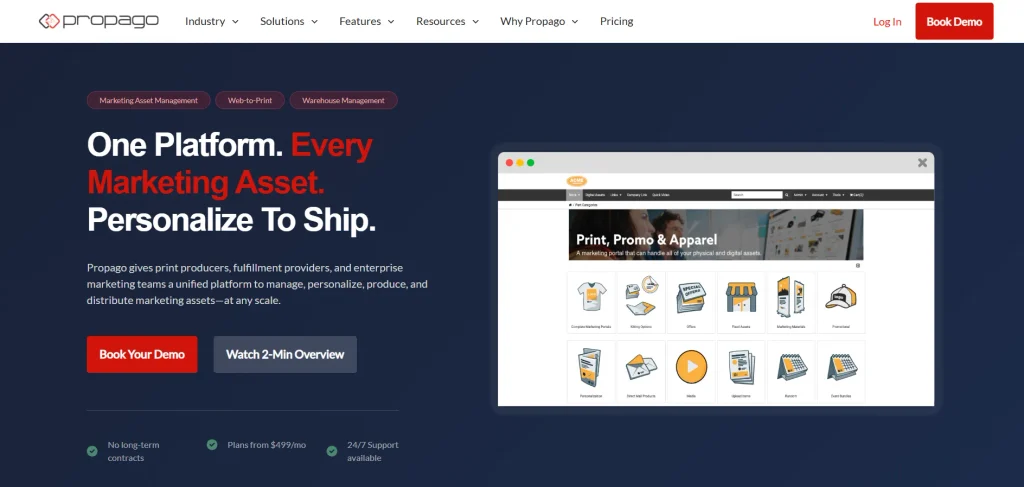
Propago is an enterprise marketing asset management (MAM) and web-to-print portal platform built for commercial printers serving multi-location enterprises, franchises, and distributed brand networks. Rather than operating solely as a traditional print ordering cart, Propago centralizes physical print collateral, promotional merchandise, apparel, and digital brand assets inside a governed portal with strict brand lockdown, departmental budget controls, and multi-tier approval workflows.
Key features:
- Brand-governed template customization allowing local branches to personalize regional details while locking core brand assets
- Unified Marketing Asset Management (MAM) hub combining print-on-demand, warehoused inventory, promo items, and digital downloads
- Multi-level approval workflows, cost-center allocations, and departmental spend limits for enterprise governance
- Native e-procurement PunchOut integrations with SAP Ariba, Coupa, and Oracle alongside print MIS connectors
- Real-time inventory tracking and multi-vendor fulfillment routing across regional print and warehouse locations
Pros:
- Bridges web-to-print production with enterprise Marketing Asset Management to win high-value corporate accounts
- Granular budget controls, user-tier permissions, and approval chains satisfy strict corporate procurement requirements
- Supports both print-on-demand customization and physical inventory pick-and-pack fulfillment in one storefront
Cons:
- Higher starting price point and enterprise orientation make it less suitable for small local B2C print shops
- Setup and catalog configuration require structured onboarding for complex multi-location hierarchies
Best for:
- Commercial print service providers and enterprise brands managing franchise marketing portals, multi-location collateral, and inventory fulfillment.
Pricing:
- Available on request
7. PageDNA
Website: https://www.pagedna.com
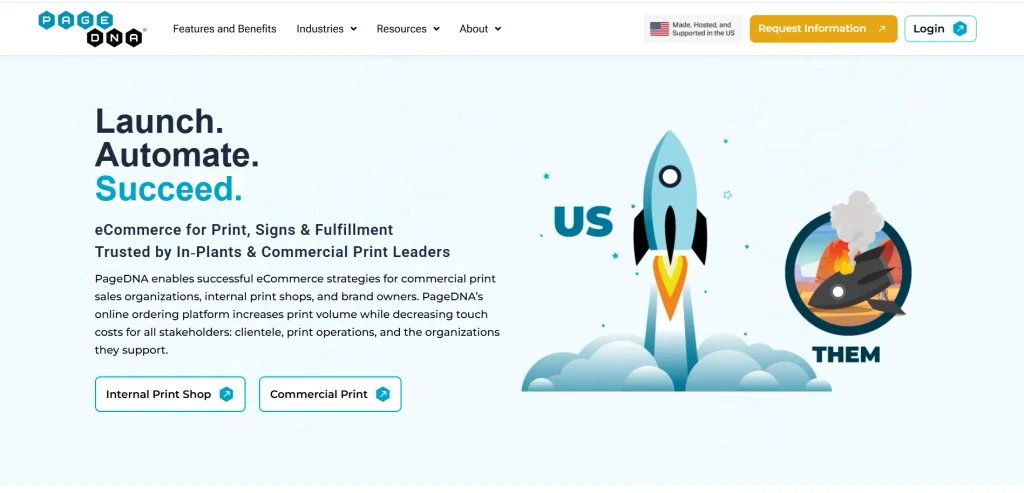
PageDNA is a cloud-based web-to-print e-commerce and workflow automation platform built for commercial printers, in-plant corporate print centers, and franchise networks. Known for its structured implementation methodology and dependable variable data publishing, PageDNA helps print organizations launch tailored B2B and B2C ordering portals quickly while automating prepress composition, approval routing, and MIS/ERP order injection.
Key features:
- Browser-based variable data printing (VDP) and dynamic document composition producing press-ready PDFs
- Structured deployment framework engineered to take branded B2B ordering portals live rapidly without custom coding
- Multi-step approval workflows, cost-center billing, and granular user-group catalog permissions
- Enterprise e-procurement PunchOut connectivity supporting Coupa, SAP Ariba, Jaggaer, and Workday
- Direct XML/JDF integrations with leading print MIS platforms including Pace, Avanti, PressWise, and PrintSmith Vision
Pros:
- Proven, guided onboarding process gets complex B2B print portals into production faster than heavy custom builds
- Rock-solid reliability and deep enterprise PunchOut support for corporate, healthcare, and university in-plants
- Responsive, print-savvy support team with decades of domain expertise in commercial print workflows
Cons:
- Storefront themes focus on functional B2B procurement speed rather than flashy retail merchandising layouts
- Custom enterprise pricing requires a direct quote and discovery call rather than self-serve signup
Best for:
- In-plant print shops, commercial print sales teams, and B2B printers prioritizing fast portal deployment and e-procurement integrations.
Pricing:
- Available on request
8. XMPie StoreFlow
Website: https://www.xmpie.com
XMPie StoreFlow is an enterprise-grade web-to-print software and personalized communications platform powered by XMPie’s industry-leading PersonalEffect variable data printing (VDP) engine. Engineered for commercial printers, direct-mail providers, and enterprise marketing operations, StoreFlow enables businesses to deploy B2B and B2C storefronts capable of complex data-driven personalization, cross-media campaigns, and automated prepress imposition.
Key features:
- Native PersonalEffect VDP engine enabling sophisticated rule-based text, image, chart, and layout personalization
- Multi-storefront B2B and B2C portal management with centralized product catalogs and localized branding
- Automated prepress workflow integration connecting directly with Xerox FreeFlow Core and Enfocus Switch
- Enterprise e-procurement support via PunchOut2Go connecting with SAP Ariba, Coupa, and Oracle
- Flexible cloud deployment tiers (Basic, Standard, Premium, and Private Cloud) alongside cross-media campaign tools
Pros:
- Unrivaled variable data printing (VDP) precision for complex direct mail, personalized catalogs, and regulated documents
- Seamless native prepress automation when paired with Xerox FreeFlow Core and high-speed digital presses
- Scales effortlessly across global enterprise networks with private cloud and multi-site routing options
Cons:
- Steep technical learning curve when building advanced rule-driven VDP templates in Adobe InDesign
- Enterprise licensing tiers carry higher costs than entry-level SaaS web-to-print storefronts
Best for:
- Enterprise commercial printers, direct-mail houses, and high-volume digital print providers specializing in complex variable data printing.
Pricing:
- Available on request
9. Printess
Website: https://www.printess.com
Printess is a modern, high-speed browser-based web-to-print editor and personalization engine built to embed seamlessly into Shopify, WooCommerce, Magento, and custom e-commerce storefronts. Engineered for personalized gifting brands, photo-product sellers, packaging companies, and online printers, Printess delivers instant mobile-friendly editing, real-time 3D product previews, and automated vector PDF generation without heavy legacy software bloat.
Key features:
- Ultra-fast browser and mobile-responsive design editor supporting multi-page photobooks, cards, apparel, and 3D packaging
- Automated high-resolution CMYK vector PDF rendering with custom bleed, trim marks, and spot color separation
- Native plug-and-play apps for Shopify, WooCommerce, and Shopware alongside a flexible JavaScript/REST API
- Smart layout rules, form-based editing modes, and AI background removal simplifying customization for casual mobile shoppers
- Cloud-native rendering architecture scaling automatically during peak seasonal e-commerce traffic spikes
Pros:
- Exceptional mobile and desktop editor speed keeps e-commerce bounce rates low and conversion rates high
- Transparent, accessible SaaS pricing starting at €199/month makes modern personalization viable for growing brands
- Clean separation between buyer-facing simplicity and professional designer template controls
Cons:
- Focuses primarily on the product customization editor and file rendering rather than full backend print MIS/ERP accounting
- Complex multi-level B2B corporate procurement approvals require pairing with an enterprise e-commerce backend
Best for:
- E-commerce print brands, personalized gifting stores, and Shopify/WooCommerce merchants needing a fast, mobile-first design editor.
Pricing:
| Small | Medium | Large | Enterprise |
| $31.95/mo | $219.26/mo | $1090.77/mo | Custom |
10. Customer’s Canvas
Website: https://customerscanvas.com
Customer’s Canvas (by Aurigma) is a developer-friendly web-to-print editor and print personalization SDK designed for online print portals, e-commerce platforms, and custom web applications. Offering both a hosted SaaS editor and customizable APIs, Customer’s Canvas lets print businesses embed rich HTML5 design tools, dynamic 3D packaging mockups, and automated preflighting into Shopify, Magento, WooCommerce, or proprietary storefronts.
Key features:
- Customizable HTML5 Web-to-Print Editor supporting rich typography, vector graphics, image effects, and multi-page layouts
- Interactive 3D Product Preview engine rendering realistic folds, textures, embossing, and foil finishes in real time
- Built-in preflight engine detecting low-resolution images, missing bleeds, and RGB-to-CMYK color issues before checkout
- Adobe InDesign and Photoshop template import workflows preserving designer layers, fonts, and editable lock rules
- Native integrations for Shopify, WooCommerce, Adobe Commerce (Magento), and NopCommerce plus full REST APIs
Pros:
- Deep API and UI customization allow developers to tailor the editor interface to match any brand experience
- Direct import of Adobe InDesign and Photoshop files accelerates template creation for professional graphic designers
- Realistic 3D packaging and finishing previews boost buyer confidence on custom boxes, labels, and promotional goods
Cons:
- Requires technical or developer involvement to unlock full API customization inside custom storefronts
- Operates as a personalization and prepress component rather than a complete standalone print MIS/ERP suite
Best for:
- Online print portals, custom packaging brands, and technical teams wanting a highly customizable HTML5 editor and 3D preview engine.
Pricing:
- Available on request
11. PrintQ
Website:https://printq.net/
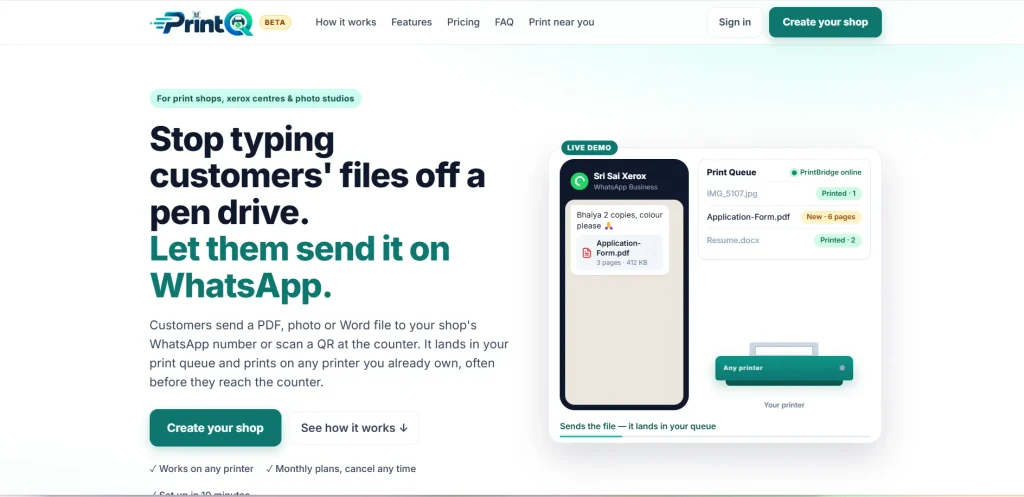
PrintQ (by CloudLab) is a modular web-to-print software and packaging e-commerce platform built natively on Adobe Commerce (Magento) for commercial printers, packaging manufacturers, and online print portals. Combining an HTML5 WYSIWYG design editor with live 3D packaging previews and automated JDF/XML prepress workflows, PrintQ handles complex multi-version print jobs, corporate B2B portals, and high-volume retail storefronts.
Key features:
- Native Adobe Commerce (Magento) foundation supporting open-source customization, SEO, and multi-store scaling
- Interactive 2D/3D product and packaging designer showing live box folds, substrates, and specialty finishes
- Automated preflight and vector PDF/X output integrated with Enfocus PitStop Server and prepress hot folders
- B2B closed portals featuring role-based budgets, approval workflows, and template brand lockdown controls
- Automated print calculation matrix handling complex paper weights, press runs, and finishing rules
Pros:
- Built on a mature, open-source-capable e-commerce core without restrictive SaaS storefront templates
- Strong 3D packaging and folding-carton visualization tailored for custom box and label producers
- Scales reliably from mid-sized commercial printers to high-traffic international online print portals
Cons:
- Requires Magento/Adobe Commerce technical expertise for hosting, maintenance, and custom extensions
- Higher initial setup and licensing investment compared to plug-and-play Shopify personalization apps
Best for:
- Mid-to-large commercial printers, packaging producers, and high-volume online print portals building on Adobe Commerce.
Pricing:
- $4.27/mo
12. Printbox
Website: https://getprintbox.com
Printbox is a specialized cloud web-to-print platform engineered specifically for personalized photo products, including photobooks, calendars, wall art, greeting cards, and photo gifts. Designed for high-volume photo labs and B2C e-commerce brands, Printbox pairs a fast, AI-assisted mobile and desktop editor with automated multi-page layout generation and print-ready PDF production.
Key features:
- Smart Creation AI engine automatically arranging hundreds of uploaded customer photos into balanced photobook layouts
- Responsive web and mobile HTML5 editor optimized for multi-page albums, calendars, canvas prints, and cards
- Automated high-resolution CMYK PDF generation with customizable spine widths, bleeds, and cover wraps
- Seamless e-commerce integrations with Shopify, Magento, WooCommerce, and custom storefronts via REST API
- Cloud rendering infrastructure built to handle extreme holiday and seasonal photo-gifting traffic surges
Pros:
- Purpose-built user experience dramatically speeds up multi-page photobook creation and boosts checkout conversion
- AI auto-fill and smart image-quality warnings prevent blurry photo prints and customer support refunds
- Handles heavy multi-page PDF rendering in the cloud without slowing down the customer’s browser
Cons:
- Tailored specifically to photo products rather than general B2B commercial print or corporate procurement portals
- Custom enterprise pricing requires a direct consultation based on order volume and catalog scope
Best for:
- Photo labs, personalized gifting brands, and e-commerce printers specializing in photobooks, calendars, and wall art.
Pricing:
- Available on request
13. MarketDirect StoreFront
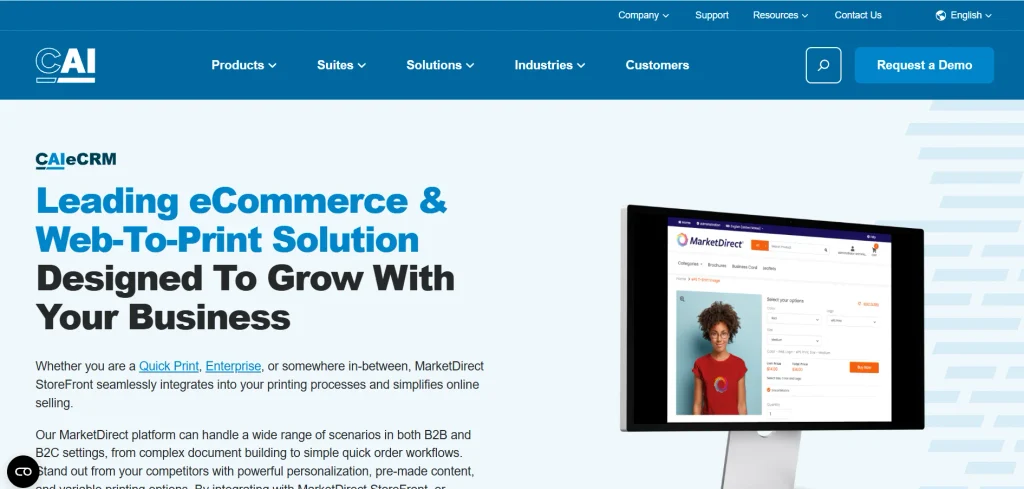
Website:https://printepssw.com/marketdirect-platform
MarketDirect StoreFront (by eProductivity Software) is an enterprise web-to-print and customer engagement platform built for large commercial printers, direct-mail providers, and corporate or university in-plant print centers. Designed to bridge online ordering with production floor automation, it offers deep bi-directional connectivity with ePS print MIS suites alongside robust B2B procurement and variable data publishing tools.
Key features:
- End-to-end MIS integration syncing orders, job tickets, inventory, and billing directly with Pace, Monarch, and PrintSmith Vision
- Configurable B2B and B2C storefronts with granular user permissions, cost-center billing, and approval chains
- Integrated variable data publishing (VDP) and dynamic document composition for personalized marketing collateral
- Enterprise e-procurement PunchOut connectivity supporting SAP Ariba, Coupa, Jaggaer, and Oracle
- Automated prepress imposition, job batching, and shipping integration with major global parcel carriers
Pros:
- Deepest native integration for print operations already running eProductivity Software (ePS) MIS systems
- Comprehensive governance, security, and PunchOut features tailored for healthcare, financial, and university in-plants
- Supports hybrid fulfillment combining print-on-demand, warehoused inventory, and digital asset downloads
Cons:
- Implementation and configuration can span months for complex enterprise and in-plant environments
- User interface feels more traditional and administrative than modern retail-first SaaS tools
Best for:
- Enterprise commercial printers and institutional in-plant print operations requiring deep MIS and PunchOut integration.
Pricing:
- Available on request
14. ImprintNext
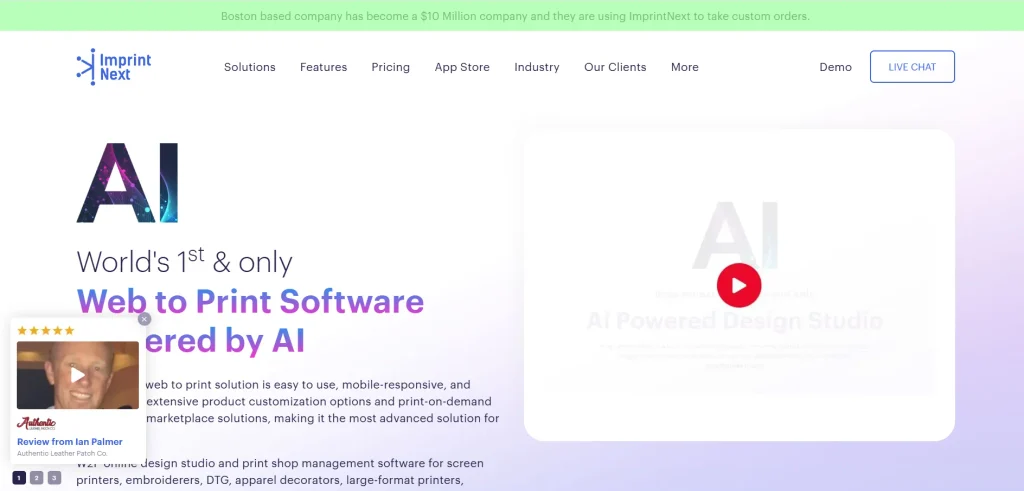
Website: https://imprintnext.com
ImprintNext is an HTML5 product customization and web-to-print software solution designed to integrate directly with existing e-commerce platforms for custom apparel, promotional merchandise, signage, and print shops. Supporting multi-device personalization across desktop and mobile browsers, ImprintNext equips online stores with interactive vector editing, 3D product previews, and automated print-ready file exports.
Key features:
- Responsive HTML5 Product Designer supporting screen printing, DTG, embroidery, sublimation, and laser engraving rules
- Real-time 3D product configurator and live mockup previews across apparel, drinkware, packaging, and signage
- Automated vector output generating print-ready PDF, SVG, PNG, and EPS files with color separation controls
- Native plugins for Shopify, WooCommerce, Magento, BigCommerce, PrestaShop, OpenCart, Wix, and Squarespace
- Dynamic pricing rules calculating extra charges based on print areas, ink colors, uploaded artwork, and quantity tiers
Pros:
- Broad e-commerce compatibility works seamlessly across virtually every major hosted and open-source shopping cart
- Specialized decoration-method rules (such as stitch counts and ink color limits) prevent unprintable custom orders
- Available with flexible one-time licensing or SaaS subscription options depending on storefront platform
Cons:
- Focuses on front-end product customization rather than full backend commercial print MIS estimating or job scheduling
- Extensive configuration options require initial setup time to calibrate print areas and pricing rules
Best for:
- Custom apparel decorators, promotional product stores, and print-on-demand merchants using Shopify, WooCommerce, or Magento.
Pricing:
| Essential | Pro | Enterprise |
| $2999 | $3999 | Custom |
15. PressWise
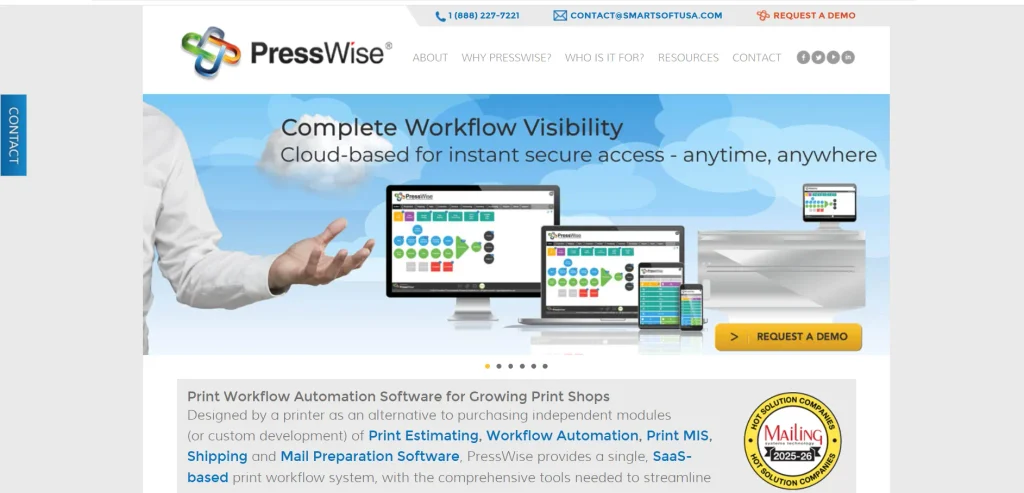
Website: https://www.presswise.com
PressWise (by SmartSoft) is an all-in-one cloud print MIS, workflow automation, and web-to-print storefront platform engineered for commercial digital and offset print providers. Built to eliminate disconnected software silos, PressWise combines customizable B2B/B2C ordering portals with automated estimating, prepress imposition, barcoded shop-floor job tracking, and integrated shipping in a single web-based system.
Key features:
- Unified web-to-print storefronts with online quoting, template customization, and automated customer proof approvals
- Automated prepress workflow engine handling preflighting, imposition, batch ganging, and hot-folder press routing
- Built-in Print MIS managing custom estimating, scheduling, paper inventory, purchasing, and invoicing
- Real-time shop-floor tracking with barcode scanning across every production, finishing, and fulfillment stage
- Open XML/API architecture connecting with external storefronts including PageDNA, Pressero, and OnPrintShop
Pros:
- Eliminates double data entry by uniting web-to-print ordering, estimating, prepress, and MIS in one database
- Automated batching and ganging maximize press sheet utilization and cut labor costs on short-run digital jobs
- Regular cloud updates require zero on-premise server maintenance
Cons:
- Storefront design customization is lighter than dedicated retail e-commerce platforms like Shopify or Magento
- Implementing both web-to-print and full shop-floor MIS workflows requires structured team onboarding
Best for:
- Commercial digital printers and print-on-demand facilities seeking a unified web-to-print storefront and end-to-end print MIS.
Pricing:
- Available on request
Benefits Of Using Web-To-Print Software
Adopting a dedicated web-to-print platform transforms how print service providers, packaging companies, and custom merchandise sellers capture orders and manage production. By shifting artwork customization and quoting online, businesses eliminate manual bottlenecks while scaling order volume without adding administrative headcount.
- 24/7 Self-Service Order Capture: Buyers can browse products, configure specifications, customize templates, and complete checkout anytime without waiting for manual sales quotes or email replies.
- Dramatic Reduction in Prepress Errors and Reprints: Automated preflight checks catch low-resolution images, missing bleeds, and incorrect color profiles before checkout, exporting press-ready PDF/X files directly to production.
- Faster Turnaround Times and Job-Floor Efficiency: Approved orders flow automatically into print MIS systems and RIP hot folders, eliminating manual data re-entry and shortening time from checkout to press.
- Consistent Brand Governance for B2B Accounts: Locked corporate templates ensure multi-location franchises and enterprise teams customize local details without altering approved logos, fonts, or brand colors.
- Higher Average Order Values and Repeat Business: Live 3D product previews, instant volume-tier pricing, and saved customer artwork libraries encourage larger orders and frictionless reorders.
How To Choose The Best Web-To-Print Solutions?
Choosing the right web-to-print platform requires evaluating how well its storefront architecture, editor capabilities, and backend integrations align with your specific business model. Key selection factors include:
- Storefront Model (B2B Portals vs. B2C Retail): Determine whether you need closed corporate procurement portals with approval chains and budget limits (such as Propago, PageDNA, or OnPrintShop) or high-speed public retail customization embedded into Shopify or WooCommerce (such as Printess, Printbox, or ImprintNext).
- Product Complexity & Visualization Needs: Match the design studio to your catalog—prioritize 3D folding-carton dielines for packaging (PrintQ, Customer’s Canvas), AI auto-layouts for photobooks (Printbox), or rule-based variable data printing for direct mail (XMPie StoreFlow, Aleyant Pressero).
- Prepress Automation & File Output Quality: Verify that the software supports automated preflighting, imposition, bleed/trim generation, and CMYK or spot-color PDF/X output compatible with your existing RIPs and presses.
- MIS, ERP & E-Commerce Ecosystem Compatibility: Ensure seamless connectivity with your existing print MIS (such as Pace, PressWise, or Tharstern), accounting software, shipping carriers, and enterprise PunchOut systems.
- Total Cost of Ownership & Scalability: Compare transparent SaaS subscriptions against custom enterprise licensing, factoring in setup fees, transaction volumes, multi-storefront limits, and ongoing technical maintenance requirements.
Conclusion
In conclusion, web-to-print software has become essential infrastructure for modern print providers, packaging converters, and custom e-commerce brands looking to automate order intake and scale profitably. All-in-one storefront platforms like OnPrintShop, Aleyant Pressero, and PressWise excel at unifying B2B/B2C portals with backend print management, while specialized editors such as Printess, Customer’s Canvas, and Printbox deliver fast, high-converting customization inside existing retail shopping carts.
For enterprise printers managing complex corporate governance or data-driven campaigns, solutions like Infigo, Propago, PageDNA, and XMPie StoreFlow provide the compliance, PunchOut procurement, and variable data depth needed to win high-volume accounts. By aligning your choice with your core product catalog, technical resources, and workflow integrations, you can eliminate prepress bottlenecks and turn online customization into a predictable growth engine.
Frequently Asked Questions (FAQs)
1. What Is The Difference Between A Web-To-Print Storefront And A Web-To-Print Editor?
A web-to-print storefront is a complete e-commerce and order management portal (such as OnPrintShop, Pressero, or Infigo) that includes product catalogs, pricing calculators, user accounts, and checkout workflows. A web-to-print editor (such as Printess or Customer’s Canvas) is a specialized browser-based design tool designed to plug into existing shopping carts like Shopify, WooCommerce, or Magento.
2. How Does Variable Data Printing (VDP) Work In Web-To-Print Solutions?
Variable data printing allows users or administrators to upload a spreadsheet (such as a CSV file) or connect a database to automatically populate dynamic text, images, QR codes, or barcodes across hundreds or thousands of personalized print pieces such as direct-mail postcards, event badges, or regional franchise flyers without manually editing each layout.
3. Can Web-To-Print Solutions Integrate With My Existing Shopify Or WooCommerce Store?
Yes. Several leading web-to-print platforms including Printess, DesignNBuy, PrintXpand, Customer’s Canvas, Printbox, and ImprintNext offer native plugins or REST APIs that embed an interactive product designer directly onto Shopify, WooCommerce, or Adobe Commerce (Magento) product pages while routing print-ready files to your production team.
4. How Do Web-To-Print Platforms Ensure Customer Files Are Actually Print-Ready?
Most modern web-to-print systems include automated preflight engines that inspect uploaded artwork and completed designs against press specifications before checkout. They verify minimum image DPI resolution, convert RGB colors to CMYK profiles, embed fonts, enforce safe margins, and automatically append bleed and crop marks to exported PDF/X files.
5. Is Web-To-Print Solutions Suitable For Small Print Shops, Or Only Large Commercial Printers?
Web-to-print solutions is viable for print businesses of every size. While enterprise platforms like MarketDirect StoreFront, Infigo, and XMPie StoreFlow serve large multi-plant operations, accessible SaaS solutions like Printess (starting around $31.95/month) and DesignNBuy (starting at $90/month) allow small print shops and niche e-commerce sellers to automate online customization without heavy upfront capital.