
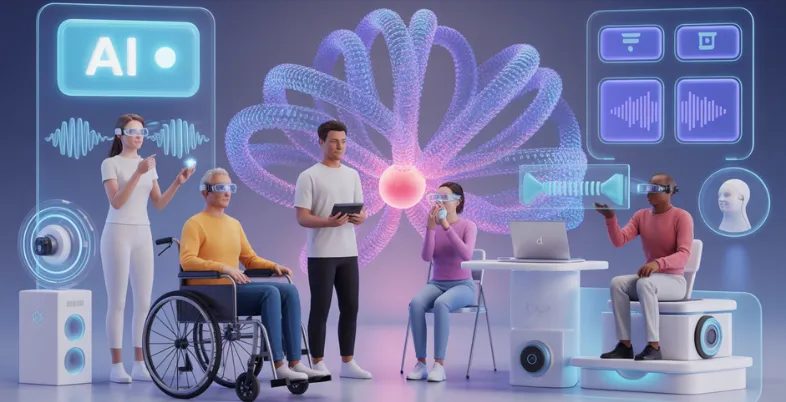
Innovations in digital technology are typically rooted in something that grows without fanfare, disrupts an existing flow of work, and finally becomes essential.
Currently, we have gained one such hidden change where agentic AI is silently changing the tech world in terms of accessibility throughout software, devices, and on different digital spectacles.
Inclusion Beyond Compliance: A NEW Paradigm
Accessibility initiatives focused on checklists, inspection of pages, and audit for compliance for decades. While these methods were invaluable, they rarely represented the experience of people with disabilities living in rapidly evolving digital spaces. This was mainly due to the accessibility testing happening too late in the software lifecycle, thus any solutions were more like reactive fixes than an integration of inclusive design principles from day one.
But that narrative is changing as autonomous, context-aware systems are here to stay. They can understand interface behavior in the same way real users do-interacting with UI elements, creating feedback loops, and adapting to signals in their environment. Engineering teams can now incorporate accessibility intelligence into the DNA of product development instead of validating accessibility after product release.
Why Accessibility Needs Intelligent Autonomy
With a more dynamic, modal-based approach to user interfaces, traditional toolkits have no way to inspect components that are interactive, hidden, or conditionally rendered. That complexity is enhanced significantly if responsive design or new-age frontend frameworks are involved, which leads to thousands of UI states. Without advanced automation, barriers to accessibility go unnoticed.
Agentic systems fill this gap by being able to function independently with decision-making capabilities. It’s not like they crawl around a page – they roam about, really. They understand flows, potential ways to go wrong, and they know how things would behave in settings similar to actual usage situations, and they identify issues. This pushes accessibility testing closer to the context of experience validation rather than external surface scanning.
This change is especially important for organisations that are building products at scale, with high velocity, short release cycles, and accessibility risks amassing across devices and browsers. Testing does not end at test execution/test completion; rather, it needs intelligence at every step of the testing process in modern digital ecosystems.
AI testing tools like TestMu AI Accessibility Testing suite offer automated and interactive features that help teams identify, track, and fix accessibility issues in websites and apps to ensure they work well for people with disabilities.
These tools scan digital content against established standards like WCAG, ADA, and Section 508, provide detailed reports with issue locations and remediation guidance, and integrate with development workflows so accessibility checks are part of everyday testing rather than an afterthought.
How Agentic AI Changes the Game for Accessibility
With teams now working with more sophisticated architectures-think micro frontends, cross-device integrations, and multimodal interactions definition of accessibility is also evolving. This now encompasses voice, gesture, screen readers, keyboard navigation, cognitive aid, and environmental responsiveness. Successful operation of all these elements necessitates systems that can reason, adapt, and even run tests without human intervention.
This gap, however, is filled by agentic intelligence, which serves as an evolving layer of meaning. This automation can pass through user workflows, states, and metadata and identify many of the hidden barriers static scanners can’t find. They can also replace them with other agents or APIs to validate interactions in other contexts, making accessibility testing a multidimensional activity, not a one-dimensional audit.
The transition from passive to active assessment also marks the dawn of a new age of inclusive experience engineering.
Autonomous Agents Enabling Real-World Applications
However, the real magic of agentic systems shines through with practical implementation. Think about an app with a lot of forms that is used on different devices. Standard tools will catch missing labels or color contrast, but none can tell you whether a blind user can submit the form without experiencing unexpected focus jumps or having dynamic errors made inaccessible to them.
In contrast, agentic models engage with the form in a sequential manner; they recognize behaviors and check if each element acts appropriately to switch from a screen reader, keyboard, or any other input device. They can reason about what failures impact real usability rather than more superficial compliance with regulatory or mechanical checklists.
Likewise, for people who are hard of hearing, agent systems can examine video players, caption timings, and accuracy of transcriptions at various playback speeds on behalf of users. For neurodiverse users, identify UI flow inconsistency, auto-run animation, or cognitive overload based on the difficulty of interaction.
In these instances, accessibility is a never-ending feedback loop, not a one-off audit event.
A Blind Spot: Agentic AI as Co-Creators of Accessibility
Agentic systems go far beyond just testing, because they enable a new way of building products. Used within design systems or development pipelines, they can provide conditional, real-time restructuring of UI elements and composition of accessible components.
Imagine a design tool where agents are given mockups, examine them and suggest alterations in contrast, structure, and interactive elements. Or perhaps a development IDE where agents guide programmers by validating ARIA roles, keyboard flows, and semantic structures as the code is being penned?
The capacity to act proactively and reactively does not only make agentic AI a guardrail, but one that co-creates accessible experiences.
Why TestMu AI for Intelligent Accessibility Execution at Scale?
For organizations creating inclusive digital experiences, scale is often the challenge-thousands of browser/device/OS combos and UI states result in enormous coverage gaps. This is why you need platforms that come with embedded high intelligence.
TestMu AI (Formerly LambdaTest), with an ever-growing ecosystem of intelligent testing solutions, enables teams to dynamically validate accessibility at scale by embedding autonomous reasoning layers into Cloud-based environments. This orchestration ability to empower agentic AI allows numerous intelligent processes to engage with one another, exercising complex interactions, adapting to UI flows, and addressing issues that arise as issues under certain device conditions.
This Agentic AI orchestration has proven to be highly beneficial in projects where accessibility compliance has to be sustained across the globe. TestMu AI helps engineering teams to resolve accessibility challenges quickly and integrate it into continuous workflows with capabilities like real device clouds, AI-powered insights, and adaptive test execution.
Autonomous agents, broad device coverage, and on-demand execution are the pillars of a powerful system that augments accessibility efforts without hindering release velocity.
The Human Side: Allowing Users the Power to Include When/What They Want
While the technology is often perceived as being years away, with little knowledge that such dysfunctions are at the core of daily lived experience, the move from compliance (or engineering efficiency) to agentic systems that ramp up accessibility is a transformational leap. It enables people using assistive technologies to engage fully in the digital world.
This enhanced navigation provides crystal-clear expandable options for the visually impaired, enabling them to execute tasks with a sense of confidence. With improved captioning and audio descriptions, their deaf users could better access learning or entertainment. The more that cognitive accessibility is improved, the more independent users can be online, who may be neurodiverse. Such results encapsulate what tech is really about: widening the room to create room for everyone.
This will be compounded by the fact that agentic systems provide intelligence that runs without rest, scales by removing error, inhibits access, or creates ubiquitous experiences that adaptively develop in a loop.
Ethical Considerations: Autonomy with Accountability
But it needs to be able to show that it is at least attempting to be fair with transparency and respect personal privacy. With agentic systems starting to impact decisions regarding accessibility, this places pressure on developers to set definitions around responsible practice. Parental guidance on accessibility norms aside, intelligent agents should promote inclusivity rather than impose a prejudiced interpretation of the word.
Outlining clear boundaries on agent behaviors and data usage, the limits of decision-making, and human oversight required can help ensure that automation and autonomy are exercised in safe and ethical manners. Agent systems, when approached right, amplify human intention, not vice versa.
A Movement Toward More Intelligent Development Culture
1. Cultural Change: More than tools, adopting agent-based accessibility workflows
Accessibility needs to be ingrained within teams as a continuous team effort. Designers, developers, testers, and product owners should not see agentic intelligence as the enemy of inclusive outcomes.
The start of this shift has to do with education: what an agentic system is, what kind of data it uses, and how it shapes decisions. The rest is practice: putting agents onto CI pipelines, design reviews, regression cycles, and usability validation.
With more companies embracing this new mindset, accessibility transforms into a strategic advantage, not a mere compliance checkbox.
2. Looking Forward: The Future of Access with Agentic Intelligence
Systems that can reason, collaborate, and act on their own are what will drive the next chapter of digital accessibility. Agentic models will personalize accessibility to the needs of the user, in real time, by dynamically changing parts of the UI flow. They will interact seamlessly with assistive technology, anticipate obstacles, and modify their approach and behaviour accordingly.
Interfaces that reconfigure without input at all, based on the context of a user (screen size, lighting, motor abilities, cognitive load, or sensory preferences) could also emerge. This adaptive way of native integration with continuous evolution would make accessibility an adaptive layer on top of the user interface, rather than a static thing like this set of guidelines.
By the same token, agentic intelligence will also promote cross-platform harmonization, resulting in unified experiences on the web, mobile, wearables, and emerging devices. The journey towards inclusive digital experiences will become more achievable with scalable testing ecosystems, such as those supported byTestMu AI, helping businesses of any scale.
Conclusion
Behind the scenes, a silent revolution driven by agentic AI is changing the fabric of accessibility – both subtly and in a breathtaking manner. Agentic systems augment accessibility from a technical necessity to a lived experience by empowering autonomous reasoning, dynamic interaction, and continual verification.
If checklists defined the previous era, the next one will be ruled by intelligence: Intelligence that understands the user, having the flexibility to change with them, and enabling organizations to create experiences allowing everybody to get in. The future of accessibility is bright, inclusive, and utterly human-centric with innovations in autonomous testing, platform orchestration, and scale execution.
Agentic systems will evolve to transform opportunities we do not yet conceive and push the digital universe towards an inclusive ecosystem that does not treat inclusion as a checkbox.