
If you want to start a pizza kingdom but are concerned about the initial investment and ongoing expenses, this guide is for you. Little Caesars Franchise Cost explains why Little Caesars, home of HOT-N-READY® pizza, is still the most affordable and profitable fast-food franchise for aspiring entrepreneurs in 2026.
From first-time investors to expanding your portfolio, this article provides all the details you need: upfront cost ($350K-$650K), ongoing fees, expected profitability (10-20% net profit for successful restaurants), and how to apply. Here’s the data to determine your return on investment (ROI), weigh against other brands, and decide whether Little Caesars is right for you – no hype, just the info you need to get started.
What Is Little Caesars? A Legacy Brand Worth Investing In
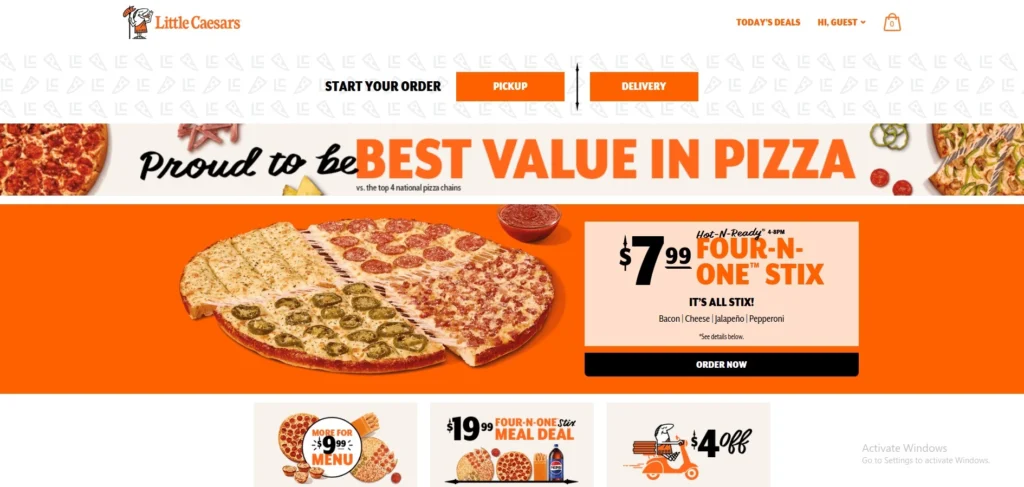
Little Caesars is a global pizza franchise, established in 1959 in Michigan, USA. The company is renowned for its low prices and “Hot-N-Ready” service, allowing customers to order a pizza and have it ready to go at the time of purchase. Little Caesars, with thousands of stores worldwide, has a straightforward and effective business model that resonates with consumers and franchisees alike. With relatively lower investment requirements than other major food franchises, high brand awareness, and a steady demand for fast food, it has become a popular choice for potential franchise owners seeking to build a successful and profitable business.
Is Little Caesars A Good Franchise Opportunity?
Why It’s a Good Investment?
- World‑class brand recognition: Little Caesars is a top‑3 pizza chain in the world, with “Pizza! Pizza!” and Hot‑N‑Ready value proposition. This instantly draws walk-in customers, minimises local branding expenses, and reduces customer acquisition costs.
- Low‑cost, high‑value positioning: The Hot‑N‑Ready concept (ready‑to‑go pizza at fixed value prices) leads to high volume, low service complexity, increasing turnover, and making prices competitive.This makes Little Caesars competitive in value‑conscious markets, such as India, where it can play against Domino’s or Pizza Hut.
- Low barrier to enter the market vs. other big pizza chains: Little Caesars typically has a lower franchise fee and total cost of opening a store than Domino’s Pizza and Pizza Hut, particularly in many overseas markets.
- Simplicity and scalability: There is a simpler and narrower menu and store format, leading to lower training time, staff costs, and kitchen complexity. This allows for the ease of expanding to multiple stores, managing them, and even potentially semi‑absentee or managed operations in the future.
- Shorter payback and good cash flow:Payback analysis reveals that the time period is between 9 and 11 years for optimally located stores, which is good for a capital-intensive QSR.High-volume/low-cost operating models can lead to significant cash flows for many franchisees once the business is up and running and concentrated in fast‑food takeout and delivery.
- Digital ordering technologies: Little Caesars has invested in digital ordering, drive-thru, and delivery systems to capture the post‑pandemic trends. Tools such as Pizza Portal® and internet ordering make it easy for customers to place orders, increase order accuracy, and enable partner delivery integration in India‑like markets.
- Adaptable store types and sites:Little Caesars is compatible with in‑line, strip‑mall, drive‑thru, and alternative locations (colleges, military bases, airports, etc.)This allows you to choose lower‑cost, high‑traffic sites – great for smaller towns or Tier‑2/3 markets where high‑end brands are still out of reach.
- Training and support: Little Caesars provides training, operations manuals, and support for franchisees, including marketing, supply chain, and general business support.This minimises new‑owner errors and ensures consistent quality throughout the chain.
Challenges to Consider
Before investing, prospective franchisees should consider the risks and challenges of operating a franchise.
- Capital Intensive: The initial investment varies considerably from about $393,000 to more than $1.7 million, requiring considerable personal wealth and cash reserves.
- Intense Competition: The pizza industry is highly competitive, with various pizza chains competing for customers in a crowded market, which may limit opportunities for profitable site development.
- Marginality Challenges: With increasing costs for labor, ingredients, and rent, profitability remains a constant challenge requiring franchisees to carefully monitor their operational costs for success.
- Volume-Driven Model: The business model of value, low-cost offerings means that profitability is largely driven by volume rather than margin.
- Rigid Systems and Controls: Franchisees are bound by corporate-provided operating procedures and required vendors, leaving limited flexibility for local product development or management strategies.
- Staffing and Management: Store performance depends on effective management and staff, and problems with staff turnover or local management can result in customer experience issues.
Little Caesars Franchise Models: Which One Fits Your Budget & Location?
Little Caesars provides franchises with a range of options to suit various budgets, space availability, and business objectives.
1. Traditional Store
The Traditional Store (also known as “Traditional carryout‑only” or inline/freestanding) is the company’s flagship model: a 1,200-1,800 sq. ft. pizza outlet, typically in line or at the end of a shopping center or shoppingdestination strip, for carryout and (if possible) drive‑thru. It offers the full menu, Hot‑N‑Ready items and standard Caesar Vision point‑of‑sale (POS) system, with parking and visibility.
Best for: Investors looking for a traditional, high‑traffic, pizza‑centred QSR in established suburban and mid‑urban retail locations.
2. Inline / End Cap
The Inline / End Cap concept is a variation on the Traditional Store model, with a focus on space efficiency and leasing. These are about 1,200-1,400 sq. ft. in size and are located within a strip mall or as an end‑cap unit. The goal is to offer a full menu and drive‑thru or pickup lane, if possible. It’s a less expensive rent and buildout than a stand‑alone restaurant, but provides good foot‑traffic visibility.
Best for: Investors with less capital who prefer a lower build-to-print cost footprint, but still desire full‑service carryout in a high‑traffic location.
3. Non-Traditional Model
The Non‑Traditional Model (also known as “Non‑Traditional Express”) is a small footprint (400-600 sq ft) for non‑traditional locations, such as convenience stores, gas stations, airports, college campuses, or military installations. It has a modified menu with an emphasis on carryout pizza and core menu items, with reduced construction and operating costs. It’s suitable for locations where retail space is limited or costly.
Best for: Franchisees seeking lower‑capex, space‑efficient units in high‑traffic, non‑retail locations, and able to offer a reduced menu.
4. Classic Express Model
The Classic Express Model is a small, pickup‑oriented model (typically 400-600 sq. ft.) inserted into existing retail properties (such as c‑stores, malls, or inline strips). It focuses on low‑cost build‑out, quick speed-to-market, and lower labor and operations expenses, and includes a menu of pizzas and carry‑out items. It often doesn’t have full dine‑in, has limited seating, or may be pickup‑only.
Best for: Cost‑sensitive operators and investors who are interested in fast rollout, lower risk per unit, and high turnover in high‑density urban or campus‑like locations.
How Much Does a Little Caesars Franchise Cost? Complete Breakdown

The cost of opening a Little Caesars franchise ranges from approximately $377,000 to $1.8 million, depending on location, store design, and build-out. This includes franchise fee, equipment, build-out, and working capital, with upfront cash requirements of $400,000 net worth and $200,000 liquid assets.
Initial Costs Table
Realistic initial costs from recent Franchise Disclosure Documents (FDD) and authorized sources vary greatly because of factors such as real estate and equipment options.
| Cost Item | Low Estimate | High Estimate |
| Initial Franchise Fee | $20,000 | $20,000 |
| Rent (3 months initial) | $1,500 | $7,000 |
| Leasehold Improvements | $50,000 | $1,000,000 |
| Supplies/Equipment (Blue Line) | $250,500 | $369,500 |
| Other Fixtures, Equipment, Signage | $15,000 | $158,000 |
| Grand Opening Advertising | $15,000 | $20,000 |
| Training Expenses | $12,000 | $16,500 |
| Start-up Inventory/Supplies | $63,000 | $154,000 |
| Insurance (initial) | $500 | $1,200 |
| Utility Expenses (initial) | $1,000 | $9,000 |
| Licenses/Permits | $1,000 | $20,000 |
| Additional Funds (3 months) | $17,000 | $47,000 |
| Total Estimated Investment | $377,000 | $1,817,200 |
Financial Requirements
Franchisees must have $400,000 net worth and $200,000 in liquid funds to ensure the capacity to pay for startup and ongoing costs. There are special discounts for veterans and first responders, including $5,000 off the franchise fee, equipment , and food orders, and more for disabled veterans (up to $20,000 franchise fee waiver).
Ongoing Fees
Pay 6% royalties (minimum $100/week) and up to 7% advertising fee on gross sales. Additional ongoing fees include $2,990-$3,500 per year for the Caesar Vision system, per-transaction fees ($0.06-$0.40 per sale), and Blue Line Distributing product purchases.
Factors Affecting Total Cost
Store types include traditional freestanding (1,400-1,800 sq ft – higher build-out), inline (1,200-1,400 sq ft), or non-traditional express (400-600 sq ft, lower costs). City or drive-thru locations add to leasehold improvements, and the official FDD estimates 6-18 months to open. Refer to the current FDD for customized estimates.
Little Caesars Veteran Franchise Discount: How Much Can You Save?
Little Caesars has special offers on franchise fees and other perks to reward veterans. The programs reduce the costs of starting a pizza franchise and offer greater discounts for those with disabilities.
Standard Benefits
This is for all eligible honorably discharged veterans and first responders. This is a $5,000 discount on the initial franchise fee, $5,000 on equipment, and $5,000 on your first order of food, plus a $1,000 credit for Pepsi products. It also provides ongoing support such as accounting services, a free grand opening promotional package, and assistance with managing your business.
Disabled Veteran Program
There are additional discounts for disabled veterans and Gold Star families. That means you save $20,000 on the franchise fee, $10,000 on equipment, and $7,000 on your initial food order. Little Caesars also gives $10,000 to a veterans’ charity (such as The C4 Foundation) in your name.
Total Savings: Regular program costs around $16,000+ in discounts; the disabled program is around $47,000+ (including the donation).
How Much Does a Little Caesars Franchise Owner Make Profit & ROI?
The profitability of Little Caesars franchises can vary substantially, depending on store volume and quality of location. Although the company does not disclose performance for individual locations, industry sources report that a typical unit will likely generate gross revenues of about $900,000 to $1,000,000 per year.
Estimated Profitability and Investment
Average operating margins are reported to be between 10% and 17%, depending on cost control, location, and efficiency. Operating expenses, including labor, cost of goods sold (COGS), royalty fees (6%), and marketing fund contributions (3-7%), are deducted from the gross revenue to calculate the net annual profit of $50,000 – $200,000 per unit.
With individual investment costs ranging based on location and construction costs, the Return on Investment (ROI) can vary. The table below outlines the expected financials for a single unit
Key Factors Impacting ROI
- Location: The business model is highly dependent on the location; “A-grade” locations can deliver much higher revenue (sometimes in excess of $1.5 million) and margins, while “C-grade” or worse sites may not be profitable.
- High-Volume Service: The business is high volume and “grab-and-go” to offset the low margin per unit, so efficiency and staffing are key to profitability.
- Scalability: Owners often own multiple units to take advantage of economies of scale and boost the profitability of the enterprise, as individual unit profits are often low before considering debt service and capital expenses
How To Apply A Little Caesars Franchise Cost (Step-by-Step)
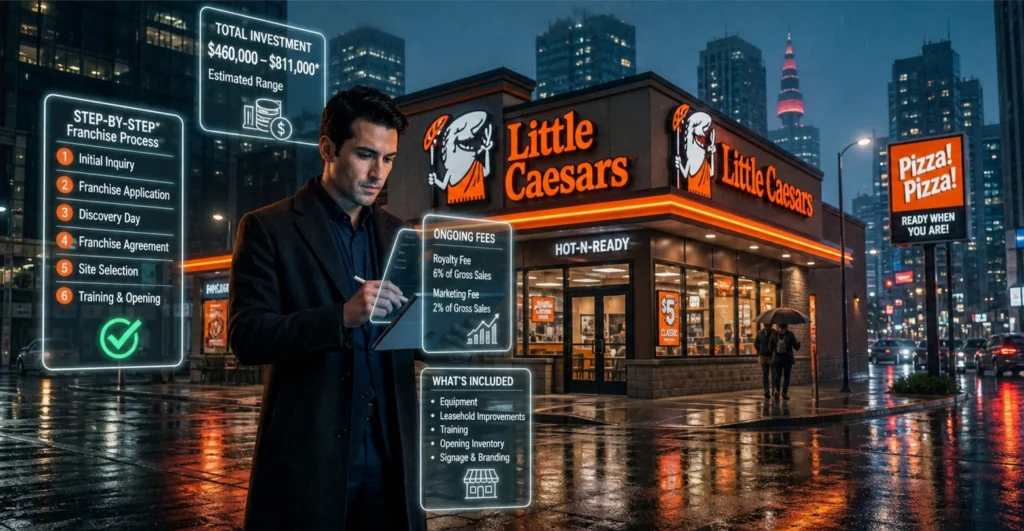
When it comes to starting a Little Caesars franchise, you need to follow a plan that combines financial readiness with corporate training and site preparation. As of April 2016, the typical process for becoming a franchisee is:
Step 1: Check Eligibility
Before applying, make sure you meet the basic requirements:
- Minimum net worth: around $400,000
- Liquid capital: $150K–$200K
- Business mindset & management skills
Step 2: Submit Franchise Inquiry Form
Go to the official Little Caesars franchise website and fill out the inquiry form with:
- Name, email, phone
- Location preference
- Investment capacity & net worth
This is the first step to start communication with their franchise team.
Step 3: Complete Franchise Application
After initial screening, you’ll need to fill a detailed application form including:
- Personal & financial details
- Assets, liabilities, and income
- Business experience and background
Step 4: Discovery Day & Approval
- Attend a Discovery Day (meeting with the brand team)
- Understand operations, expectations, and support
- Final approval is given based on qualifications
Step 5: Training Program
Once approved:
- ~5 weeks in-store training
- 1 week classroom/brand training
- Additional online modules
Step 6: Location & Store Setup
- Choose location with company support
- Begin construction and setup
- Equipment installation and hiring staff
Step 7: Grand Opening
- Start operations and revenue generation
- Launch your outlet
- Marketing support provided
How To Finance A Little Caesars Franchise
Little Caesars franchise financing involves substantial up-front costs, with a total investment of $446,500 to $1,817,200, including a $20,000 franchise fee. The franchise requires potential franchisees to have a net worth of at least $400,000 and liquid assets of $200,000.
- Financial Requirements: Key startup costs cover leasehold improvements ($50,000–$1,000,000), equipment and signage ($212,000–$424,000), inventory ($63,000–$154,000), and training ($12,000–$16,500). Ongoing costs, 6% royalty, and 5% marketing. These are typically checked by lenders from the Franchise Disclosure Document (FDD) submitted for approval.
- SBA Loans: SBA loans are commonly used to finance start-up costs such as equipment or real estate; they have low interest rates if you qualify. They minimise initial cash requirements but demand good credit and a viable business plan, with a long approval process.
- Term Loans: Term loans from banks or alternative lenders offer upfront payments paid at a fixed rate, suitable for overall startup needs. Alternative lenders such as Biz2Credit have quicker approval and less stringent requirements, but charge higher rates.
- Equipment Financing: Use equipment loans to finance specific equipment, such as pizza ovens or refrigerators, with the equipment as collateral. This frees up cash for other costs and can have flexible repayment schedules based on equipment lifespan.
- Other Options: The cash requirement ($200,000) can be met by owner funds or investors. Lenders such as IRH Capital have special programs for Little Caesars builds and refinances. Apply on the company’s website for lender referrals and the FDD.
Little Caesars Franchise Training & Support: What You Get
Little Caesars offers extensive franchise training and support to help franchisees succeed in the pizza industry.
- Training Program: New owners have a first multi-week (usually 6-8 weeks) training program that combines on-site, classroom, and online training in operations, food preparation and management simulations.
- Site Selection Aid:Corporate helps with market and site analysis, territory mapping, and signing off on sites to fit the corporate image before building.
- Construction Guidance: This involves store planning, architectural design, contractor selection, and management to adhere to zoning and building regulations.
- Business Management Help: Yearly accounting, financial planning, HR advice, and business consulting is provided by teams.
- Marketing Assistance: National advertising, market research, grand opening packages, and marketing materials are available to franchisees.
- Field Operations Support: Consultants and zone managers conduct regular visits, inspections, and problem-solving.
- Staff Development:Ongoing training tools, leadership/team building workshops, and web-based training modules ensure staff training.
- Grand Opening Backing: Corporate staff supports the establishment of equipment, initial food orders, and opening readiness.
Little Caesars Franchise Cost vs Competitors: Which Is the Better Investment?
Domino’s is the top franchise opportunity in 2026 with strong sales and returns, Little Caesars is the most affordable and easiest to run, Pizza Hut is larger but more complex, Papa John’s offers a balanced mid-range investment, Papa Murphy’s is simple but has lower profit potential, and Blaze Pizza provides a modern fast-casual model with solid growth potential.
| Brand | Total Investment | Franchise Fee | Royalty Fee | Business Model | Complexity | Profit Potential |
|---|---|---|---|---|---|---|
| Domino’s | $107K – $683K | $0 – $10K | ~5.5% | Delivery + Tech-driven | Low–Medium | High |
| Little Caesars | $364K – $1.36M | $20K | ~6% | Carryout (Hot & Ready) | Low | Medium |
| Pizza Hut | $300K – $2.2M | $25K | ~6% | Dine-in + Delivery | High | Medium |
| Papa John’s | $261K – $853K | $25K | ~6% | Delivery-focused | Medium | Medium |
| Papa Murphy’s | $367K – $733K | ~$25K | ~5–6% | Take & Bake | Low | Medium–Low |
| Blaze Pizza | $597K – $1.1M | ~$30K | ~6% | Fast-casual | Medium | Medium–High |
Best choice for the investor profile
If you want to be the most viable in terms of size, revenue, and credibility to be a long-term franchisor, choose Domino’s. Choose Little Caesars if you want cheaper startups and a simpler business model with quicker service and fewer staff. Choose Pizza Hut only if you have a good location, experience, and a market for dine-in or mixed delivery business, because it is generally less attractive based on franchise economics alone.
Bottom line
Domino’s is likely the best franchise to buy in 2026 for most investors because it seems to be the best performing and most likely to succeed. Little Caesars is the value play, and Pizza Hut is the worst of the three unless you have a very strong local site and market.
Some Suggested Franchise Options:
- Pizza Hut Franchise Cost
- Wow Momo Franchise Cost
- Subway Franchise Cost
- Krispy Krunchy Chicken Franchise Cost
Conclusion
Little Caesars represents an attractive franchise opportunity for entrepreneurs seeking a balance between a legacy brand with “Hot-N-Ready” bargain pizzas and the promise of average annual profits of $100,000-$110,000 per location ($800,000-$900,000 revenue), albeit with a high upfront investment ($393,000-$1.8 million) and ongoing 6% royalties and 5-7% marketing fees, making Little Caesars Franchise Cost a key factor to evaluate before investing.
Despite risks like site selection and high net worth requirements ($400,000 minimum, $200,000 liquid), the low 6% three-year failure rate, six-week training, exclusivity, and veteran discounts (up to $68,000) make it feasible for established operators considering scaling with multiple sites.
In conclusion, Little Caesars could be a good investment for those with the financial resources and commitment to a carryout pizza business that surpasses competitors like Pizza Hut in simplicity, potentially averaging 100-110% profits after 5-10 years: review the Franchise Disclosure Document and inquire online to see if it’s right for you.
FAQs
1. What Is The Total Investment Required For A Little Caesars Franchise?
The total investment typically ranges from $376,000 to $1.7+ million, depending on location, store type, and setup costs.
2. What Is The Franchise Fee For Little Caesars?
The initial franchise fee is $20,000, which is a one-time payment to start the franchise.
3. What Are The Net Worth And Liquid Capital Requirements?
You generally need a net worth of around $200,000–$400,000 and liquid capital of $100,000–$200,000 to qualify.
4. What Are The Ongoing Fees For A Little Caesars Franchise?
Franchisees pay ongoing fees such as:
- Royalty fee: Around 6% of gross sales
- Advertising fee: Up to 7% of gross sales
5. Is Little Caesars A Profitable Franchise?
Profitability depends on factors like location, sales volume, and management. While it has a proven business model and strong brand presence, actual profits vary by outlet and operational efficiency.